REVIEW · JEJU
Jeju Island UNESCO Heritage Bus Tour
Book on Viator →Operated by Jeju Travel Lucas · Bookable on Viator
Jeju can feel like two islands inside one. This 2-day UNESCO-focused bus tour helps you hit the key East and West sights without building your own route from scratch.
I like how the plan mixes geology, culture, and iconic viewpoints, and you get a lot of time outdoors. English support makes the stories behind places easier to follow, not just see.
Two things I really appreciate are the tight stop order and the range of experiences. You start with easy-to-moderate nature walks like the Saryeoni Forest Path, then swing into heritage stops like Seongeup Folk Village and Seongsan Ilchulbong.
One drawback to keep in mind: weather and site closures can change your exact stops. Manjanggul is scheduled to reopen later, and coastal access can be limited by tides or bad conditions.
In This Review
- Key things to know before you ride
- Why this 2-day Jeju UNESCO bus tour works for tight schedules
- Picking the right day: East UNESCO vs West UNESCO (and K-drama routes)
- Day 1 morning: Saryeoni Forest Path and Seongeup Folk Village
- Saryeoni Forest Path
- Seongeup Folk Village
- Day 1 midday: Seopjikoji or Sangumburi (season swaps you should plan for)
- Seopjikoji (typically)
- Sangumburi (October to December best)
- Seongsan Ilchulbong: the UNESCO sunrise peak + women divers
- Jongdal-ri coastline drive: beaches, hydrangeas, and quick coastal viewing
- Hamdeok Beach and the Haenyeo Museum option on rainy days
- Manjanggul Lava Tube: what to do with the closure reality
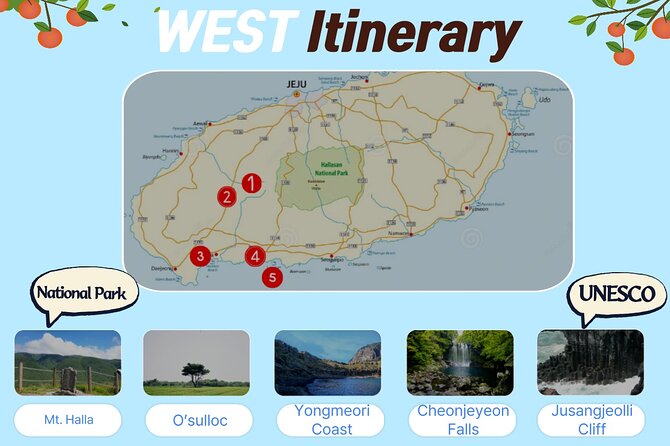
- Day 2 start: Hallasan National Park and the Oreum volcano shape
- O’sulloc Tea Museum: the calm, fragrant middle of the day
- Sanbangsan Mountain: a craterless dome and a temple cave
- Yongmeori Coast: volcanic ash beach, dragon head name, and tide checks
- Cheonjeyeon Falls: three tiers with plantlife details
- Daepo Haean Jusangjeolli Cliff: UNESCO Geo Park columnar joints
- Jeju Art Circus (Jeju아트서커스): a rain-proof finale with performance energy
- Price and logistics: value, group size, and what guide time really means
- Should you book this UNESCO bus tour of Jeju?
- FAQ
- What is the duration of the Jeju Island UNESCO bus tour?
- Is hotel pickup included?
- Will I need to speak Korean?
- Which UNESCO areas are part of the tour?
- What happens if Manjanggul Lava Tube or Manjang Cave is closed?
- Are meals included in the price?
- What should I wear or prepare for?
- How big are the groups, and will there always be a guide?
- Can I cancel and still get a full refund?
Key things to know before you ride
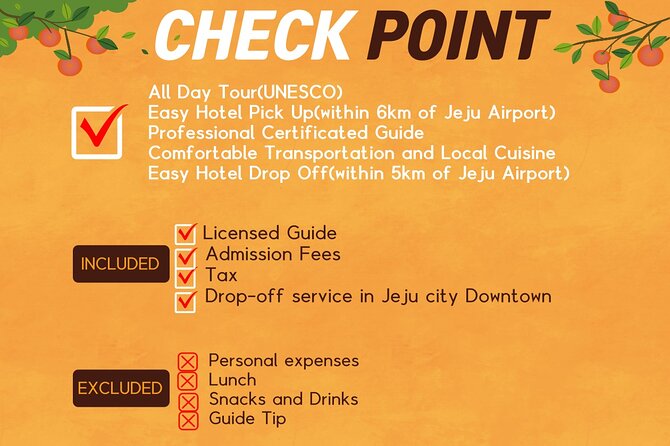
- East vs West timing: routes run on set days (Western UNESCO on Mon/Wed/Fri, East UNESCO on Tue/Thu/Sat).
- UNESCO anchors: Seongsan Ilchulbong and the UNESCO lava-tube area are core highlights (with a planned substitution when needed).
- Rain-day replacements: Haenyeo Museum and Circus World help you stay on schedule when outdoor sights are rough.
- Guide quality varies by group size: smaller groups may get a strong English-speaking driver instead of a full guide.
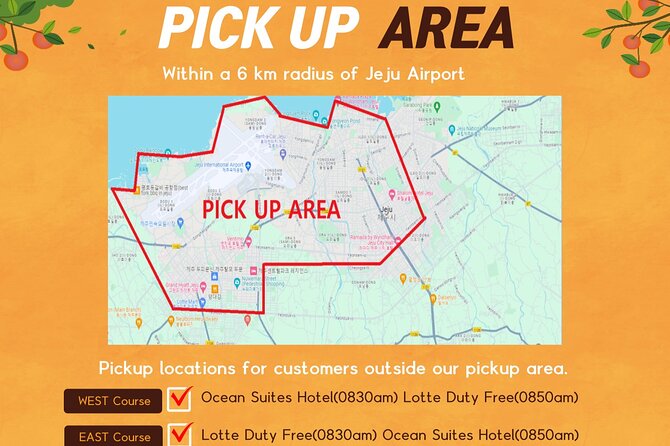
- Downtown pickup only: you’ll need an extra fee if you’re outside Jeju City’s downtown area.
Why this 2-day Jeju UNESCO bus tour works for tight schedules
If you only have two days on Jeju, the main problem isn’t choosing “the best places.” It’s choosing the order and the transport so you don’t waste half a day crossing the island. This tour is designed to solve that. You ride a single route and let the itinerary do the heavy lifting.
I also like the pacing. Stops typically run about 40–80 minutes, long enough to look around and take photos, but short enough that you’re not stuck “waiting for the tour.” It’s a good rhythm for people who want memorable Jeju scenes without turning the trip into a full-time job.
You can also read our reviews of more historical tours in Jeju
Picking the right day: East UNESCO vs West UNESCO (and K-drama routes)
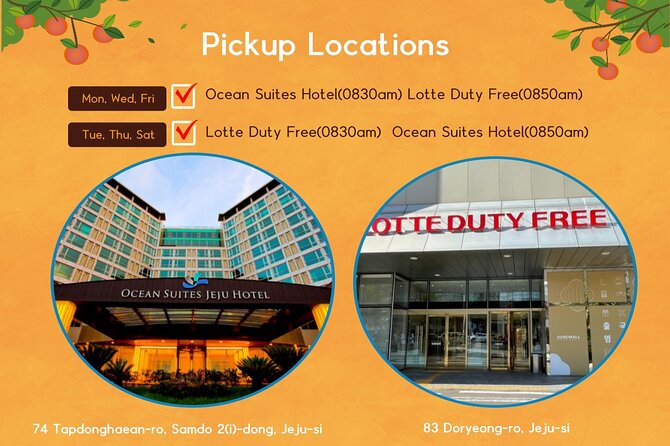
Jeju has a left side and a right side, and this tour respects that. The departure theme changes by weekday: Western Jeju UNESCO runs on Mon/Wed/Fri, and East Jeju UNESCO runs on Tue/Thu/Sat. From Monday to Saturday there are also K-drama-themed East/West schedules.
So before you book, pick the day that matches what you want most. If your must-see list includes Seongsan Ilchulbong and East-coast geology, choose the East day. If you’re chasing the western UNESCO-type cliffs and sea-coast formations, align with the Western day. This isn’t a “same tour every day” situation, and choosing the correct departure saves time later.
Day 1 morning: Saryeoni Forest Path and Seongeup Folk Village

Day 1 starts with greenery and heritage, which is smart. Morning light is usually better for photos, and you’re not already fried by the long coastal driving.
Saryeoni Forest Path
This is a protected forest trail and one of Jeju’s well-known outdoor walks (about 50 minutes, and admission is free). It’s the kind of stop that helps you feel the island’s volcanic-green vibe without needing big climbs. Wear shoes you’re comfortable in, because forest paths are often uneven.
Seongeup Folk Village
Next you step into preserved Joseon-era village life (about 50 minutes, admission free). The place is remembered for stone structures built to shield roofs from wind. It’s also tied to the idea of coastal defense, including forms that were meant to protect against past invasions.
What makes this stop worth your time is the way it connects daily life to Jeju’s weather. You’ll notice how people designed buildings for the island, not for Seoul.
Day 1 midday: Seopjikoji or Sangumburi (season swaps you should plan for)
Your route then heads toward Jeju’s dramatic headlands and craters. The tour can swap Seopjikoji with Sangumburi depending on the month.
Seopjikoji (typically)
Seopjikoji sits on the eastern shoreline with standout scenery, especially in April when canola flowers bloom. It’s quick but photogenic (about 40 minutes, free admission). The name is tied to local dialect, which makes the stop feel a bit more grounded than a generic viewpoint.
Sangumburi (October to December best)
On October, the plan shifts to Sangumburi crater ridges, and the tour notes October–December as prime season. You’ll be looking at gold tones on the crater slopes (silvergrass and planted cedar show up in the seasonal story). In plain terms: you’re going for color and atmosphere here.
If autumn is your travel window, this swap matters. It turns a simple photo stop into a seasonal show.
Seongsan Ilchulbong: the UNESCO sunrise peak + women divers
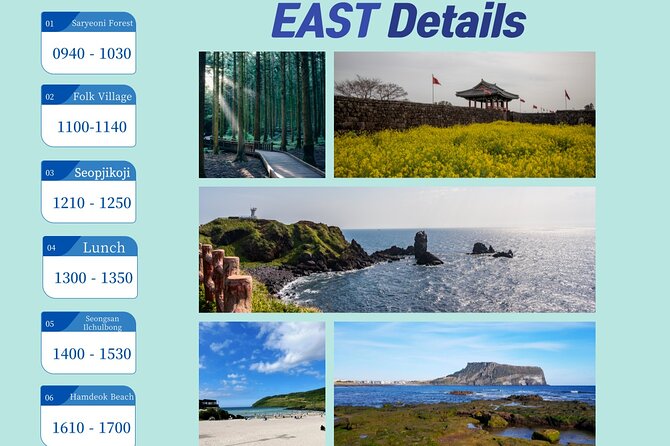
This is the big-ticket stop on Day 1: Seongsan Ilchulbong (about 1 hour 20 minutes; admission included). It’s a UNESCO-listed volcanic tuff cone formed by hydrovolcanic eruptions long ago. The tour also includes a women diver show, which is one of the most unique cultural moments on Jeju.
Here’s what you should expect when you go: you’re not just looking at a hill with views. You’re looking at a volcanic structure with a crater bowl and layered inner features. Jeju’s geology explains why the island looks the way it does, and Seongsan is one of the clearest introductions.
If you’re traveling with someone who cares more about culture than rocks, the women diver show gives you that balance.
Jongdal-ri coastline drive: beaches, hydrangeas, and quick coastal viewing
After the UNESCO moment, the tour keeps you near the sea. You’ll pass by Hado Beach and Saehwa Beach, and you’ll learn a local note about Jongdal-ri Shore Road being known for hydrangeas in summer (about 40 minutes, free admission).
This isn’t a “you’ll spend all day here” stop, but it’s useful if you’re trying to see multiple coastal moods in one day. You get the coastline feel without sacrificing time for bigger attractions.
Hamdeok Beach and the Haenyeo Museum option on rainy days
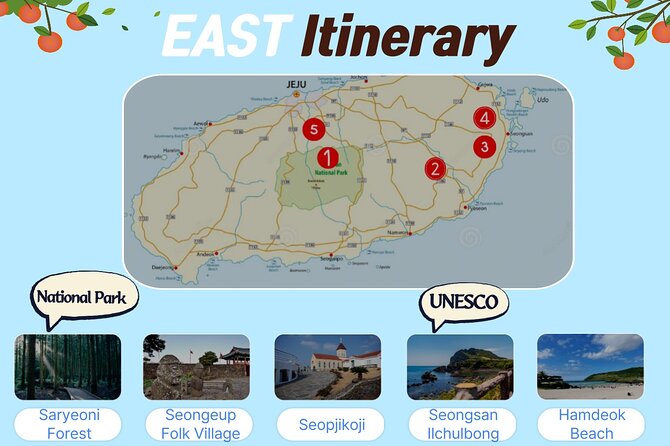
Next you head to the area around Hamdeok Beach (about 1 hour, free admission). The itinerary also flags a practical substitute: on rainy days, Hamdeok can be replaced by visiting the Haenyeo Museum.
The Haenyeo Museum is built to preserve and educate about haenyeo culture—those famous Jeju women divers. The exhibits cover the fishing villages, folk culture, and fisheries industry, with haenyeo culture as the center. If weather turns ugly, this swap can be a win. You trade outdoor walking for a place where you can learn, warm up, and still feel culturally connected.
Manjanggul Lava Tube: what to do with the closure reality
The itinerary’s UNESCO-style lava tube highlight is Manjanggul Lava Tube (described as a world-scale lava tube with a famous stone-turtle feature). But the tour data is very clear: Manjang Cave is currently closed due to anti-falling construction and is scheduled to reopen in August 2025.
During the closure period, the tour substitutes by using Hamdeok Beach instead. There’s also a note that Manjanggul can be closed on the first Wednesday of every month, and in that case the Haenyeo Museum becomes the alternative.
So here’s the practical advice: if the lava tube is your #1 reason for booking, check your travel month against these closure notes. If your goal is broader Jeju variety—forest + folk village + UNESCO peak + coast—then the substitution still keeps the day meaningful.
Day 2 start: Hallasan National Park and the Oreum volcano shape
Day 2 begins at Hallasan National Park, focusing on a baby-volcano feature called Eoseungsaengak (about 1 hour; admission included). The tour describes Oreum as a smaller volcanic form connected to Hallasan.
On rainy days, Hallasan is replaced with Circus World. That swap makes sense because Hallasan depends heavily on visibility and trail conditions. If your schedule is fixed, rainy-day planning is the difference between a frustrating Day 2 and a successful one.
O’sulloc Tea Museum: the calm, fragrant middle of the day
Then it’s time for a slower stop: O’sulloc Tea Museum (about 1 hour, free admission). It’s described as Korea’s first tea museum, and next to it there’s Osulloc Tea Stone with tea experience and cultural activity programs.
Tea stops on group tours can be hit-or-miss, but this one usually works because it gives you a reset. It also rounds out the Jeju story beyond volcanoes and coasts. You’re shifting from geology to lifestyle.
Sanbangsan Mountain: a craterless dome and a temple cave
Next comes Sanbangsan Mountain (about 30 minutes; admission included). The tour frames Sanbangsan as a typical dome-shaped, craterless volcano. It also points you toward Sanbanggulsa Temple, which is inside a cave on the mountain.
There’s a legend tied to the cave: water drops from the ceiling are described as the tears of a goddess who protects the stone walls. I like stops like this because they explain what you’re seeing without turning it into a lecture. You leave with a mental picture and a reason for the place’s importance.
Yongmeori Coast: volcanic ash beach, dragon head name, and tide checks
Then you reach Yongmeori Coast (about 1 hour; admission included). It’s described as a volcanic beach made from ash emitted during violent explosions when hot magma met cold seawater. The name means dragon’s head, because the rock and path angle resemble a dragon ready to plunge.
But you need a weather-and-tide reality check: access may be restricted during rising tides or bad weather. If Yongmeori is closed, the tour substitutes Mt. Songaksan.
This is one of those parts of Jeju where flexible planning pays off. You don’t want to build expectations around one specific coastline moment. Instead, treat it as a chance to see volcanic shoreline forms, then accept the substitute if conditions don’t cooperate.
Cheonjeyeon Falls: three tiers with plantlife details
After the coast, the tour heads inland again to Cheonjeyeon Falls (about 40 minutes; admission included). The falls are described as three sections. Water comes from a cave, forms a pool, then drops again twice before flowing to the sea.
What I appreciate here is the stop’s structure. The tour doesn’t just say falls are pretty; it gives you a sense of how the water system works. You’ll also hear plantlife notes around the falls, including mention of rare reeds.
Daepo Haean Jusangjeolli Cliff: UNESCO Geo Park columnar joints
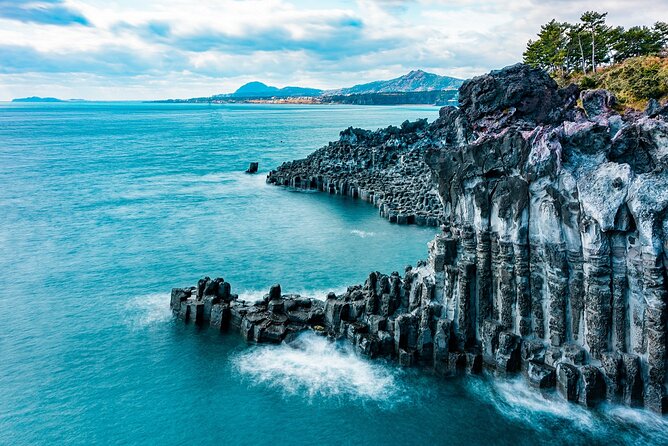
The itinerary finishes with Daepo Haean Jusangjeolli Cliff in the Jungmun area (about 50 minutes; admission included). This is listed as UNESCO GEO Park, and the tour describes the columnar joints like a folding screen of black hexagonal stone pillars.
If you’ve ever seen similar formations elsewhere, the key here is scale and ocean timing. Ocean waves hitting the columns make it feel alive, not static. Even if you’re not a geology person, this one gives your eyes something to do.
Jeju Art Circus (Jeju아트서커스): a rain-proof finale with performance energy
The final stop is Jeju Art Circus (about 1 hour; admission free). The tour description highlights a Chinese-technique circus show, plus performance elements connected to Arirang. It also mentions a motorcycle show segment designed to raise adrenaline, and notes the show has received awards at an international circus festival.
Why I like this ending: it gives you a controlled indoor option when outdoor sights are hit by rain. It also breaks the “constant walking” pattern that group tours sometimes fall into.
Price and logistics: value, group size, and what guide time really means
The price is $125 per person for roughly 2 days. That’s not bargain-basement pricing, but it’s also not pure sightseeing fluff. You’re paying for transportation across Jeju plus a structured route built around UNESCO anchor sights and timed stops.
One detail I’d treat seriously: the tour’s minimum is 13 travelers, and it notes that if there aren’t enough people, alternatives may be offered. Also, the guide setup depends on group size. The tour states that:
- Up to 4 individuals can join at the same price with a regular taxi driver who has advanced English skills.
- 5 to 10 people get a tour accompanied by a professional English-speaking guide.
- 10+ people are grouped by larger vehicle types, and they make efforts to arrange an English-speaking guide.
That matters because it changes how much narration you get while you ride. I recommend you plan to ask what the format is for your departure date if you’re a small group. In the past, I’ve seen how assuming a full guide can lead to a mismatch.
Pickup and drop-off are another practical point. Hotel pickup/drop is included within Jeju City downtown area only. If you’re outside that area, the tour data says there’s an 80,000 KRW one-way extra charge.
Lastly, the tour is weather-dependent and uses mobile tickets. If you’re the type who likes certainty, don’t book this as your only plan. Book it as your main plan, then stay flexible.
Should you book this UNESCO bus tour of Jeju?
Book it if you want an efficient Jeju plan with UNESCO highlights, strong variety (forest, folk village, tea, falls, volcanic coast), and weather-sensible substitutions. It’s especially good for short stays, first-time visitors, and people who don’t want to figure out driving, parking, and routing on an island.
Don’t book it if your heart is locked onto one specific closed-site moment like the Manjanggul Lava Tube during construction periods. Also, if you’re traveling as a very small party and you want a full professional guide every step, confirm the format for your exact group size.
If you match those expectations, this is one of the more practical ways to see a lot of Jeju without burning your whole trip on logistics.
FAQ
What is the duration of the Jeju Island UNESCO bus tour?
It runs for about 2 days.
Is hotel pickup included?
Yes, pickup and drop-off are included within Jeju city downtown area only.
Will I need to speak Korean?
No. The tour is designed with English support, and it includes a professional English-speaking guide depending on group size.
Which UNESCO areas are part of the tour?
Seongsan Ilchulbong is included, and the tour also references UNESCO World Heritage for Manjanggul Lava Tube. Daepo Haean Jusangjeolli Cliff is listed as UNESCO GEO Park.
What happens if Manjanggul Lava Tube or Manjang Cave is closed?
Manjang Cave is currently closed due to construction and is scheduled to reopen in August 2025. During the closure, the tour substitutes Hamdeok Beach. It can also close on the first Wednesday of each month, in which case Haenyeo Museum may be used instead.
Are meals included in the price?
No. Personal expenses, drinks, meals, and gratuities are not included.
What should I wear or prepare for?
The tour asks for a moderate physical fitness level. You’ll be doing walking at several stops, including forest and outdoor viewpoints.
How big are the groups, and will there always be a guide?
The minimum is 13 travelers. Guide format can vary by group size: smaller groups may have a taxi driver with advanced English skills, while larger groups can include a professional English-speaking guide.
Can I cancel and still get a full refund?
Yes. You can cancel up to 24 hours in advance for a full refund, and changes within 24 hours aren’t accepted. If the experience is canceled due to poor weather, you’ll be offered another date or a full refund.