REVIEW · GENOA
2 Hours Private Historical Tour in Genoa
Book on Viator →Operated by Treecycle · Bookable on Viator
Genoa’s alleys feel easier with a driver. This 2-hour private tour lets you cover major landmarks with no traffic stress and frequent photo breaks, starting from the Galata Museo del Mare area. I like that the route is built for short stops in the medieval center, and I like that the ride helps you save your legs on hills and narrow lanes. The one drawback to plan for: the timing is tight (most stops are 5–15 minutes), so you won’t linger long if you want deep, slow museum time.
You’ll get a mobile ticket and the tour runs in English, for just your group. It’s a great match for a first-time Genoa visit or a port-day schedule, when you want context fast and still feel like you saw the city up close.
One more thing to consider: the experience requires good weather. Light rain might still be fine, but if conditions are bad, the operator will adjust with a different date or a full refund.
In This Review
- Key highlights worth planning around
- Tour in plain terms: what this 2 hours feels like
- Starting at Galata: where your Genoa day gets its bearings
- Piazza Sarzano: the old nucleus and Ravecca street color
- Santi Cosma e Damiano: a quick medieval church moment
- Via Garibaldi: the Golden Street story in real stone
- La Casa di Colombo: Columbus lore near Porta Soprana
- Piazza Banchi: grain market and the money-changers’ stalls
- San Lorenzo area: cathedral-area power and the role of squares
- Giardini Luzzati: the quick break you didn’t plan for
- Piazza De Ferrari: Genoa’s main square and the famous neighbors
- Palazzo San Giorgio: the medieval power vibe
- Old Port and the Renzo Piano waterfront: views plus room to breathe
- Price and value: $114.93 for up to 2, and what you’re really buying
- Weather, comfort, and one real-world risk: vehicle problems
- Who this tour fits best
- Should you book this private historical tour?
- FAQ
- FAQ
- How long is the private historical tour in Genoa?
- How much does the tour cost?
- Where is the meeting point?
- Is this tour private?
- What language is the tour offered in?
- Is pickup available?
- What if the weather is bad?
- Can I cancel for a full refund?
Key highlights worth planning around
- Easy start near the port: Meet at Galata Museo del Mare, with the driver waiting by the terminal exit.
- Traffic-free sightseeing: Your driver-guide handles tight roads and turns while you focus on the sights.
- A focused “best-of” route: Piazza Sarzano to Via Garibaldi to Piazza De Ferrari to the Old Port.
- Short, efficient stops: Designed for photos and quick stories, not long museum sessions.
- Local guide personalities: Past tours have praised guides such as Eleonora, Sophie, Soufi, Youssef, and Gavino for fun, clear explanations.
- Mechanical or timing hiccups can happen: A couple of past reviews mention vehicle trouble that shortened or delayed the ride.
Tour in plain terms: what this 2 hours feels like
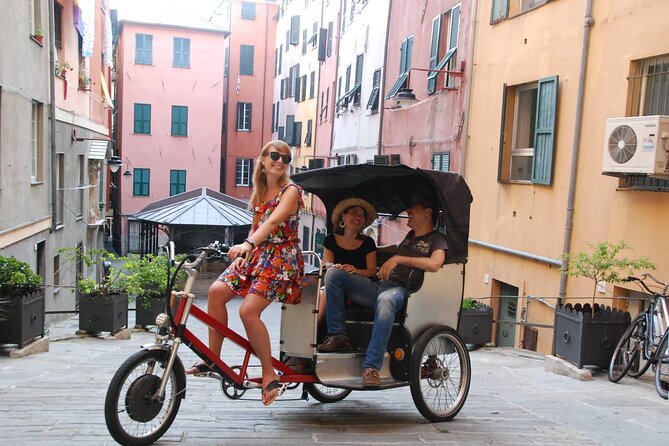
Think of this as a quick orientation tour with history stitched through the streets. Genoa’s old town is a maze—so getting a vehicle that can handle narrow routes matters. You’re not trying to “win” by seeing everything. You’re learning how the city hangs together: original nucleus, merchant palaces, Columbus lore, cathedral-area power, and the harbor where modern Genoa plays.
The route is mostly outdoors, with church and palace exteriors plus a few interior moments depending on what’s open at the time. Because so much is close together, the time budget works. You’re moving, stopping, looking, and moving again—enough to feel satisfied without turning the day into a treadmill.
Starting at Galata: where your Genoa day gets its bearings
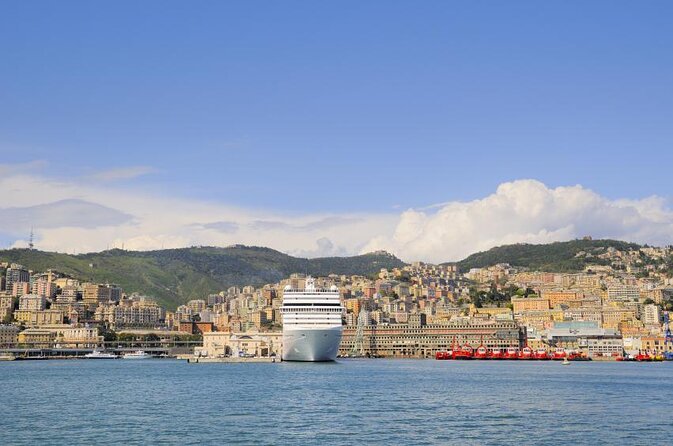
The meeting point is at Galata Museo del Mare, Calata Ansaldo De Mari 1. The driver waits in the square in front of the terminal exit, so you’re not hunting for a guide in a maze of alleys.
This is a smart setup for two reasons. First, you’re already near the waterfront and the port-side logic of the city. Second, it reduces that awkward first hour where you’re lost, late, or both. When you start in a central, easy-to-find place, you can relax into the old town instead of spending energy on logistics.
It’s also a private tour for just your group, so you can move at a pace that fits your comfort level—especially helpful if someone in your party needs more frequent photo time.
Piazza Sarzano: the old nucleus and Ravecca street color
Your first stop is Piazza Sarzano, an area tied to Genoa’s original nucleus—often referred to as Ianua. Even if you don’t know the medieval map yet, this is where you begin to feel the city’s rhythm.
What to look for:
- The bell tower of Sant’Agostino church
- A small temple in the square area
- The view direction toward Ravecca street, known for its bright, lively character
This stop works well because it’s visual. You get landmarks first, then the rest of the day makes more sense. Timing here is about 15 minutes, which is enough to orient your eyes and grab a couple of photos without feeling rushed.
If you’re the type who wants silence and time to read every plaque, keep expectations realistic. This is more about seeing and learning the big picture than studying one building deeply.
Santi Cosma e Damiano: a quick medieval church moment
Next is Chiesa Santi Cosma e Damiano, a short stop (about 5 minutes). The tour doesn’t over-explain it ahead of time, and that can be a good thing—church exteriors in Genoa often reward surprise more than speeches.
Here’s what you should do in this tiny window:
- Pause for a good look at the façade details
- Take one steady photo from a comfortable angle
- Use the time to spot how the medieval center “fits” into the street layout
Because the stop is brief, it won’t feel like a letdown if you understand the format. You’re collecting touchpoints, not completing a checklist.
Via Garibaldi: the Golden Street story in real stone
Then you get the showpiece: Via Garibaldi, a major historical street lined with palaces and garden spaces. The tour frames it as a street where time seems to stand still—but the best part is that it’s not just romantic wording. The street names themselves tell the plot.
You’ll hear the street’s evolution:
- Originally Strada Maggiore
- Later Strada Nuova
- Known until the 19th century as Via Aurea, the Golden Street
- Renamed in 1882 for Giuseppe Garibaldi
Timing here is about 15 minutes, and that’s perfect for a slow walk-and-look moment without getting stuck. The main benefit: you start seeing how Genoa’s wealth was displayed through architecture and street-scale design.
A small drawback: this section can be popular. If you’re tall, keep your camera ready so you’re not blocked for your best shot window.
La Casa di Colombo: Columbus lore near Porta Soprana
Your next stop is La Casa di Colombo, near the gate of Porta Soprana, just outside the medieval walls. The tour calls it the so-called Columbus’ House, and it’s tied to a specific range of history.
What you’ll get in plain English:
- The building is likely an 18th-century reconstruction of an older medieval structure.
- Genoa’s Columbus connection is linked to youth spent here, with written sources placing him between 1455 and 1470.
- The original medieval building was probably destroyed during the 1684 French fleet bombing under King Louis XIV.
This is one of those stops where you don’t need a ticket to feel the weight of the story. It gives your later sightseeing a reason. When you reach the Old Port, you’ll understand better why a city that exported goods and ideas also exported legends.
It’s also a good “reset” stop—about 10 minutes—because it’s easier to take in a single façade area than to process a complex cluster of buildings.
Piazza Banchi: grain market and the money-changers’ stalls
Then comes Piazza Banchi, just off the city’s important docks. Historically, this space was tied to an old grain market.
The tour’s detail that makes this stop click:
- In the 12th century it was known as piazza dei banchi
- That name connected to money-changers’ stalls under porticoes of surrounding buildings
Why this is valuable: Genoa wasn’t just a pretty harbor city. It was a working finance-and-trade machine. Piazza Banchi gives you the merchant logic without needing a lecture hall.
This stop runs about 15 minutes. Use it to notice how the dock area and the street market layouts connect. It’s the kind of thing you’d miss if you only walked the waterfront and called it a day.
San Lorenzo area: cathedral-area power and the role of squares
After Banchi, you’ll head toward Il Cittadino – Arcidiocesi di Genova, in the broader area connected to the cathedral Cattedrale di San Lorenzo.
The tour’s main idea here is about social space. It points out that Genoa historically had a city structure without typical squares. That’s why the parvis of San Lorenzo mattered—it became a stage for social and political life in the Middle Ages.
You’ll also hear how:
- The cathedral and the artistic representations on its walls led to legends and curiosities
- The heart of the city shifted when the cathedral moved and walls were constructed
Timing is about 15 minutes, so you’re not trying to memorize everything. Instead, you’re learning the pattern: Genoa organizes around religious landmarks and civic life, with the harbor and trade feeding the wealth behind it all.
If you prefer long church time, you may want to return later on your own. This tour gives you context, not a full worship visit.
Giardini Luzzati: the quick break you didn’t plan for
Then you get Giardini Luzzati (about 10 minutes). The tour description intentionally keeps some of the specifics as a surprise. In practice, that’s a nice design choice.
This is the kind of stop that helps you enjoy the rest of the route more. After palaces, docks, and churches, a garden pause gives your eyes a break and your body a moment to reset. It also helps with photos because the background isn’t just stone and shadow.
One practical note: gardens in historic centers can be breezy. If you’re sensitive to wind off the harbor, bring something light or at least expect a breeze.
Piazza De Ferrari: Genoa’s main square and the famous neighbors
Next is Piazza Raffaele De Ferrari, Genoa’s major gathering square. It’s dedicated to Raffaele De Ferrari, a benefactor who donated money in 1875 to expand the port.
Key features you’ll see:
- A monumental bronze fountain, designed by architect Cesare Crosa of Vergagni in 1936
- Nearby landmarks, including Teatro Carlo Felice
- The Accademia Ligustica di Belle Arti
- Borders with important buildings like Palazzo Ducale, Palazzo della Regione Liguria (built 1920), and Palazzo della Nuova Borsa (Art Nouveau, 1912)
Timing here is about 10 minutes. Even in that short span, this square helps you calibrate the city. You’re not only in medieval Genoa anymore—you’re seeing how the port city expressed itself in more modern civic spaces.
If you’re sensitive to crowds, pick moments for photos when foot traffic shifts. This is a natural pause point for many visitors.
Palazzo San Giorgio: the medieval power vibe
Your route continues to Palazzo Di San Giorgio (about 10 minutes). The stop is described simply as one of the beautiful palaces in the medieval historic center.
In this kind of palace stop, I like to focus on three quick checks:
- The façade proportions (how wealth “reads” in stone)
- Any visible coat-of-arms style clues (if present)
- How the palace sits against the street, because Genoa’s streets often feel like corridors between merchant worlds
You won’t get a full interior tour at this stage. That’s not the point. The goal is to keep your mental map building while you roll toward the harbor.
Old Port and the Renzo Piano waterfront: views plus room to breathe
The final highlight is the Old Port area, with a waterfront plaza designed by Renzo Piano.
You’ll use this time to enjoy what Genoa does well outside museums:
- Panoramic views over the city and harbor
- A lively waterfront feel with space for downtime
- Cultural and recreational events and activities in the area
- Access to some of Genoa’s best-known attractions
This stop runs about 15 minutes, which is a nice ending length. It works because you’ve been walking through the city’s stories, then you finish where the city’s stories connect to water and trade.
If your ship time or train timing is tight, this is also a practical last stop: you’re already near the port-side area again.
Price and value: $114.93 for up to 2, and what you’re really buying
The price is $114.93 per group (up to 2) for about 2 hours. On paper, that can look high if you compare it to a free walking tour. But you’re not just buying information. You’re buying transportation through a tough urban layout.
Here’s the value math I’d use:
- You get private time with a local driver-guide.
- You cover multiple key stops that would take longer on foot, especially with Genoa’s hills and tight streets.
- The tour ends back at the meeting point, so it’s efficient if you’re on a port schedule.
If you’re traveling with one other person, the per-person value is usually much kinder than solo sightseeing. If you’re traveling alone, the cost may feel steep—but the ride and the guided context still make sense if you want to avoid getting lost.
Also, the average booking window is about 43 days in advance, which suggests this is a popular slot. If you’re on a tight schedule, book early so you get a departure time that fits your day.
Weather, comfort, and one real-world risk: vehicle problems
This experience requires good weather. That’s not a small note—historic centers + tight routes + outdoor stops mean weather affects comfort and safety.
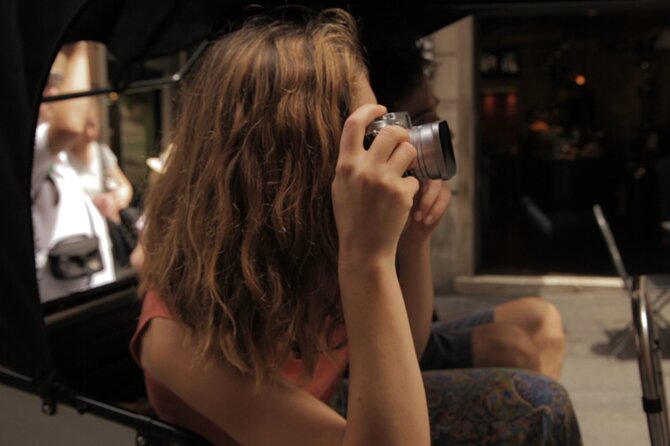
From past experiences, I’d also plan for the reality that small vehicles are still vehicles. A couple of tours were shortened or delayed due to mechanical issues like a rickshaw not working or a flat tire. Most of the time, these setups are meant to be smooth, but with any ride-based tour, it’s smart to keep your day flexible.
Comfort tips that actually help in Genoa:
- Wear layers. Even when the sun is out, breezes can shift quickly near the port.
- Bring a hat or sunscreen. There can be a lot of outdoor time.
- If you’re not a fan of waiting around, schedule this earlier rather than as your last activity before an absolute deadline.
Who this tour fits best
This is a good match if:
- You want a first-time orientation in Genoa without walking every lane.
- Your time is limited (for example, a cruise-port window).
- You’d rather enjoy the ride and the stories than manage maps and uphill routes.
- You like seeing a city in connected neighborhoods rather than separate attractions.
It’s less ideal if:
- You want museum depth or long interior visits.
- You hate short stops and prefer slow, quiet pacing.
- You’re traveling only in conditions that can’t handle light schedule changes.
Should you book this private historical tour?
Yes, I’d book it if you want a fast, private way to understand Genoa’s structure: origins around Piazza Sarzano, the merchant glamour of Via Garibaldi, Columbus lore near Porta Soprana, the cathedral-area civic role, and a satisfying finish at the Old Port.
Do it early in your Genoa time if you can. Then you can return later on your own to the churches, streets, and viewpoints that you want to see again—at your pace, with no timer.
If your calendar is tight and weather is uncertain, keep a little slack in your day. The route makes sense, but the city’s outdoor nature means conditions matter.
FAQ
FAQ
How long is the private historical tour in Genoa?
It runs for about 2 hours.
How much does the tour cost?
The price is $114.93 per group, up to 2 people.
Where is the meeting point?
Meet at Galata Museo del Mare, Calata Ansaldo De Mari 1, 16126 Genova GE, Italy. The driver will be in the square in front of the terminal exit.
Is this tour private?
Yes. It’s a private tour/activity, so only your group participates.
What language is the tour offered in?
The tour is offered in English.
Is pickup available?
Pickup is offered. You’ll still find the driver at the meeting-area square in front of the terminal exit.
What if the weather is bad?
This experience requires good weather. If it’s canceled due to poor weather, you’ll be offered a different date or a full refund.
Can I cancel for a full refund?
You can cancel up to 24 hours in advance for a full refund.