REVIEW · SPLIT
Jewish Heritage & Diocletian’s Palace Private Split Tour
Book on Viator →Operated by Jelena Vrancic Private Tourist Guide · Bookable on Viator
Old walls, hidden menorahs, real stories. This private tour pairs Diocletian’s Palace substructures with a walk through Split’s Jewish ghetto, then stops at the synagogue for a conversation with a community member. I like how the guide threads Roman-era facts together with centuries of Jewish life, and I also like the distinctly personal moment of meeting the caretaker (Albert comes up in many visits). The main trade-off is time: the synagogue stop is about 30 minutes, so bring your key questions.
It’s about 2 hours 30 minutes at a walking-friendly pace, with pickup offered for cruises and Old Town stays. If you have mobility limits, the guide can adjust as needed, which matters in Split where cobblestones don’t do you any favors.
In This Review
- Key things to know before you go
- Jewish heritage in Split: how it fits inside Diocletian’s Old Town
- Diocletian’s Palace substructures: where menorahs show up
- The palace top side: vestibule, peristyle, and the city’s Roman spine
- Grgur Ninski statue: Croatian identity meets church history
- Split’s synagogue and Jewish ghetto walk: the human part of the tour
- Narodni Trg memorial plaque: what happened in 1942
- Fruit’s Square, Riva, and Prokurative: ending with the city you actually live in
- Price and value: what you’re really paying for at $187.05
- Logistics that actually matter on cruise and city days
- Who should book this Split private tour (and who may want a different style)
- Should you book? My straight answer
- FAQ
- How long is the Jewish Heritage & Diocletian’s Palace private tour in Split?
- Is pickup available for this private tour?
- What sites will we visit?
- Is the synagogue visit included, and do we meet someone?
- What’s included in the price?
- Are tickets or a mobile ticket involved?
- What if plans change at the last minute?
Key things to know before you go
- Menorah carvings in the palace basements connect Jewish presence to early centuries in the region.
- Private guide, just your group means you can move with your interests, not a bus schedule.
- Synagogue + meeting a community member turns a site visit into a real conversation.
- A short, efficient route hits Roman landmarks, Jewish memorials, and then daily-life squares.
- Substructures admission is included so you’re not hunting for tickets on the fly.
Jewish heritage in Split: how it fits inside Diocletian’s Old Town
Split can feel like one big time capsule. You walk through Roman stone today, but the city keeps adding layers—different people, different faiths, different eras of survival. That’s why this tour works so well: it doesn’t treat Jewish heritage as a side note. It shows how the Jewish community of Split ties into the wider story of Salona, Roman life, and the later move into Diocletian’s Palace.
The heart of the experience is the framing. You start in a place that still looks Roman—basements, palace corridors, and the structure that once belonged to an emperor’s world. Then the guide shifts you into the Jewish story of the city. You’ll learn that archaeological findings point to Jews living together with Romans in the Salona area, likely in the 2nd–3rd century AD. Later, when Salona’s residents fled attacks, many ended up living in Diocletian’s Palace—so Jewish life in Split isn’t tacked on. It’s part of the city’s earliest “settled” history.
This is also where your visit becomes more meaningful than a simple photo stop. Instead of just seeing old walls, you start understanding why certain spaces mattered. And you’ll carry that perspective through the whole walk—from palace stones to synagogue walls to memorial details in the square.
You can also read our reviews of more tours and experiences in Split.

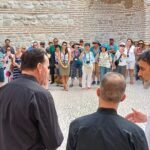
Diocletian’s Palace substructures: where menorahs show up
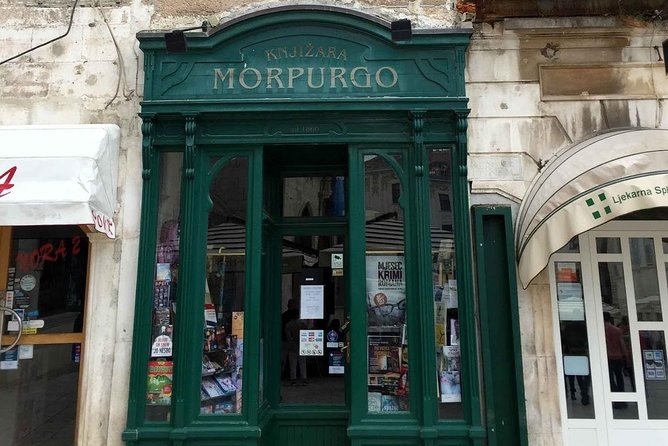
Most people think of Diocletian’s Palace as above-ground sightseeing. This tour goes lower—into the substructures—and it’s the payoff for anyone who wants context, not just architecture.
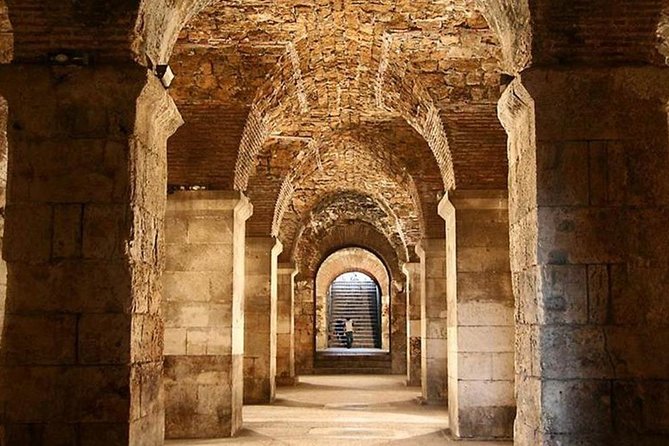
You begin in the palace substructures for about 45 minutes with the admission fee included. This is where you’ll spot the menorah carvings in the basements. They function like quiet proof: evidence that Jewish presence in Split reaches back to early centuries. Even if you don’t know a lot about Roman-era Jewish life before you go, the guide builds the story step by step, so the carvings feel like a message rather than a random detail.
A practical note: basements can be cooler and a bit damp-feeling, and lighting may be less bright than outside. If you want to take photos, check your camera phone settings beforehand and expect to adjust angle and brightness.
The palace top side: vestibule, peristyle, and the city’s Roman spine
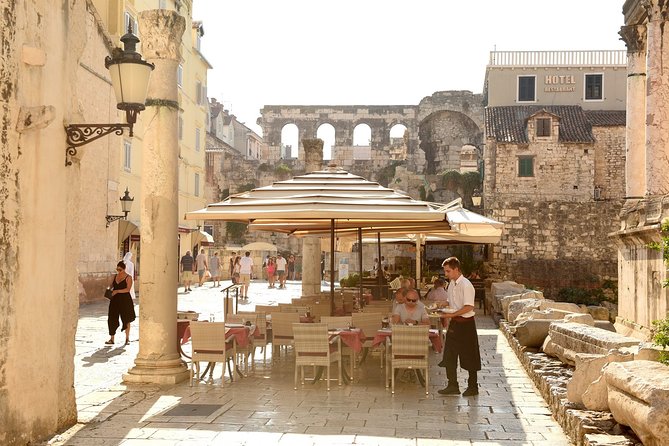
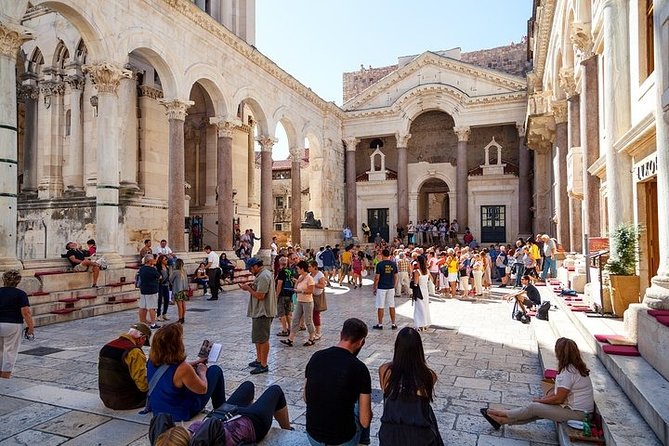
After the basement story, the tour comes up into the spaces that shape how you understand Diocletian’s Palace. You’ll get quick stops in key areas, including the Vestibulum, which used to serve as a foyer of the palace.
Then you move to the Peristyle, the main square space of the complex. You’ll learn what it was used for in the Roman world and what functions it has today. One of the best details here is how the columns were assembled for the palace. You’ll hear that the columns were brought from different parts of the empire when Diocletian built the palace in 305 AD. That single fact makes the whole area feel more “real” than a museum label ever could. This wasn’t random building work. It was imperial engineering and materials from far away.
This part of the tour is timed to keep momentum—short stops, clear explanations, and enough time to look around. The main drawback is that if you want a long, slow amble through the peristyle area, you won’t get it here. This is a guided route with multiple themes, so the palace stops are designed for understanding fast.
Grgur Ninski statue: Croatian identity meets church history
Not every stop is about Judaism or Rome. One of the pleasant surprises is the quick detour to the Grgur Ninski statue, where you’ll learn about the bishop Grgur Ninski and the sculptor Ivan Meštrović (Croatian’s well-known name in sculpture).
Why include this? Because Split’s story isn’t only Roman stone and synagogue walls. Croatia’s later identity and church history help explain why certain public artworks ended up here and how different eras keep taking turns at the center of city life.
It’s also a good “breather” stop. You step away from the heavier themes and get a moment to look at a figure in the street-scape rather than underground.
Split’s synagogue and Jewish ghetto walk: the human part of the tour
This is the section you remember when the day ends.
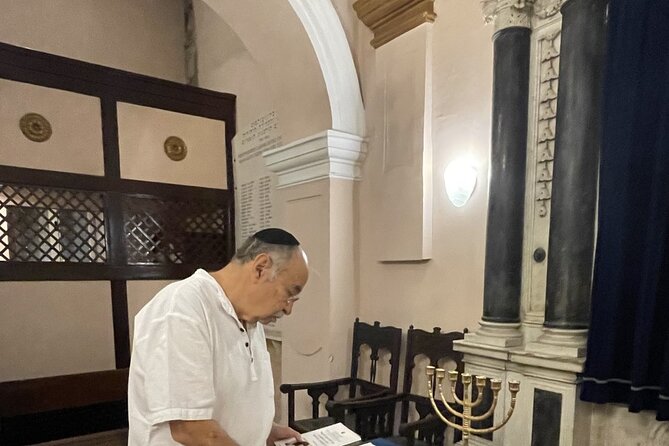
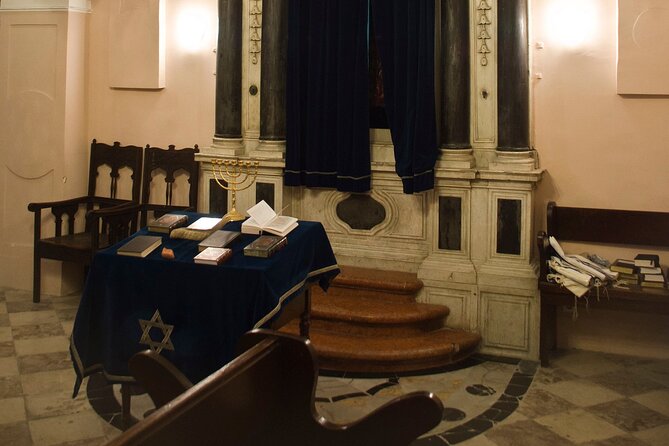
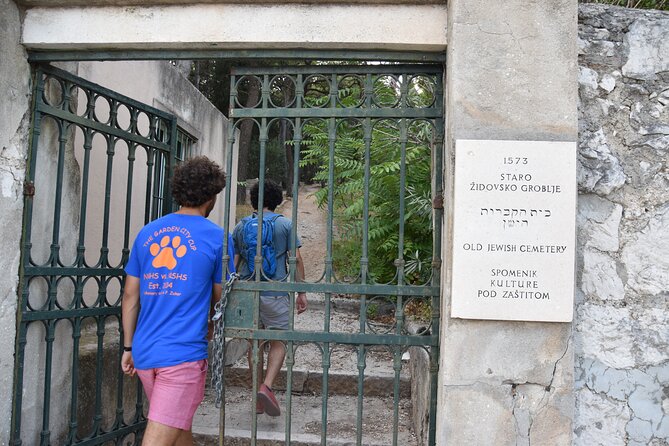
You walk through the Jewish ghetto area, learning the story of the Jewish people in Split as you go. The guide then takes you into the synagogue and you get a chance to meet a community member who shares stories about Jewish life in the city.
In several visit accounts, the caretaker Albert plays a key role, and that matters because it changes the sound of the experience. You’re not only hearing dates and descriptions. You’re getting living context—how the synagogue functions today, how the community understands its own past, and what it’s like to preserve a place that’s still active.
The synagogue visit itself lasts about 30 minutes. That’s short enough to keep the pace from dragging, but long enough to ask questions and feel like you’re part of the moment. If you’re the type who asks a lot, jot down your top 3 questions before you arrive. Questions you can’t fit into those 30 minutes will still be there in your brain later.
Also, it helps that this synagogue is often described as among the oldest in Europe. While the exact ranking can vary depending on sources, the point stays the same: you’re visiting a place with serious age and continuity.

Narodni Trg memorial plaque: what happened in 1942
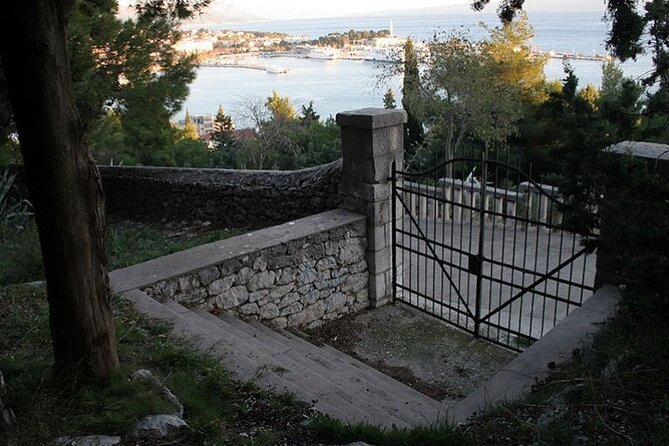
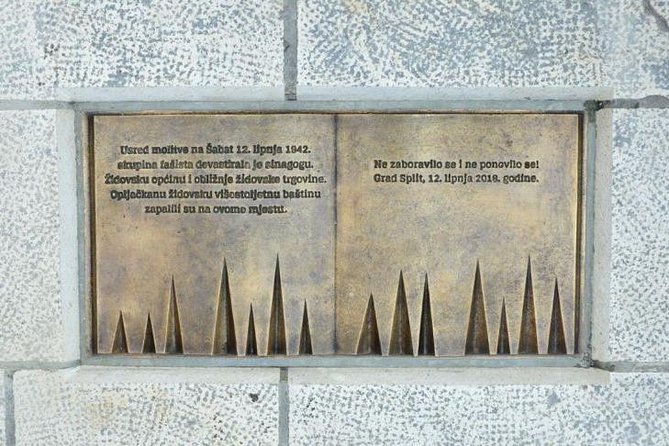
Once you’ve seen the synagogue, you’re ready for the next layer of meaning. The tour moves you to Narodni Trg, where you’ll learn about a bronze plaque placed on the square in memory of the destruction of precious items and archives from the synagogue on 12 June 1942.
This stop keeps the day honest. It’s not just celebration of survival; it also recognizes loss. And because it’s located right in the public space of the city, it avoids the feel of a distant monument. You see how remembrance sits inside everyday streets.
If you’re visiting during a busy time of day, take a minute to step slightly away from foot traffic so you can read the plaque calmly. The memorial detail is the kind of thing you’ll want to absorb fully.
Fruit’s Square, Riva, and Prokurative: ending with the city you actually live in
After the weightier stops, the route turns toward everyday Split—squares and promenades where locals spend time.
You’ll pass through Fruit’s Square (Trg Brace Radic), outside the Roman palace area, and learn about Marko Marulić, described here as the father of Croatian literature, with his statue in the middle of the square. This is a quick stop, but it gives you a sense of how cultural identity plays out in public art.
Then the tour heads to Riva, the main harbor promenade locals call their living room. You’ll get the explanation behind why it’s so popular, plus practical context: where people linger for coffee or drinks and why the waterfront has become the social heart of Split.
After Riva, you’ll visit Prokurative (Republic Square), sometimes compared to St. Mark’s Square in Venice because of the arcaded edges on three sides. You’ll learn the naming connection to the arches on the neo-Renaissance buildings. The goal here isn’t to “tour Venice.” It’s to help you read the architecture of Split as a living street design.
Finally, you’ll walk along Marmontova Ulica, another popular promenade. You may even have a chance to look at the fish market nearby if you want to see how locals buy fresh Adriatic fish.
This closing sequence is valuable because it prevents the common problem with heritage tours: you go heavy on history and then leave without feeling the city’s present rhythm. Here, you get both.
Price and value: what you’re really paying for at $187.05
At $187.05 per person for about 2.5 hours, this isn’t a budget deal. But you’re not just paying for walking and explanations. You’re paying for a private guided tour that combines three things that are often separate: Diocletian’s Palace substructures access (with an included fee), a synagogue visit, and a walk through the Jewish ghetto and key memorial points.
It also helps that this is booked relatively far ahead on average (around two months), which often signals demand for the niche subject matter and the time inside the synagogue.
The best value angle is the private format. If you’re traveling as a couple, a family, or with a small group, you get the guide’s attention without sharing it with strangers. And if you need pacing adjustments, the guide can work with you. One account I’d take seriously: a group reported ambulation problems and that the guide made adjustments. That’s the sort of flexibility you don’t get on larger group tours.
If you’re traveling solo, the price may feel steep compared to standard city walking tours. If you can split the cost among 2–4 people, it often starts to look more reasonable for what you get.
Logistics that actually matter on cruise and city days
This tour is offered in English and includes pickup. That’s a big deal in Split, especially if you’re on a cruise and want to avoid wasting time figuring out transport.
You meet at Obala Hrvatskog narodnog preporoda 23, 21000 Split, Croatia, near the bronze map of the city at Riva. If you’re a cruise ship guest, the guide meets you at the port after you clear customs, with your name on a sign.
There’s also pickup for apartments in the Old Town of Split. For places outside the Old Town, the meeting point becomes Riva.
One practical tip: because the start time is on request for private tours, plan your day with a little buffer. If you’re managing strict cruise timing, confirm your pickup time early so you’re not stressed on the day.
Also, you’ll be doing city walking, including uneven stone. Service animals are allowed, and the tour is listed as suitable for most travelers, but you’ll still want comfortable shoes.
Who should book this Split private tour (and who may want a different style)
Book this if you want:
- A private guide who can answer your questions in a slower, more thoughtful way.
- A route that connects Jewish heritage directly to Diocletian’s Palace, instead of treating it like a separate sightseeing add-on.
- A synagogue visit that includes a conversation with someone from the community, not only a quick exterior view.
You might choose something else if:
- You want lots of free time to wander alone through the palace and square areas. This tour is timed and guided, with shorter stops.
- You only care about Roman architecture and don’t want the Jewish heritage focus. The palace is central, but Jewish sites are a core theme.
This is also a smart pick for multigenerational groups. One group account praised the guide for keeping both adults and teens engaged and for making the information easy to follow without turning it into a lecture.
Should you book? My straight answer
Yes, if you’re visiting Split and want your day to feel both historically grounded and personally meaningful. The synagogue stop and the story behind the palace substructures are the kind of combination that you can’t easily replicate on your own in a single afternoon without missing context.
If you’re deciding between a general Old Town walk and this themed private tour, I’d lean toward this one. The price buys you focus: Roman spaces with Jewish evidence in the basements, plus a living community conversation, plus a clear memorial point in Narodni Trg, and then an ending that still lets you enjoy Split as a place people actually hang out.
And given how often this is booked in advance, if this theme matters to you, don’t wait until the last week to decide.
FAQ
How long is the Jewish Heritage & Diocletian’s Palace private tour in Split?
It runs about 2 hours 30 minutes (approx.).
Is pickup available for this private tour?
Yes. Pickup is offered. The exact start time is on request since it’s private, and cruise guests are met at the port. Guests staying in Old Town Split can also be picked up from their apartments.
What sites will we visit?
You’ll see Diocletian’s Palace substructures, the Vestibulum and Peristyle areas, a stop at the Grgur Ninski statue, walk through the Jewish ghetto, visit the synagogue, and visit key squares including Narodni Trg, Fruit’s Square, Riva Harbor, Prokurative, and Marmontova Ulica.
Is the synagogue visit included, and do we meet someone?
Yes. The tour includes a visit to the synagogue and includes time to meet a member of the Jewish community who shares stories.
What’s included in the price?
Included items are a private guided tour with a licensed guide, the synagogue and Jewish ghetto visit, and the fee for Diocletian’s Palace substructures. Admission for the substructures is included in the tour plan.
Are tickets or a mobile ticket involved?
A mobile ticket is offered.
What if plans change at the last minute?
You can cancel for a full refund up to 24 hours in advance of the experience start time.