REVIEW · SPLIT
Private History tour – small group
Book on Viator →Operated by Ivan Fistanić · Bookable on Viator
Split’s Roman bones are right underfoot. This private history walk turns the old walls into a clear story, with a local guide who has a Master’s Degree in History. I especially liked how the route starts at the Golden Gate and keeps moving through the palace’s key spaces without feeling rushed, and how you get practical context at each stop. One thing to consider: it’s mostly an outdoor walking tour, so good weather matters, and the cathedral/temple viewpoints are outside since admission isn’t included.
Small group means you’re not shouting over strangers. With up to 10 people, Ivan can handle questions and slow down when something catches your eye—exactly what you want when you’re standing in front of ancient architecture that can feel confusing at first. If you want a quick photo stop and nothing else, this may be more explanation than you expected.
In This Review
- Key highlights that make this walk worth it
- Split’s Roman core: why this tour works so well
- Meet at Ul. kralja Tomislava and start fast with a private guide
- Golden Gate and the palace entrance logic
- The Peristyle: learning the palace’s main “stage”
- St. Domnius from the outside: Roman structure with a living role
- Temple of Jupiter: late Roman design turned into a baptistery
- Vestibulum and the private-chamber vibe
- Riva Harbor: where Split’s everyday rhythm meets the palace wall
- Fruit’s Square and Pjaca: palace leftovers become city squares
- The Grgur Ninski statue and a fun last-minute tradition
- Value and price: what $238.28 per group really means
- Practical tips: tickets, weather, and how to prepare
- Who should book this Private History tour?
- Should you book Private History with Ivan Fistanić?
- FAQ
- How long is the Private History tour in Split?
- How big is the group?
- Where does the tour start?
- Is the tour ticket mobile?
- Are entrance tickets included for the cathedral and the Temple of Jupiter?
- Are there stops outside the Diocletian’s Palace area?
- Is the tour suitable for most travelers?
- What happens if the weather is bad?
Key highlights that make this walk worth it
- Master’s Degree history guide: Ivan brings facts and real context to the palace maze
- Small-group pace (up to 10): easier conversation and fewer bottlenecks
- Golden Gate + Peristyle as anchors: you learn how the palace was laid out from the inside out
- Big sights without extra hassle: cathedral and temple are covered from outside, with the key details explained
- You finish near the waterfront squares: Riva, Fruit’s Square, and Pjaca all connect naturally
- Local ritual at the end: a fun stop at the Grgur Ninski statue, including the toe-rub tradition
Split’s Roman core: why this tour works so well
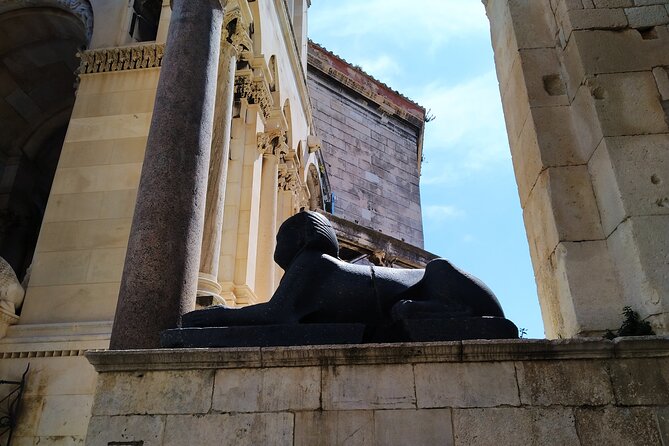
Split can feel like two cities at once: modern life along the sea, and a Roman palace that still shapes how you move through town. This tour focuses on the overlap—where the old palace structure meets the everyday streets and squares people use today.
That matters because Diocletian’s Palace isn’t just “old stones.” It’s a plan: entrances, open spaces, religious conversions, and private areas. When you understand the layout, everything else in Split starts making sense.
You can also read our reviews of more private tours in Split
Meet at Ul. kralja Tomislava and start fast with a private guide
The tour meets at Ul. kralja Tomislava 15 in Split. The location is central, and it’s convenient if you’re using public transport. You’ll use a mobile ticket, and the activity ends back at the meeting point, so you’re not stuck figuring out how to get home after.
You’re booking a private tour for your group only, not a shared shuffle. The total time is about 1 hour 30 minutes to 2 hours, which is a sweet spot for first-timers who want the big story without spending half a day.
Also, the group size cap (up to 10) makes a difference on tight palace paths. You can hear the guide without hiking your neck back every minute.
Golden Gate and the palace entrance logic
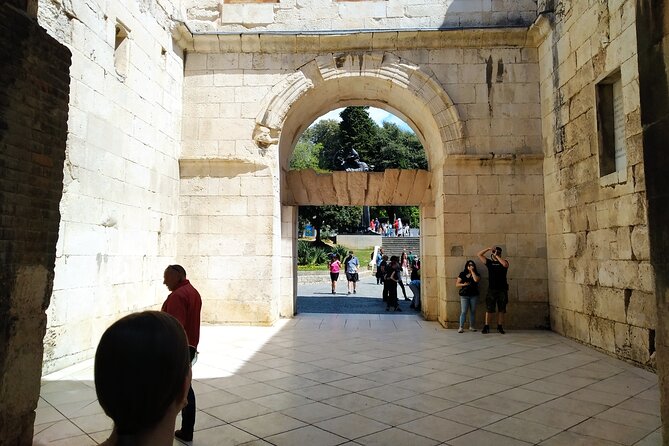
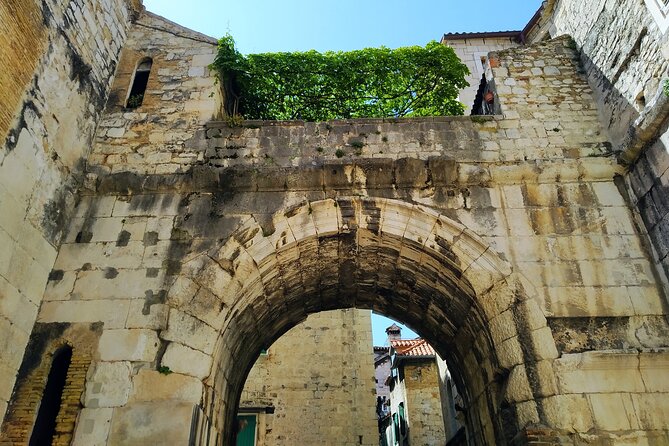
The walk kicks off at the Golden Gate, the main entrance to Diocletian’s Palace. It’s one of four Roman gates into the palace, and it sits on the road north toward Salona—Roman Dalmatia’s capital and Diocletian’s birthplace.
What I like about starting here is the way it fixes your mental map. You’re not just seeing a gate; you’re learning why it’s placed where it is and how the palace connects to the wider Roman world.
You also get an immediate visual link to another well-known monument nearby: Gregory of Nin stands opposite, so your route feels connected from the first minutes.
The Peristyle: learning the palace’s main “stage”
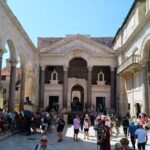
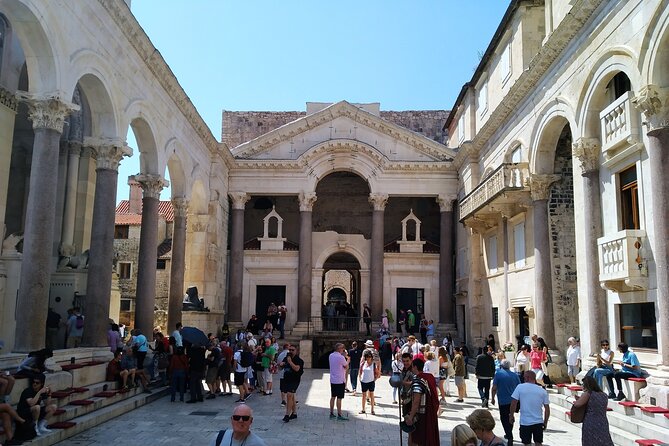
Next comes the Peristyle, the big open space that’s like the palace’s central hub. From here, you can picture the imperial square and see monumental arcades framing the space. The guide also points out how the architecture connects toward the imperial loggia.
This stop is special because it’s where you can understand the palace as a living civic space, not just a leftover ruin. Ivan explains how changes in building use played out over time, including transitions connected to the spread of Christianity.
Even if you’ve read about ancient places before, standing in the Peristyle helps your brain put pieces together. It’s one of those spots where the guide’s explanation makes the stones feel arranged, not random.
St. Domnius from the outside: Roman structure with a living role
At the Cathedral of Saint Domnius, you don’t go inside. You’ll stand on the Peristyle and focus on what matters visually, with the guide explaining the significant parts and the story behind them.
One practical point: admission isn’t included for the cathedral. Since you’re not entering, you can treat this as a high-value viewpoint stop. If you later want to go inside on your own, you’ll want to plan that separately.
Why this works even without entry is simple: you’re getting the context while your feet are already in position. After hearing the cathedral story at this exact vantage point, you’ll likely feel you understand what you’re looking at rather than just checking a box.
You can also read our reviews of more historical tours in Split
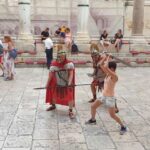

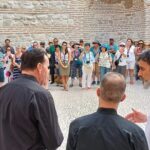
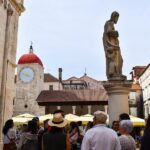
Temple of Jupiter: late Roman design turned into a baptistery
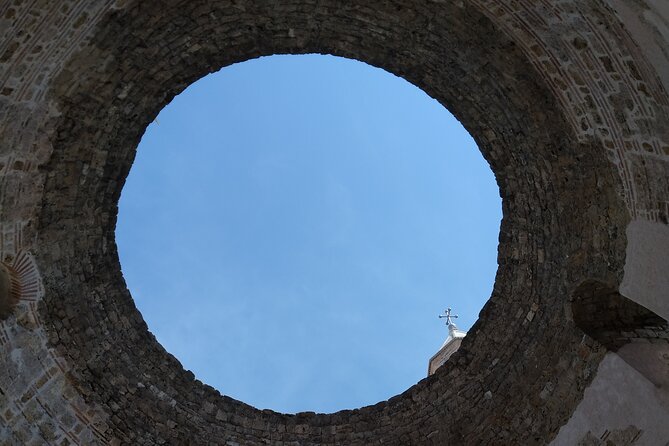
Then it’s on to the Temple of Jupiter, described as one of the best-preserved late Roman temples in the world. The guide explains the location choice as a statement of divine connection between Diocletian and Jupiter, including who Jupiter was in Roman belief.
During the Middle Ages, this temple was converted into a baptistery dedicated to St. John the Baptist. That single detail is the kind of thing that changes how you read the building. You see it as history layered over history, not one moment frozen in time.
Like the cathedral, admission isn’t included. The tour approach is to keep you outside and give you the key facts so you don’t spend the walk waiting in ticket lines.
Vestibulum and the private-chamber vibe
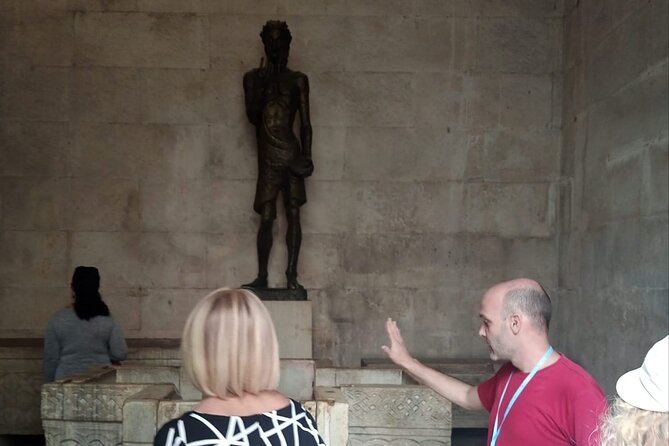
After the big public spaces, the tour shifts toward the palace interior zones. The Vestibulum is the pre-entrance of Diocletian’s private chambers, decorated in line with its importance. This is a good stop if you like “how people actually moved and lived” stories, because it feels more personal than the imperial square.
From here, you also check up the Triclinium. Even if you don’t have a long time inside, the guide’s explanation helps you picture what the space meant and how daily life would have worked in a palace setting.
This section also helps connect the dots across the tour: you go from entry, to public hub, to religious transformation, and then toward private spaces and function.
Riva Harbor: where Split’s everyday rhythm meets the palace wall
Then you’re out on the Riva Harbor, the main promenade and a meeting point for locals and visitors. The guide explains how the Riva was built over the centuries and why it became central to city life.
One of the nice payoff moments here is the view of the southern wall of Diocletian’s Palace. You finally see the palace as something that hugs the coastline and shapes the city’s long-term geography.
This is a good transition stop if you want a breather. You’re still getting history, but it feels lighter because you’re standing in an active public space instead of inside the palace maze.
Fruit’s Square and Pjaca: palace leftovers become city squares
Next is Fruit’s Square (Trg Brace Radic), just outside the palace. It’s one of the more picturesque squares in the area, and it’s dominated by the remains of a 15th-century Venetian fort.
That Venetian layer is easy to miss when you think only “Roman palace.” The guide’s explanation helps you understand that Split’s story kept moving, and the old structures didn’t just disappear—they got reused, surrounded, and reinterpreted.
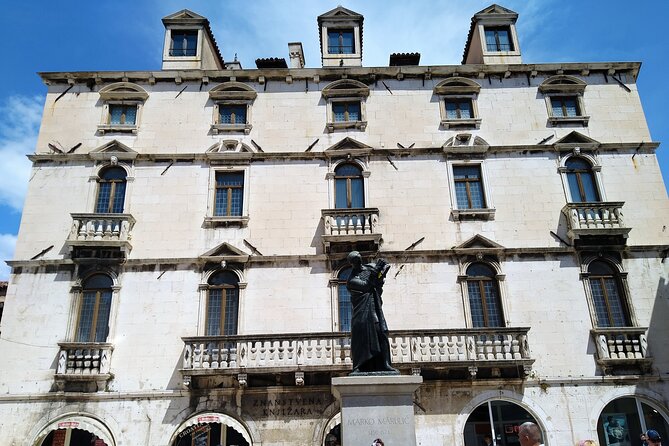
Then the tour heads to Pjaca, the city’s main square since medieval times, outside the western wall of the palace. You’ll see the 14th-century Town Hall and other interesting structures, and the guide helps you connect the square’s role to what came before it.
If you’re wondering what to do with your last hour in Split, this “square sequence” is a smart way to end your history walk. You get open space, local life, and landmarks in one compact area.
The Grgur Ninski statue and a fun last-minute tradition
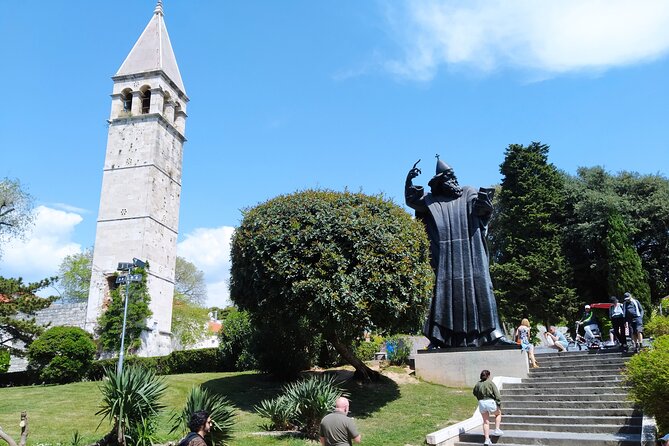
The final stop is the Grgur Ninski statue, a recognizable landmark in Split. The guide shares the story and facts about Gregory of Nin, plus details about the highest monument in Split dedicated to him and the sculptor of the monument.
Ivan Mestrovic’s name comes up here, which adds a modern Croatian art connection to an ancient setting. And yes, there’s a local tradition: you’ll hear about rubbing the statue’s toe for good luck.
It’s a quick, memorable ending. By the time you reach this spot, you’ve gone from gateways and imperial squares to transformed sacred buildings and city squares. The toe-rub is the cherry on top, not the main course.
Value and price: what $238.28 per group really means
The price is $238.28 per group for up to 10 people. If you have the full group, that’s roughly $24 per person. Even if you don’t fill all 10 spots, you’re typically paying for one guide and one private route through the main sights.
You should see it as paying for clarity. An un-guided walk through Diocletian’s Palace can turn into lots of “what is this?” moments. Here, a history-trained guide helps you understand entrances, central spaces, religious transitions, and functional areas like the Vestibulum and Triclinium.
The payoff is that you finish with a mental map. And in a place like Split, a good map beats another pile of photos.
Practical tips: tickets, weather, and how to prepare
This tour requires good weather. Much of the walk is outdoors, and the pacing depends on you keeping moving between key stops.
On tickets: many stops are listed with admission ticket free, but the cathedral of Saint Domnius and the Temple of Jupiter are marked as not included. Since the tour keeps you outside at these points, you’re not losing key time inside. Still, if you think you’ll want to go in later, plan for that separately.
Logistics are straightforward: mobile ticket, central meeting point, near public transportation, and it ends back where you started. Most travelers can participate, so it’s a solid option if you’re not looking for a hardcore long hike.
Who should book this Private History tour?
Book this if you’re in Split for a short time and you want the Diocletian’s Palace story in a logical order. It’s also ideal if you like asking questions during the walk and want a guide who can explain in plain language.
If you’re the kind of traveler who enjoys architecture as a “why” story—why a gate faces a certain direction, why an open square functions the way it does—this will click quickly.
If you only want to casually stroll and do zero thinking, you might find the explanations a bit heavy. In that case, you may prefer a lighter, more free-form walk.
Should you book Private History with Ivan Fistanić?
Yes, if your goal is understanding. This tour is built around the palace’s strongest anchors: Golden Gate, the Peristyle, St. Domnius viewpoints, the Temple of Jupiter story, then the squares and promenade that keep Split living today.
The big reason I’d recommend it is the mix of structure and flexibility. You get a clear route, but it’s still private for your group, and Ivan’s history training shows in how he connects each stop.
If you want a memorable Split experience that doesn’t leave you confused in front of Roman walls, this is the kind of walking tour that gives you a real payoff fast.
FAQ
How long is the Private History tour in Split?
It runs about 1 hour 30 minutes to 2 hours.
How big is the group?
It’s a private tour with your group only, up to 10 people.
Where does the tour start?
It starts at Ul. kralja Tomislava 15, 21000, Split, Croatia.
Is the tour ticket mobile?
Yes, you receive a mobile ticket.
Are entrance tickets included for the cathedral and the Temple of Jupiter?
No. Admission tickets are not included for the Cathedral of Saint Domnius and the Temple of Jupiter.
Are there stops outside the Diocletian’s Palace area?
Yes. The tour includes Riva Harbor, Fruit’s Square, and Pjaca, which are outside the palace walls.
Is the tour suitable for most travelers?
Most travelers can participate.
What happens if the weather is bad?
The experience requires good weather. If it’s canceled due to poor weather, you’ll be offered a different date or a full refund.