REVIEW · ATHENS
An exciting exploration of Peloponnese at ancient Corinth, Mycenae and Nafplio
Book on Viator →Operated by Athens Tours Greece · Bookable on Viator
One day. Three ancient stops. Lots of steering wheels. This private Peloponnese route is built to squeeze big names—Corinth Canal, Ancient Corinth, and Mycenae—into a tight mainland Greece schedule without making you fight the clock.
I love the way this tour keeps the day moving with punctual, private transportation. Pick-up is arranged from your Athens hotel or directly at Piraeus cruise port, and you’re not hopping between buses with strangers’ schedules. You also get a driver who explains what you’re seeing along the drive, so the countryside has a story, not just scenery.
One consideration: entrance fees aren’t included for the archaeological sites, and the English-speaking driver can guide you up to the entrances (licensed site companions inside the museums require an extra cost). That means you’ll want to plan for ticket time and added costs so the day stays smooth.
In This Review
- Key highlights that make this Peloponnese route work
- From Piraeus Port to the Acropolis: a smooth start you can count on
- Attica in transit: why the drive matters, not just the stops
- Corinth Canal: a 2,000-year dream cut into stone
- Ancient Corinth: ruins that explain how trade and power spread
- Mycenae’s Agamemnon connection: where myth and Late Bronze Age politics meet
- Nafplio break: lunch time, castles, and a town shaped by many rulers
- Why the pacing (and private format) feels better than rushing
- Price and what you actually get: private value vs. add-ons
- Practical planning tips so the day stays easy
- The one thing you’ll notice at the end of the day
- Should you book this Peloponnese day trip?
- FAQ
- Is this tour private and how many people are in a group?
- Where does pick-up happen for hotels and for cruises?
- Are entrance fees to the archaeological sites included?
- Is lunch included in Nafplio?
- Do I get a licensed guide inside the sites?
- What’s the cancellation policy?
Key highlights that make this Peloponnese route work
- Cruise-port friendly pick-up and drop-off at Piraeus, so you’re not guessing how to get back in time.
- Corinth Canal stop with context, including the old dream of cutting through the isthmus and who first imagined it.
- Ancient Corinth time to explore, not just a quick photo stop—especially valuable if you like ruins with geography.
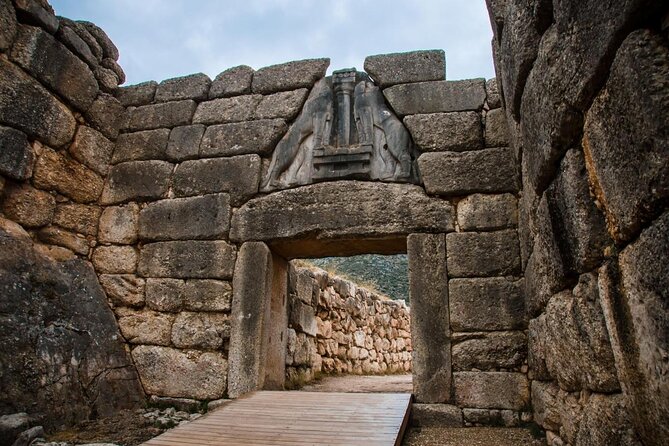
- Mycenae focused for the Late Bronze Age, tied to Agamemnon’s mythical world.
- Nafplio built in as a real break, with time for a relaxed lunch and a stroll in a town shaped by many eras.
- Private tour up to 3 people, so you can keep the pace without feeling rushed by a large group.
From Piraeus Port to the Acropolis: a smooth start you can count on
If your trip begins in Athens, you meet at your hotel main entrance. If you’re on a cruise, you meet outside the terminal exit with a sign showing your name. That last detail matters more than it sounds; when a ship is moving, clarity beats guesswork.
The plan is to drive you directly toward the Acropolis area to admire the Temple of Democracy. You get a big “Athens intro” before the day turns south toward Peloponnese. And since Piraeus is only about 12 km from Athens, the morning doesn’t waste time crawling through the city.
This part of the day also sets expectations: you’re not getting a slow, museum-heavy Athens morning. You’re getting the key landmarks, then hitting the road while the day still feels young.
You can also read our reviews of more tours and experiences in Athens.


Attica in transit: why the drive matters, not just the stops
Even though the route is mostly about Peloponnese, you’ll travel through Attica, the region tied to thousands of years of Greek history and culture. The idea here is simple: while you’re in the car, you’re not just passing time. You’re being given the storyline so the ancient sites later make more sense.
Attica is described as a land where major monuments, archaeological sites, and museums live side by side with newer heritage from the 19th and 20th centuries. The tour frames this as a “journey” through layers—ancient foundations, medieval shifts, then later architectural influence.
Practically, that means you arrive at Corinth already knowing what kind of place you’re looking at: not random ruins, but a crossroads and a power center. It’s a smart use of a limited day.
Corinth Canal: a 2,000-year dream cut into stone
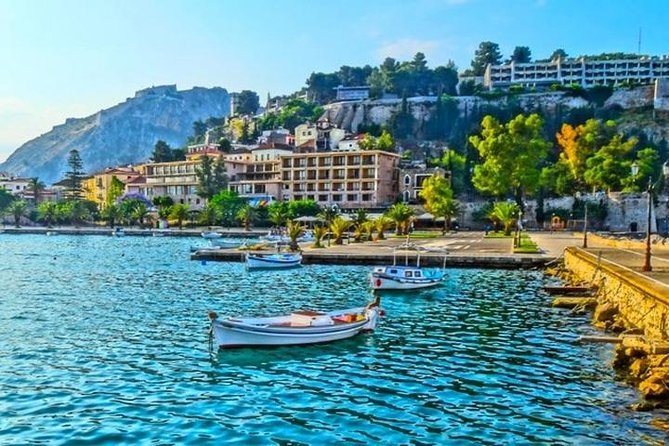
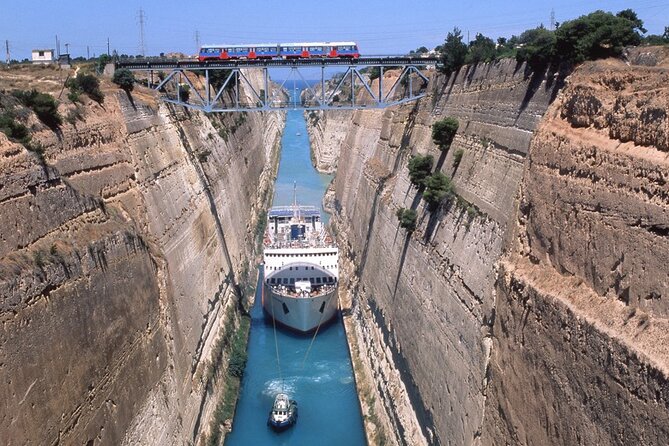
Corinth Canal is one of those places you can understand fast and remember for years. It links the Gulf of Corinth with the Saronic Gulf, effectively turning the Peloponnese peninsula into something closer to an island. That geographic trick is the whole point.
The canal is about 6.4 km long and only 25 meters wide, cut at sea level. It was executed in the late 19th century, but the dream had been around for about 2,000 years. The tour also brings in the story of Periander, the tyrant of Corinth, and the earlier solution: the diolkós, a stone road where ships could be transferred on wheeled platforms.
You’ll have about 15 minutes here. That sounds short, but it’s enough time to get oriented, see the canal’s scale, and grab photos without burning the schedule. The biggest value is not the visit length—it’s the explanation that makes the canal feel like a strategic invention, not just a body of water.
Ancient Corinth: ruins that explain how trade and power spread
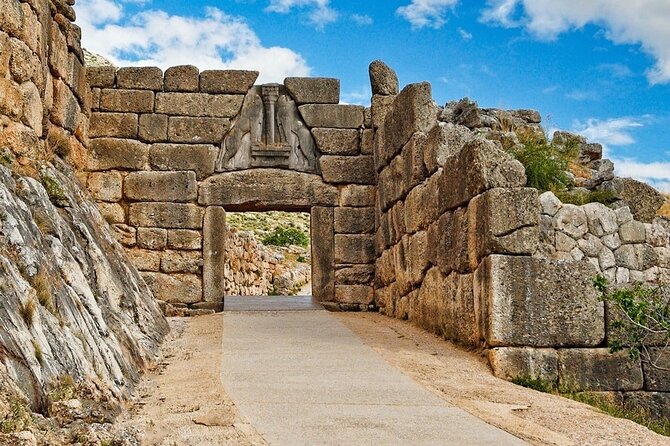
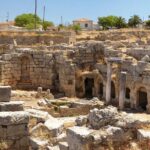
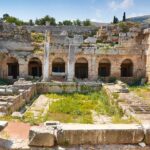
After the canal, the route heads about 20 minutes to Ancient Corinth, known as Archaia Korinthos. This is a site with early roots, first inhabited in the Neolithic period (6500–3250 BC), then shaped by its location at the meeting of land routes and waterways.
What I like about this stop is how the tour’s framing fits what you’ll likely notice on the ground: Corinth’s prosperity wasn’t accidental. It sat at a junction—routes from the Balkans into mainland Greece toward the Peloponnese, plus sea connections linking the western Mediterranean to Asia Minor and beyond.
Time on site is about 1 hour 20 minutes, and admission tickets for the archaeological area are not included. So your ticket prep becomes part of your day’s ease.
What to look for (without expecting a single wow moment)
- Think in terms of “crossroads.” Corinth is about movement—people, goods, ideas.
- Watch for details that reflect long-term occupation and changing eras; Corinth’s story stretches across multiple periods.
- Use your time for slower wandering rather than rushing. The site is more rewarding if you give it a little breathing room.
One drawback to keep in mind: because this is a popular historic stop, your experience depends on ticket availability and line conditions. The tour suggests having tickets pre-purchased, and that’s good advice here.
Mycenae’s Agamemnon connection: where myth and Late Bronze Age politics meet
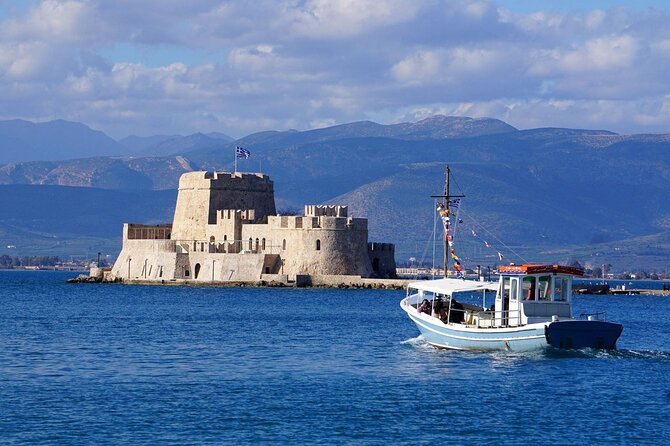
Next comes Mycenae, about 35 minutes from Ancient Corinth. This stop is aimed right at the Late Bronze Age, described as the most important and richest palatial center in Greece. The nickname you’ll hear in the description is “Rich in Gold,” tied to the mythical Agamemnon made famous through Homer’s epics.
Mycenae’s value is not only archaeological—it’s the way the stories are linked to place. The tour connects the myths (including Perseus) to the founding narrative and explains how the name Mycenae ties to the pommel of Perseus’s sword and a spring reference reported in ancient sources.
You’ll have about 1 hour 55 minutes here, with admission not included. That longer time window is helpful because Mycenae can reward patience. If you like understanding why people built where they built, you’ll likely appreciate this stop more than a quick “stand-and-snap” approach.
Practical note: Mycenae often involves uneven ground and some walking. The tour states you should have moderate physical fitness level, which is exactly what you want for a day like this—enough stamina to enjoy ruins without suffering.



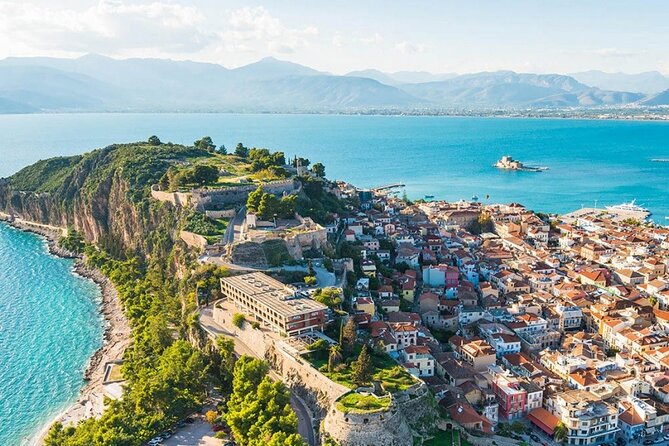
Nafplio break: lunch time, castles, and a town shaped by many rulers
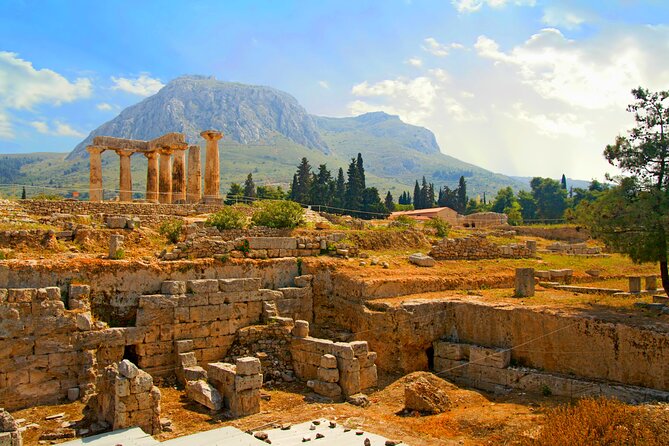
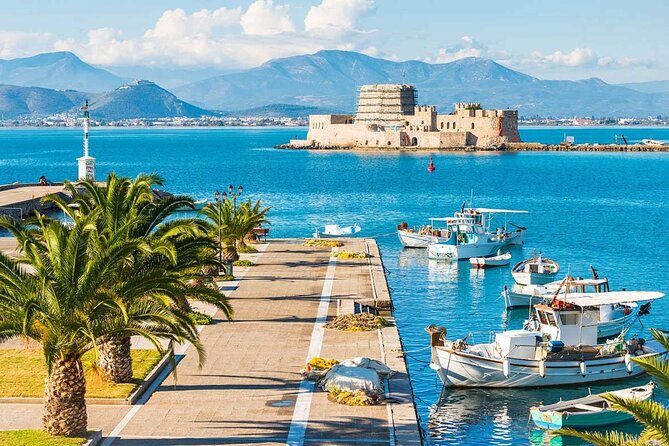
From Mycenae to Nafplio is around 20 minutes. This is where the day takes a friendlier turn. You’ll have about 1 hour 30 minutes in town, and the tour mentions you can enjoy a lunch here (not included).
Nafplio is described as one of the most beautiful towns in Argolis and also one of the most romantic cities in Greece. More importantly, it wasn’t just pretty—it was politically significant. It became the first capital of the newly born Greek state (1823–1834).
The tour also gives you the mythology angle (Nafplios, son of Poseidon, and Danaus’s daughter), but what really helps is the layered history you’ll see as you walk. The description calls out medieval castles, ancient walls, and marks left by Frankish and Venetian conquerors, plus Byzantine periods and later neoclassical influence.
What to do with your Nafplio time
- Prioritize walking rather than driving off to one viewpoint you can’t enjoy.
- Plan your lunch so you don’t lose the stroll window.
- Save energy—Mycenae to Nafplio is a mental reset, and you’ll want to actually enjoy it.
This stop is included as free time at the right moment. After ancient sites, Nafplio gives your brain a place to wander.
Why the pacing (and private format) feels better than rushing
This is an 8-hour day, and it combines distance driving with three big history stops plus a town break. That’s a lot. The private format is what makes it workable: you’re not waiting for others to line up, not negotiating a shared timeline, and not stuck with the slowest member of a bus group.
The “why” is in the structure:
- Corinth Canal gives quick, high-impact geography.
- Ancient Corinth gives trade and strategy context.
- Mycenae gives the heavy myth-and-palace centerpiece.
- Nafplio gives your legs and mood a change of pace.
There is still a realism check. The tour is moderate fitness friendly, but it’s not built for people who want a totally seated experience. Also, entrance fees add cost, so the all-in price won’t just be the base rate.
Price and what you actually get: private value vs. add-ons
The cost is listed as $504.10 per group (up to 3) for the roughly 8-hour experience. That pricing is meant for families or small groups who want private transportation without paying for a full larger-vehicle charter.
Here’s what you get in that base price:
- A professional English-speaking tour driver
- Air-conditioned vehicle appropriate for your group size
- Hotel pick-up and drop-off in Athens
- Cruise ship pick-up and return at Piraeus
- A private tour setup
What isn’t included is equally important:
- Entrance fees to archaeological sites and museums
- Food and drinks
- An English-speaking licensed tour guide for inside sites (the driver can guide you up to entrances, then licensed companions can be arranged for extra cost)
So the real question isn’t just “is it expensive?” It’s whether you’re paying to remove friction. If you value smooth pick-up from Piraeus, comfortable driving, and someone to narrate the story along the way, the price can feel fair. If you’re hoping for fully guided museum-level commentary at no extra cost, you’ll want to plan for ticket and guide add-ons.
One extra tip from the tour info: the provider recommends having admission tickets pre-purchased due to potential availability limits, and they can buy tickets for you in advance for a small service fee. That’s not a gimmick—it’s how you protect your schedule.
Practical planning tips so the day stays easy
A few details can make or break a long day like this:
- Bring your ticket plan upfront. Entrance fees aren’t included, and the tour suggests pre-purchasing. If you’re cruising, that matters even more because your day is time-boxed.
- Wear shoes for ancient ground. “Moderate physical fitness” usually means you’ll walk more than you expect on uneven surfaces.
- Know what your driver can and can’t do inside sites. The driver has history and culture knowledge and guides you up to the entry points, but isn’t licensed to accompany you inside archaeological sites and museums. If you want a licensed guide for inside, ask about arranging it (subject to availability).
- Use the customization option wisely. The tour says you can customize within the itinerary. If you have a must-see or a must-skip, this is where you can adjust without derailing the whole plan.
If you like structure, you’ll appreciate the clean stop order. If you love spontaneity, keep adjustments small so you still have enough time at each major site.
The one thing you’ll notice at the end of the day
When the tour wraps, you return to your original pick-up location. That simple “return to where we started” is a big deal for a day trip: it reduces stress and avoids last-minute transport searching.
And when you think back on it, the day tends to hang together like a map:
- canal as the geographic hinge,
- Corinth as the human trade machine,
- Mycenae as the palace-and-myth core,
- Nafplio as the place where you can actually exhale.
That’s the value of this itinerary: it doesn’t treat ancient Greece like disconnected postcards.
Should you book this Peloponnese day trip?
Book it if:
- you have limited time on mainland Greece and want the highlights without chaotic transfers,
- you prefer private transportation (especially if you’re starting from Piraeus cruise port),
- you like your history explained along the drive so the sites make more sense when you arrive,
- you’re okay managing entrance fees and possibly adding a licensed guide if you want deeper inside-site narration.
Consider skipping or upgrading your plan if:
- you want fully guided, licensed commentary inside every site included in the base price,
- you’re counting on food to be covered (lunch time in Nafplio is offered, but it’s not included),
- you don’t want a day with walking and uneven ancient ground.
My take: for a small group that values comfort and efficient routing, this is a smart way to see more of Peloponnese in one go—especially if your trip starts at Piraeus and you want a schedule that respects it.
FAQ
Is this tour private and how many people are in a group?
Yes. It’s listed as a private tour/activity, and the price is per group up to 3 travelers.
Where does pick-up happen for hotels and for cruises?
You can be picked up from your hotel in Athens or from the cruise ship pier at Port of Piraeus. For cruises, you meet outside the terminal exit where the driver holds a sign with your name.
Are entrance fees to the archaeological sites included?
No. Entrance fees to the archaeological sites and museum are not included.
Is lunch included in Nafplio?
Lunch is not included. The itinerary notes you can enjoy lunch in Nafplio during your free time there.
Do I get a licensed guide inside the sites?
Not automatically. You’ll have a professional English-speaking driver who can guide you up to the entrances, but drivers are not licensed to accompany you inside archaeological sites and museums. A licensed guide can be arranged for an extra cost, subject to availability.
What’s the cancellation policy?
You can cancel for a full refund up to 24 hours before the experience’s start time. If you cancel less than 24 hours before, the amount paid is not refunded.