REVIEW · BORDEAUX
Bordeaux: Wine History Tour with Tasting
Book on GetYourGuide →Operated by Free Walking tours Bordeaux · Bookable on GetYourGuide
A wine lesson with a city lesson. You get Chartrons history on foot plus a blind tasting that trains your brain, not just your nose. It’s a tight 2 hours that teaches how Bordeaux wine is explained in real life.
I especially like that the guide uses practical skills: how a sommelier can decode wines in a blind tasting, and how you can remember Bordeaux village names. The other big win for me is the bottle-to-cheese pairing, with 4 organic Bordeaux glasses (1 white, 2 reds, 1 sweet) matched to 3 French cheeses at a local wine bar.
One consideration: the walk focuses on sights from the outside—some landmarks are seen from a distance, and you won’t enter monuments. If you want lots of indoor time, this may feel a bit more “walk and look” than “museum.”
In This Review
- What You’ll Really Get From This Bordeaux Wine History Walk
- Meeting at Quai des Chartrons: A Simple Start With a Clear Focus
- Chartrons: The 300-Year Wine Merchants Quarter You Can Walk Through
- Église Saint-Louis des Chartrons: A Photo Stop With Story, Not a Ticket
- CAPC Museum Area: Contemporary Art Nearby, Wine Culture First
- Pont de Pierre: Where the River Feels Like Part of the Wine Story
- Cité du Vin From the Outside: The Big Wine Message, Without the Cost
- How the Guide Makes Wine Labels Make Sense (French, Not Mystic)
- The Blind Tasting: Where Skills Beat Opinions
- Price and Value: What $76 Really Buys You
- Who This Tour Fits Best (And Who Should Skip It)
- Should You Book This Bordeaux Wine History Tour?
- FAQ
- How long is the tour?
- Where does the tour start and how do I find the guide?
- What languages are offered?
- What’s included in the tasting?
- Will you enter monuments during the walk?
- Is the tour suitable for children or pregnant people?
- Is it wheelchair accessible, and is cancellation possible?
What You’ll Really Get From This Bordeaux Wine History Walk
- Chartrons and the riverfront walk focused on wine merchants and why this part of Bordeaux matters
- Sommelier-style blind tasting with 4 Bordeaux Appellation wines to sharpen recognition
- French wine label decoding: grape varieties, classification, and what the bottle format actually means
- Memory tricks for Bordeaux village names so the regions stick after the tour
- Cheese pairing practice with 3 French cheeses to understand balance, not just flavor
- English or Spanish guiding, with guides reported as Adrián, Caz, and Clemence on different dates
Meeting at Quai des Chartrons: A Simple Start With a Clear Focus
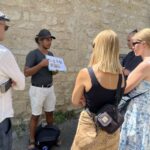
The experience starts at 64 Quai des Chartrons, a smart choice because you’re right where the wine trade energy still feels close. Your guide will be holding a turquoise umbrella, so you can find the group quickly even if Bordeaux crowds are doing their thing nearby.
From the first moments, the tone is practical. This tour isn’t about memorizing wine facts for an exam. It’s about learning how wine gets interpreted—by trained professionals, and by you—using what’s on the label, plus what shows up in a glass.
The timing is also realistic: you’ll spend time walking, sight-seeing, and then sit down for the tasting. With a 2-hour total duration, it fits well if you’re staying central and want a high-impact activity without eating half your day.
You can also read our reviews of more food & drink experiences in Bordeaux
Chartrons: The 300-Year Wine Merchants Quarter You Can Walk Through
The heart of the walk is Chartrons, tied to wine merchants arriving in Bordeaux about 300 years ago. You’ll get about an hour of walking through the neighborhood and along the riverside, with views over Bordeaux that help the whole story make sense.
Why this matters: wine isn’t only grapes and barrels. It’s logistics, commerce, and geography. When you connect the wine to the place where it was bought and moved, labels and classifications stop feeling like random terms.
At this stage, you’ll also start picking up the “language” of Bordeaux wine. You’re not just looking at buildings—you’re learning how to connect grape varieties, appellations, and classification to what you taste later. That’s the trick that makes the tasting feel like a lesson, not a gamble.
Église Saint-Louis des Chartrons: A Photo Stop With Story, Not a Ticket
One of the quick stops is Église Saint-Louis des Chartrons. You get a short visit and a photo stop, plus walking time to keep the flow moving.
It’s worth keeping expectations aligned. This is not a deep church tour where you linger inside. The emphasis is on framing the neighborhood and its character while you’re already walking through the area.
Since you won’t enter monuments during the tour, this works best if you’re happy learning from explanations and outside views. If you want interior time, you may prefer pairing this with a separate museum visit on another day.
CAPC Museum Area: Contemporary Art Nearby, Wine Culture First
You also pass the CAPC Museum of Contemporary Art of Bordeaux. There’s sightseeing time here, but again: the point is not a full museum break. Think of it as a contrast checkpoint—modern culture showing up in the same broader city fabric where older trade and wine systems shaped the region.
This stop helps you shift gears mentally. You’re learning wine history, but you’re doing it in a living city. Bordeaux doesn’t treat wine as a dead artifact; it’s part of what people build around today.
If your brain likes themes, this helps: your wine lesson sits inside a walk that also demonstrates how Bordeaux evolves.
Pont de Pierre: Where the River Feels Like Part of the Wine Story
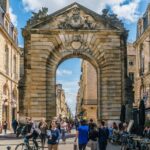
Then you’re at Pont de Pierre, a classic Bordeaux crossing that gives you that “oh right, this city moves goods” feeling. The river and bridges are more than scenery here. They reinforce why the wine economy clustered along the water.
Even though you’re not going into anything major here, it’s the kind of viewpoint that makes later topics easier. When you learn about appellations and classification, you’re essentially learning a structured system for something that once had to travel, trade, and get identified reliably.
For practical travelers: wear comfortable shoes. The walking time adds up over the 2 hours, and Bordeaux sidewalks can be uneven in small stretches.
You can also read our reviews of more historical tours in Bordeaux
Cité du Vin From the Outside: The Big Wine Message, Without the Cost
You’ll also see the Cité du Vin area. You get sightseeing time and a 15-minute block, but you’re still in “look and learn” mode rather than paying for entry.
This stop can be useful even if you’re not touring it: it gives a visual sense of how Bordeaux sells the idea of wine as culture. It’s a reminder that the labeling systems and tasting vocabulary you’ll practice are part of a much bigger story—how Bordeaux explains wine to the world.
I like having this in the middle of the experience because it makes the tasting feel less random. You’re not just tasting; you’re stepping into the culture that surrounds the glass.
How the Guide Makes Wine Labels Make Sense (French, Not Mystic)
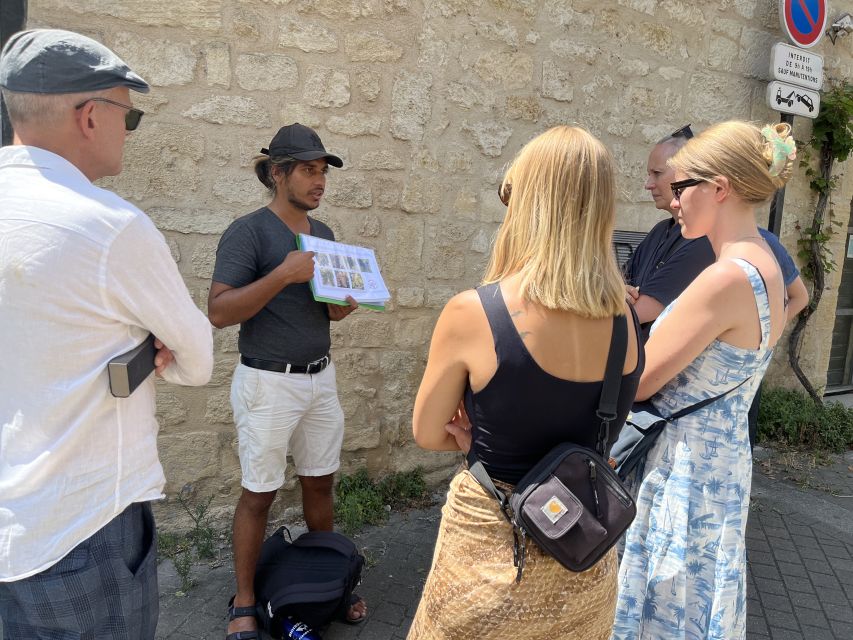
One of the most valuable parts of this tour is the focus on understanding French wine labeling. French bottles can look like code: multiple terms, different labeling formats, and classification language that feels inconsistent if you haven’t been trained to read it.
Here’s what you can expect to practice:
- recognizing grape varieties and how they hint at style
- reading the label of a French wine bottle in a more logical way
- understanding classification as a key part of Bordeaux’s structure
- learning why bottles are commonly 75 cl (instead of guessing or shrugging)
Why this matters for you: once you can read a label without panic, you stop relying on someone else’s taste. You can walk into a shop, interpret what you see, and buy with confidence—even on a budget.
And because the tour is anchored in a neighborhood walk, the label lesson feels connected to the real region, not just classroom theory.
The Blind Tasting: Where Skills Beat Opinions
The final act is the most fun: a blind tasting of 4 Bordeaux Appellation wines, paired with 3 French cheeses, in a local wine bar.
Blind tasting can sound intimidating, but the method is the point. You’ll learn how a sommelier can decode wines without relying on branding or expectations. That trains your senses to notice patterns: acidity, balance, and how the wine’s character shows up before you ever know the name.
The cheese pairing is also more than a snack. It helps you understand how taste interacts with texture and saltiness. When you match a wine to cheese, your brain learns what the wine is doing in a bigger food context.
Based on past guides mentioned for this experience—people like Adrián, Caz, and Clemence—the instruction tends to be clear and friendly. The emphasis stays on learning, not judging. You’ll leave with a better sense of how to describe what you taste, which is the real takeaway for anyone trying to order confidently later.
Price and Value: What $76 Really Buys You
At $76 per person for 2 hours, this is not a bargain in the way a free walk is. But it’s also not a pricey “do nothing” tour. You’re paying for three things that add up quickly:
- an expert wine guide/sommelier approach
- 4 glasses of Bordeaux organic wine (1 white, 2 reds, 1 sweet)
- pairing with 3 French cheeses, not just wine samples
If you’ve ever bought wine and cheese in Bordeaux without a plan, the cost can jump fast. Here, the tasting is structured around learning: blind testing skills, label reading basics, and regional memory-building. That turns the price into “paid practice.”
Who This Tour Fits Best (And Who Should Skip It)
This works best if you want a first jump into Bordeaux wine and you prefer hands-on learning. If you enjoy walking, sightseeing from the outside, and then sitting down for a focused tasting, you’ll probably love the format.
It’s also great for couples and solo travelers because the group experience is structured but not overly formal. You get guided explanation, then you get a tasting environment where you can actually connect the dots.
I’d skip it if you’re booking with kids under 18 or if pregnancy makes a longer walk uncomfortable—this experience isn’t suitable for those situations. Also skip it if your ideal tour includes lots of interior monument time. Here, you’ll be learning mainly from views and stories, not entry tickets.
Should You Book This Bordeaux Wine History Tour?
Yes—if you want a compact, high-value way to understand Bordeaux wine beyond the tourist basics. The combination of Chartrons walking and a blind tasting with cheese pairings is a smart pairing. You get to practice the skill (reading labels, remembering village names, tasting without bias) while seeing the city that shaped the wine trade.
Book it especially if you feel stuck when looking at French bottles. The guide’s focus on decoding labels and explaining classification helps you stop guessing. And if you’ve been curious about Bordeaux wine but intimidated by the terminology, this tour gives you tools you can actually use later.
FAQ
How long is the tour?
It lasts 2 hours.
Where does the tour start and how do I find the guide?
The meeting point is 64 Quai des Chartrons. Your guide will be holding a turquoise umbrella.
What languages are offered?
The live tour guide speaks English and Spanish.
What’s included in the tasting?
You’ll get 4 glasses of Bordeaux organic wines (1 white, 2 reds, and 1 sweet) paired with 3 French cheeses.
Will you enter monuments during the walk?
No. You will not enter monuments, and some landmarks are only seen from a distance.
Is the tour suitable for children or pregnant people?
No. It is not suitable for children under 18, and it is not suitable for pregnant women.
Is it wheelchair accessible, and is cancellation possible?
Yes, it is wheelchair accessible. Cancellation is free up to 24 hours in advance for a full refund.