REVIEW · OLBIA
Olbia : Tuk-Tuk Tour – Ancient Treasures of Sardinia + pickup
Book on Viator →Operated by Ape Romantic Tour · Bookable on Viator
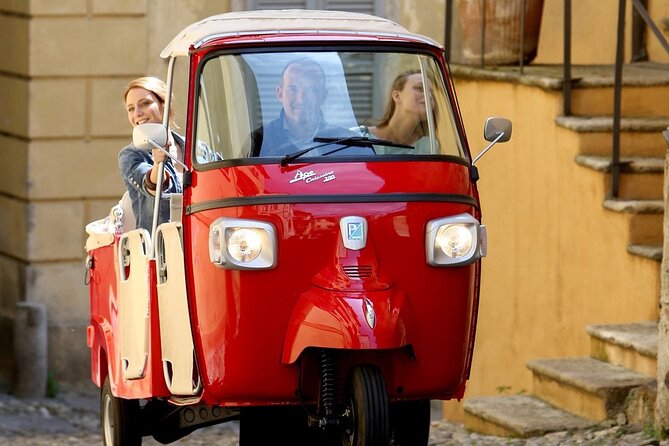
Tuk-tuk turns Olbia’s ruins into a movie. This private 2.5-hour ride hits several headline sites in and around town, with clear audio speakers so you get context while you move. The pacing is smart: you’re not stuck bouncing between distant bus stops, and you still get short, purposeful looks at places that shaped Sardinia over thousands of years.
Two things I really like are (1) the mix of periods—Nuragic, Roman, and medieval—so you see the long storyline, not just one era, and (2) the hands-on feeling of a tuk-tuk route that keeps you close to the action. The one drawback to think about: not every site’s entry is included, and the tour also includes a church, park, and city-center time that may feel less archaeological if that’s all you want.
In This Review
- Key highlights worth knowing up front
- Tuk-tuk in Olbia: why this route format works
- Getting to the start at Smeralda 360 (port or hotel)
- Stop 1: Basilica of San Simplicio and the Diocese Museum system
- Stop 2: Pozzo Sacro Sa Testa—Nuragic water worship
- Stop 3: Acquedotto Romano—the Roman aqueduct still legible
- Stop 4: Tomba dei Giganti Su Monte ’e S’Abe and the bull-headed theme
- Stop 5: Castello di Pedres—Pisan-Aragonese to Visconti-era context
- The extra stops that shape the full Olbia story
- Audio guidance: how to use it for better memories
- Price and value: $180.21 per person for a tight historical loop
- What could disappoint you (and how to avoid it)
- Who should book this Olbia tuk-tuk tour?
- Should you book it?
- FAQ
- How long is the Olbia tuk-tuk tour?
- Is this tour private?
- Does the tour include pickup from the port or hotels?
- Is the tour available in English?
- Are admission tickets included for the sites?
- Do I need a cardigan for church visits?
- Is bottled water provided?
- What happens if weather is bad?
- When can I cancel for a full refund?
Key highlights worth knowing up front
- Audio system with speakers designed for listening on the ride, not just standing still
- Private group experience with your own route pacing and no sharing with strangers
- Roman aqueduct + Nuragic sacred well in one smooth loop around Olbia and nearby areas
- Bull-headed Tomba dei Giganti stop that fits perfectly into a short visit
- Castello di Pedres with a longer 25-minute block for photos and viewpoint time
- Fausto Noce Park and a historic-street stroll to balance the heavy archaeology stops
Tuk-tuk in Olbia: why this route format works
Olbia is a good place to visit by foot and scooter, but it’s not always the easiest place to visit by public transport if your goal is archaeology. The big wins of a tuk-tuk tour are (1) you cut out the “time tax” of getting between sites and (2) you get to see Olbia’s spread—old town, monumental sites, and the greener edges—without needing to plan multiple local transfers.
In a compact 2 hours 30 minutes, you can cover a lot of ground and still have moments where the stonework actually sinks in. That’s the feel I’d aim for here: short stops with meaning, then back on the tuk-tuk to connect the dots.
Also, this is a private tour. That matters more than you’d think. It’s easier to ask your guide questions, linger for a photo without holding up a crowd, and pace yourself in heat or shade.
You can also read our reviews of more tours and experiences in Olbia.
Getting to the start at Smeralda 360 (port or hotel)
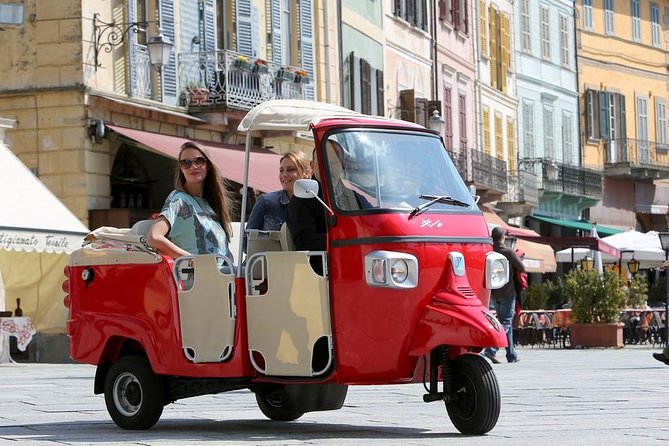
The meeting point is Smeralda 360, Molo Brin 1 in Olbia (07026). If you’re arriving by cruise, you’ll use the free shuttle under the ship to get to the Maritime Station, then head inside and exit the main entrance. A Smeralda 360 representative waits outside with a sign. Arrive about 10 minutes early so you’re not stressed.
If you booked pickup from a hotel or apartment, the vehicle meets you at the main entrance of your place. For some travelers, pickup from the city center is free, while hotel transfers may require an upgrade.
Practical tip: bring whatever you need for quick entry to sites (and don’t plan on shopping for essentials like a cardigan at the last minute).
Stop 1: Basilica of San Simplicio and the Diocese Museum system
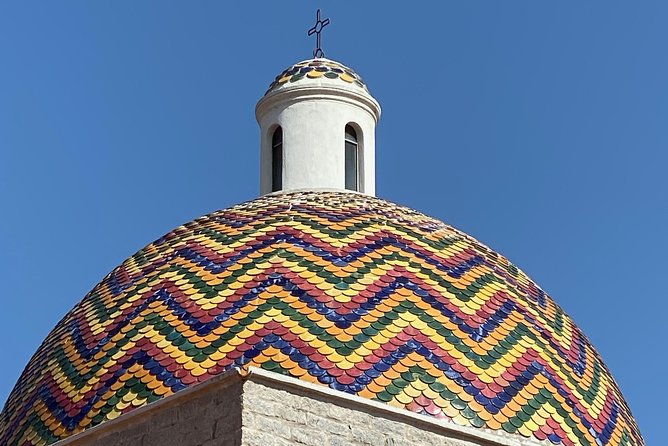
Your first stop is the Diocesan Museum system of the Diocese of Tempio–Ampurias, centered on the Basilica of San Simplicio in Olbia. This is the kind of place that feels important even when you only have 10 minutes: it’s described as the most important and ancient religious monument in northeastern Sardinia.
Here’s what makes it interesting beyond the name.
- It’s tied to St. Simplicio, described as a protobishop of the city and a martyr under Emperor Diocletian.
- The building’s religious role shifts over time: cathedral until 1839, then parish church since 1955, and later named a minor basilica in 1993 by Pope John Paul II.
- The tour also connects with the necropolis located under the Basilica of San Simplicio, so you’re not just looking at a church façade—you’re being pointed toward a deeper layer beneath.
What to watch for: this stop is admission ticket not included and it’s a church setting. If you plan to go inside, you’ll want to be ready for typical church expectations. A cardigan is noted as not included, so plan to bring one if you think you’ll need it.
The time here is short (about 10 minutes), so treat it like orientation: get your bearings, then let the audio narration set up what you’ll see next.
Stop 2: Pozzo Sacro Sa Testa—Nuragic water worship
Next comes Pozzo Sacro Sa Testa, a sacred well tied to the Nuragic civilization in Gallura. This is one of those monuments where the purpose is bigger than the stones. The focus here is ritual water worship—people gathered at a water source with religious meaning.
The tour gives you around 15 minutes, and the entry ticket is included. That’s good value, because it’s exactly the type of site where a little explanation makes a big difference. Without context, a well can feel like… a well. With context, it becomes a window into how ancient communities understood survival, water, and ceremony.
Practical note: for a quick stop, you’ll want to arrive with an eye for details—shapes, craftsmanship, and how the site is arranged for ritual use. If you’re the type who likes to connect what you see to what people needed to live, this is a strong stop.
Stop 3: Acquedotto Romano—the Roman aqueduct still legible
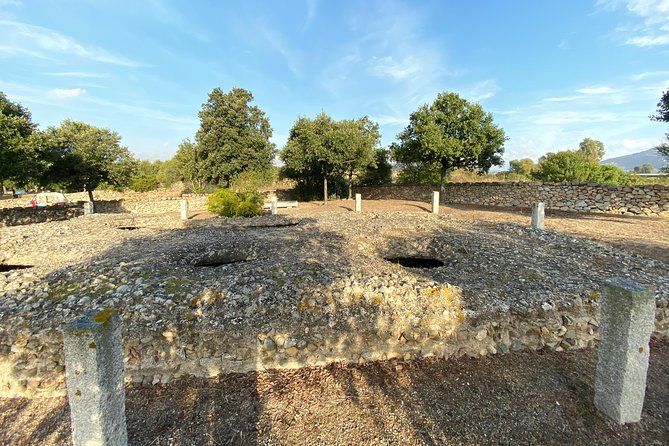
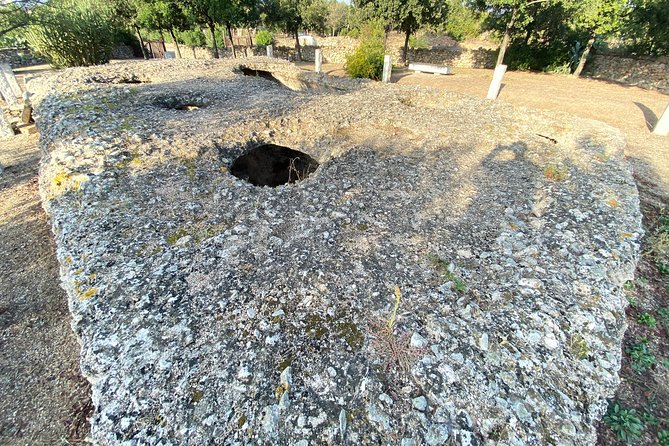
After the Nuragic ritual well, the tour shifts to Roman engineering at the Acquedotto Romano. Built in the 1st to 2nd centuries AD, the aqueduct’s job was to collect water from the springs of Mount Cabu Abas.
What I love about this stop is that you’re not guessing. The description emphasizes features you can actually spot:
- a settling tank carved into stone
- ventilation through six holes
- smaller tanks on the sides
- and visible channels on the arches for water transport
Also, it’s presented as the best preserved Roman archaeological site in Sardinia, which explains why it’s such a frequent headline on short itineraries.
Time-wise you get about 15 minutes, and entry is included. This is a good place to slow down for a minute and let your brain translate function into design. Romans did practical work, but they also built it to last and to be read by anyone maintaining the system.
Stop 4: Tomba dei Giganti Su Monte ’e S’Abe and the bull-headed theme
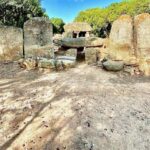
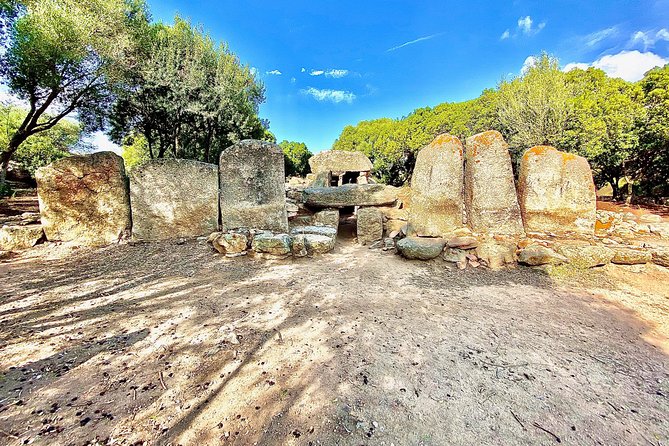
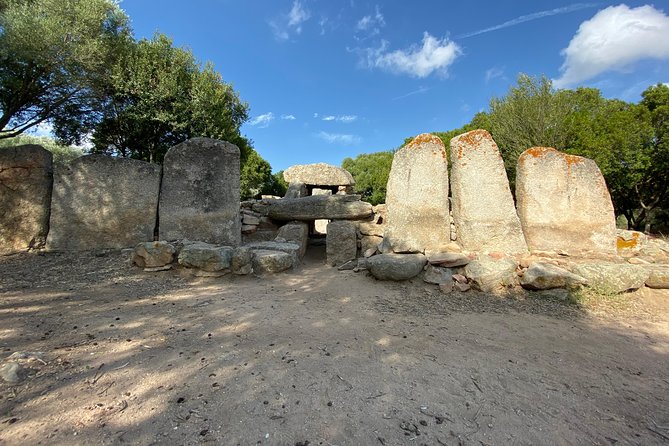
Then you’re at Tomba dei Giganti Su Monte ’e S’Abe, a prehistoric monument that’s described as over 4,000 years old. The design evokes the head of a bull, connected to a Nuragic deity.
Even in just 10 minutes, this stop can land because it’s specific. You’re not viewing an abstract ruin—you’re seeing a form meant to represent power, symbolism, and belief. The word “giants” is part of how these tombs get commonly labeled; what matters for your visit is the architecture and what the shapes were meant to communicate.
Admission is included here as well. With so many included entries across the day, this is a spot where you get more than just photos: you get actual access.
Stop 5: Castello di Pedres—Pisan-Aragonese to Visconti-era context
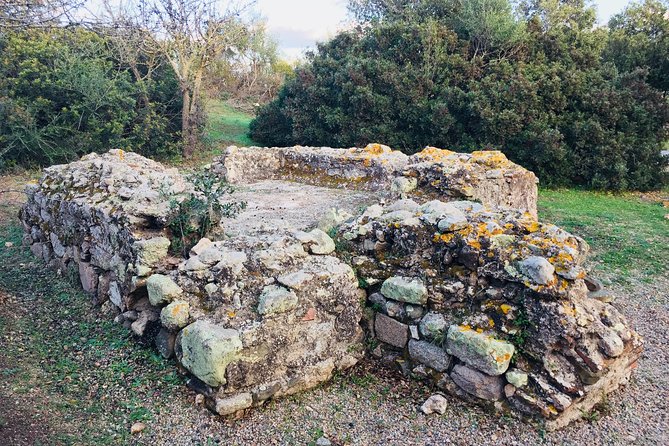
Your longest single stop is Castello di Pedres, with about 25 minutes. The castle sits on a fortress at 89 meters, and the location is tied to the southern part of the Olbia basin—meaning you’re not only seeing the stones, you’re also getting a sense of control over the surrounding area.
The origin details matter for understanding why this place existed:
- it dates back to 1296 and 1322
- during the period of Pisan-Aragonese domination
- in the era connected to the rise of the Visconti family
In other words, this isn’t just a viewpoint. It’s a snapshot of shifting power. If you enjoy history that connects to geography, this stop is one of the best uses of your time.
Entry is included. That helps justify the overall price, because you’re paying for time plus paid access at multiple key sites.
The extra stops that shape the full Olbia story
Beyond the five main monuments, the tour typically adds several “between-the-big-sites” moments:
- the necropolis under the Basilica of San Simplicio
- an Archaeological Museum
- the main street of the historic city centre
- and a break at Fausto Noce Park, described as Olbia’s green space
Fausto Noce Park is highlighted as 18 hectares of greenery and noted as the second best green project in Italy (2005). Even if you’re not a park person, this is a smart inclusion when you’re doing archaeology in a short window. It gives you shade and a reset, and it also reminds you that Olbia is alive now, not just preserved stone.
One caution: if your goal is strictly “ruins only,” you may feel mixed about the church and park portions. The tour’s value is in the full storyline—religion, engineering, burial rituals, medieval power, and the everyday city around them.
Audio guidance: how to use it for better memories
The tour includes a clear audio system with speakers aimed at optimal listening. That’s more useful than it sounds, especially on a tuk-tuk where you’d otherwise hear only traffic and wind.
Here’s how I’d work it:
- Listen while moving between stops so you arrive with names and concepts ready.
- If you’re the photo-taking type, pause your camera long enough to catch a key detail, then shoot right after.
- Treat the audio as your “mental map.” The stones can blur together when you’re visiting multiple eras in one go.
In one positive experience, the audio information and the combination of fun riding plus explanations were praised as what made the monuments feel more connected. In other words, the audio isn’t filler—it’s part of how the tour stays coherent.
Price and value: $180.21 per person for a tight historical loop
At $180.21 per person for about 2 hours 30 minutes, this isn’t a budget activity. But value here comes from three places:
- Private transport
You’re paying for a tuk-tuk with a Pro Driver and the ability to cover multiple sites without building your own route. If you don’t want to rent a car or manage taxis across several archaeological stops, this can work out as the simpler option.
- Paid admissions included at several key monuments
Entry is included for Pozzo Sacro Sa Testa, Acquedotto Romano, Tomba dei Giganti Su Monte ’e S’Abe, and Castello di Pedres. The Basilica/Diocese Museum stop is listed as ticket not included, so you should be ready for that one cost.
- Time efficiency
When you have limited time in Olbia—like a port day—this kind of structure is hard to replicate cheaply without some planning overhead.
A fair way to judge value is to compare it to the cost and hassle of getting to and between those sites on your own. One sentiment that matches this logic: it’s expensive if you’re trying to do it without a car, because the sites aren’t all in one tight cluster that’s effortless by public transport.
Also note: the tour is offered in English, and it’s booked fairly far in advance on average (about 82 days). That’s another hint this is a popular way to do Olbia quickly.
What could disappoint you (and how to avoid it)
This tour has a strong reputation for fun + learning, but I’d flag a few points to keep your expectations aligned.
- Water is not included. If you’re going in warm weather, plan to bring your own or buy nearby when you can.
- Not every stop is strictly archaeological. The route may include a church and a park. If you want only tombs and ruins, you might want a different itinerary style.
- Some explanations may come through audio rather than full live narration. The tour is offered in English and has an audio system with speakers, but the exact balance between live guiding and audio can matter to you. If you’re picky about interactive guiding, keep that in mind.
And one more practical note: if you’re sensitive to indoor church rules, remember that a cardigan is not included.
Who should book this Olbia tuk-tuk tour?
This is a great fit if you:
- want a 2.5-hour overview that moves through major periods (Nuragic → Roman → medieval)
- prefer private transport over figuring out independent connections
- like learning through audio plus short site visits, not long museum marathons
- have limited time and want to see a lot without renting a car
It may be less ideal if you:
- want long stays at only one or two sites
- dislike tours that include parks or city-center walking
- expect bottled water to be provided (it isn’t)
Should you book it?
If you’re trying to make the most of a short Olbia window, I think this is a solid choice. The combination of included entry tickets at several headline monuments, audio guidance, and the tuk-tuk format makes it unusually efficient for a history-heavy day.
My decision rule: book it if you want a fast, organized way to connect eras and don’t want transport headaches. Skip or compare if you need long time in one place, or if you only want ruins and nothing else. Bring a layer for churches, and plan for water yourself.
FAQ
How long is the Olbia tuk-tuk tour?
It’s approximately 2 hours 30 minutes.
Is this tour private?
Yes. It’s a private tour/activity, so only your group participates.
Does the tour include pickup from the port or hotels?
Pickup details depend on where you’re staying. There’s free pickup from the city center, and there’s also pickup from hotels or apartments (hotel transfer may require a surcharge). For cruise passengers, you’ll use the free shuttle bus to the Maritime Station and meet a representative at the Smeralda 360 sign.
Is the tour available in English?
Yes. It’s offered in English.
Are admission tickets included for the sites?
Some are included and some are not. Admission is included for Pozzo Sacro Sa Testa, Acquedotto Romano, Tomba dei Giganti Su Monte ’e S’Abe, and Castello di Pedres. Admission is listed as not included for the Basilica/Diocesan Museum stop at San Simplicio.
Do I need a cardigan for church visits?
A cardigan is listed as not included, so if you think you’ll need one for church entry, bring a light layer.
Is bottled water provided?
No. Bottled water is not included.
What happens if weather is bad?
The experience requires good weather. If it’s canceled due to poor weather, you’ll be offered a different date or a full refund. It may also depend on a minimum number of travelers.
When can I cancel for a full refund?
You can cancel for a full refund if you cancel at least 24 hours before the experience’s start time.