REVIEW · BEIRUT
Guided Half-Day Private Beirut Historical Tour
Book on Viator →Operated by Lebanon Tours & travels · Bookable on Viator
Beirut’s history hits fast and close. This private half-day tour is a smart way to see major downtown landmarks with front-door pickup and a private guide handling the context. You get a clear overview of Lebanon’s cultural crossroads without spending your whole day figuring out routes.
What I really like is the mix: archaeology at the National Museum of Beirut, then quick but meaningful stops through centuries of faith, power, and conflict. A second thing I love is the pace for a short visit—five hours (approx.) with comfortable transport and plenty of photo-and-walk time, so you still have the rest of the day for your own plans.
One possible drawback: the National Museum ticket isn’t included, and lunch is not part of the tour. If you’re hungry or museum time runs long for you, that can shift the rest of the day—so it helps to plan food before or after.
In This Review
- Key highlights worth centering your day around
- A 5-hour Beirut history hit that actually fits a schedule
- Hotel pickup and air-conditioned comfort in downtown Beirut
- National Museum of Beirut: your context engine (ticket not included)
- Roman Baths in downtown: ancient engineering with a modern use
- Martyr’s Square: where names carry war and memory
- Mohammad Al-Amin Mosque (the Blue Mosque) and its striking skyline
- Al-Omari Grand Mosque: layers from Omar to Mamluks to today
- Greek Orthodox Cathedral of Saint George: one of the oldest churches in the city
- Place de l’Etoile: the Rolex clock, parliament buildings, and downtown symbolism
- Beirut Souks: shopping and city energy without the planning headache
- Zaitunay Bay and the Corniche: waterfront time with big-name views
- Raouche’s Pigeon Rocks: the classic stop at Beirut’s edge
- The abandoned Holiday Inn: a war landmark you shouldn’t rush
- How the itinerary timing really feels in practice
- Price and value: $75 per person for a lot of guided ground
- Who should book this tour?
- Should you book the Guided Half-Day Private Beirut Historical Tour?
- FAQ
- FAQ
- How long is the Guided Half-Day Private Beirut Historical Tour?
- Is this tour private?
- Do I get hotel pickup and drop-off?
- What transportation do we use?
- Is lunch included?
- Are entrance tickets included?
- What are the main stops on the tour?
- Is there a mobile ticket?
- Can most travelers participate?
- What is the cancellation policy?
Key highlights worth centering your day around
- Front-door hotel pickup and drop-off keeps your time focused on sights, not logistics.
- National Museum of Beirut (2 hours) gives you the context that most quick city walks miss.
- Roman Baths plus multiple free downtown stops means you can sample big-ticket sights without extra ticket costs.
- Faiths in one tight loop: Mohammad Al-Amin Mosque, Al-Omari Mosque, and the Greek Orthodox Cathedral of Saint George.
- Rolex-clock architecture and shopping energy at Place de l’Etoile and Beirut Souks.
- The abandoned Holiday Inn as a war landmark adds a sobering chapter to the skyline.
A 5-hour Beirut history hit that actually fits a schedule
This is built for travelers who don’t want to spend a half day bargaining with traffic, parking, or confusing turns. With private transportation and dedicated guiding, the tour stays in control: you’re moving between key sights with less friction, and you’re getting the story behind what you’re seeing as you go.
The format works especially well if Beirut is part of a multi-stop trip. You’ll cover a lot of ground—souks, mosques, an Orthodox cathedral, seafront viewpoints—then you’re done while there’s still time to explore at your own speed.
And it’s private, so it’s your group only. That matters here because downtown Beirut has a lot to interpret, and having a guide manage the order and explanations saves you time and confusion.
You can also read our reviews of more guided tours in Beirut

Hotel pickup and air-conditioned comfort in downtown Beirut
The best part of a short guided tour is that it protects your attention. You’re picked up and dropped off at your hotel, and you travel by comfortable private vehicle with air conditioning.
That may not sound glamorous, but it’s practical value. Beirut can be intense on foot if you’re bouncing between stops, and weather can be unpredictable. Staying in an A/C vehicle for the longer stretches helps you arrive at the landmarks more alert and ready to listen.
Also, private means your timing is more flexible than big-group tours. You’re not stuck waiting for slow walkers or forced into a rigid herd rhythm, which keeps the experience more enjoyable.
National Museum of Beirut: your context engine (ticket not included)
The day starts with the National Museum of Beirut, Lebanon’s main archaeology museum. It’s a strong first stop because it gives you a broad overview of Lebanon’s history and the civilizations that shaped this cultural crossroads.
You’ll have about 2 hours here, and the key detail for planning is that admission ticket is not included. If you’re trying to control total costs, budget for that extra ticket day-of.
Inside, the museum draws from significant excavations across the country. The value isn’t just seeing artifacts—it’s understanding why Beirut and Lebanon feel layered. Once you’ve seen that big picture, the later stops make more sense: Roman-era remnants, medieval religious history, and the modern city all connect to earlier chapters.
Roman Baths in downtown: ancient engineering with a modern use
Next you’ll see the Roman Berytus Baths, described as the largest outdoor sight located in downtown Beirut. These baths were discovered in 1968–1969 and later underwent major renovation in the mid 1990s.
Here’s what makes this stop more than a quick glance: Roman Berytus had four major bath complexes. The first was created in the early first century under Augustus, and then everything was destroyed by the terrible Berytus earthquake in 551 AD. That story of construction, disaster, and later revival gives the ruins extra weight.
You’ll also notice how the site is used today. One of the baths serves as an artistic performance and concert space. Even if you just catch it as a photo stop, it’s a useful reminder that history isn’t locked behind fences—it can have a current life.
The stop is short—about 15 minutes—and admission is free, so you get a lot of payoff without feeling rushed.
Martyr’s Square: where names carry war and memory
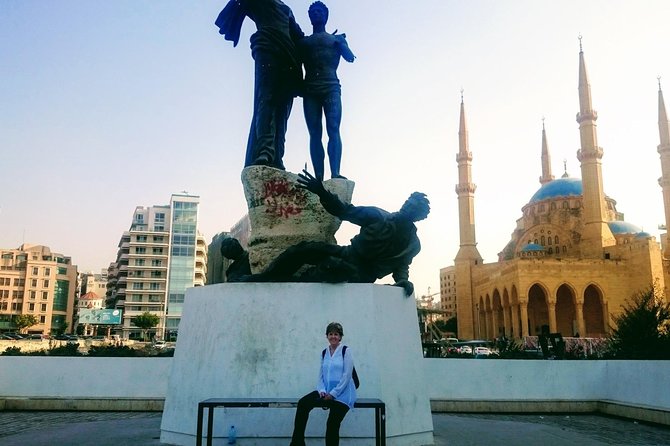
Martyr’s Square is a central downtown square with deep historical meaning. It has been known historically as Al Burj and Place des Cannons, and it’s named for the executions carried out on 6 May 1916 by the Ottomans of Lebanese nationalists during World War I.
That date and the name behind it matter because the square isn’t just a place to take pictures. It’s also a place where history is physically present in the naming. A guide’s context helps you notice details you might otherwise skip, like why this square became such a focal point in the city’s political story.
Time here is about 15 minutes, and entry is free. You’ll move on quickly, but you’ll leave with a clearer sense of the city’s modern downtown gravity.
Mohammad Al-Amin Mosque (the Blue Mosque) and its striking skyline
Then the tour heads to Mohammad Al-Amin Mosque, also called the Blue Mosque. It’s the biggest mosque in Lebanon, and it sits near Martyr’s Square in downtown Beirut.
This mosque is newer than many visitors expect: it opened in 2008 and has four minarets, each standing 65 meters high. The color is part of the visual identity too—its amber tone sets a warm contrast against the surrounding streets.
Architecturally, it has multiple domes. The domes are made from light blue tiles, and there are multiple arches that stretch across multiple stories. Even with a short visit of about 10 minutes, you’ll understand why it’s one of Beirut’s most recognizable landmarks.
Entry is free. The main challenge is simply timing: the stop is short, so it’s worth looking up early to catch the full effect before you’re on the move again.
Al-Omari Grand Mosque: layers from Omar to Mamluks to today
Next is the Al-Omari Grand Mosque, a site with a complicated, layered timeline. It was built in the age of Omar Bin El Khattab in 635 AD. Later, during the crusaders’ period in the 12th century, it was converted to the Church of Saint John.
Then the Mamluks retransformed it into the city’s Grand Mosque in 1291. The building also took damage during the Lebanese Civil War, and refurbishment was completed in 2004.
That sequence is exactly why this tour works: you’re not just seeing a religious building—you’re seeing how power and belief changed hands over centuries, right in the same architectural footprint.
You’ll spend about 10 minutes here, and admission is free. A guide’s explanation is especially helpful on a stop like this because the building’s history is the main story.
Greek Orthodox Cathedral of Saint George: one of the oldest churches in the city
The Greek Orthodox Cathedral of Saint George is one of the oldest church sites in Beirut and in the region. It’s the seat of the Greek Orthodox Metropolitan bishop of the Greek Orthodox Archdiocese of Beirut.
The stop is short—about 10 minutes—but it’s meaningful for context. The information here matters: the first Christian temple at this location goes back to the mid sixth century AD, and it’s closely associated with Beirut’s famous Law School.
That connection helps you see the cathedral not just as a religious site, but as part of Beirut’s intellectual and civic history. Admission is free, so it’s a high-value stop in terms of impact per minute.
Place de l’Etoile: the Rolex clock, parliament buildings, and downtown symbolism
Place de l’Etoile, also called Nejme Square, is the central square in Beirut’s Downtown area. It’s home to the Lebanese Parliament and complementary buildings, plus two cathedrals, a museum, and several cafes and restaurants.
The landmark that most people point out is the 1930 four-faced Rolex clock. It’s a recognizable icon and also a good visual anchor in a city where landmarks can blur together if you’re just moving around randomly.
You’ll have around 15 minutes here, and it’s free. This is a great stop to reset your bearings, look around, and decide what you want to return to later.
Beirut Souks: shopping and city energy without the planning headache
Next up is Beirut Souks, a commercial district in the city center with over 200 shops and 25 restaurants and cafes, plus an entertainment center and a cinema complex. It’s also described as Beirut’s largest and most diverse shopping and leisure area.
The time is about 15 minutes, and entry is free. You’re not here to complete a shopping marathon; you’re here to understand what the souks area feels like. A guide can help point out which lanes and blocks are more interesting for walking later, so your own time doesn’t start from zero.
This stop is also useful for practical travel reasons. Once you know where the souks are, you know where people gather, where you’re likely to find casual meals, and where the city’s rhythm is strongest.
Zaitunay Bay and the Corniche: waterfront time with big-name views
The itinerary then shifts toward the water.
First is Zaytouna Bay, a newer waterfront promenade with shops and restaurants. It’s promoted as Beirut’s finest leisure destination, and it functions like a calm contrast to the downtown intensity.
Time here is about 10 minutes, and it’s free. Even briefly, it gives you a sense of the city’s direction: where people go to relax, spend time, and enjoy sea views.
After that, you’ll reach the Corniche Beirut (Al Manara Corniche), a famous seaside promenade stretching from Ramlet al Bayda to the Saint George marina. It’s lined with palm trees and offers Mediterranean Sea views, including visible references like Pigeon Rock and the Mount Lebanon summits on the eastern side.
You’ll have about 15 minutes there, and it’s also free. This is a helpful part of the tour because it breaks up the dense downtown stops with an easier, more open feeling.
Raouche’s Pigeon Rocks: the classic stop at Beirut’s edge
At the western-most tip of Beirut you’ll see Pigeon Rock (also known as the Rock of Raouché). It’s one of the city’s most iconic natural sights: two huge rock formations rising out of the sea, framed by seaside views.
Time is about 15 minutes, and entry is free. This stop works as a visual payoff: after all the mosques, markets, and ruins, you get a scenic reset.
If you’re short on time, this is exactly the kind of landmark you want on a half-day tour. It’s quick, it’s recognizable, and it makes for great photos without needing a long hike or long waiting.
The abandoned Holiday Inn: a war landmark you shouldn’t rush
The final element in the tour is one of its most sobering moments: an abandoned Holiday Inn hotel that serves as a war landmark.
This Holiday Inn was built between 1971 and 1974 during a period when Beirut’s economy was booming and the city was visited by many tourists from the Middle East. It functioned until the Lebanese Civil War began in 1975.
After that, it became part of a long conflict area known as the Battle of the Hotels, where more than 25,000 combatants fought for control of luxury hotels—including this Holiday Inn and the famous Phoenicia hotel.
Today, the Holiday Inn remains untouched and abandoned for decades, acting as a reminder to Lebanon’s population of the horrors of war. It’s not an entertainment stop. Plan to move through it with a respectful mindset, and pay attention to the story your guide connects to the surrounding city.
How the itinerary timing really feels in practice
The itinerary is designed around a pattern: a few longer stops for meaning, then short stops to keep momentum.
The museum is the long anchor at about 2 hours. The rest are mostly 10–15 minute moments: mosques, cathedral, squares, and waterfront viewpoints. Roman Baths is also 15 minutes. When you add transit time between downtown blocks and the seafront, the overall duration lands around five hours (approx.).
This schedule is great if you want breadth over depth. It’s not meant for slow wandering or long sit-down breaks at each location. If you want that kind of deep exploration, you can use this tour as your starting outline, then return later to the places that hook you most.
Also, because lunch is not included, you’ll want to plan your meal timing so you don’t lose your energy halfway through the afternoon.
Price and value: $75 per person for a lot of guided ground
At $75.00 per person, you’re paying for three things that matter in a city like Beirut: guided storytelling, private transport, and a packed route of major sights in a half-day.
Many of the key stops are free (Roman Baths, Martyr’s Square, both mosques, the cathedral, Place de l’Etoile, Beirut Souks, Zaytouna Bay, Corniche, and Pigeon Rocks). The one clear paid exception in the tour plan is the National Museum of Beirut, where admission isn’t included.
So from a value standpoint, this price is less about paying for lots of tickets and more about paying for convenience and context. You also get group discounts and mobile ticket included, which can be useful if you’re traveling with friends or family.
If you were to taxi around and pay for guide time yourself, the overall cost could quickly creep upward—especially when you’re trying to see this many locations without losing time.
Who should book this tour?
This works best for:
- First-time visitors who want a high-impact overview of Beirut in a single half-day
- Travelers who prefer to avoid planning and want a guide to connect the dots
- People who like variety: archaeology, religion, downtown politics symbolism, and waterfront scenery
- Groups who value private comfort and a customized feel (it’s your group only)
It may not be ideal if you’re seeking a slow, flexible day with long free time in one neighborhood. This tour is designed to cover a lot, so it favors efficiency.
Should you book the Guided Half-Day Private Beirut Historical Tour?
If your goal is to get your bearings fast and understand Beirut’s layers—ancient, medieval, modern, and even the war years—this is a solid pick. The structure is efficient, the mix of sights is smart, and the fact that many stops are free helps you feel like you’re getting more for your time.
I would book it if you have limited time and you want history explained while you’re actually in the right places. I’d think twice only if you know you want long museum time, a full meal break inside the tour window, or a slower pace with lots of wandering.
FAQ
FAQ
How long is the Guided Half-Day Private Beirut Historical Tour?
It runs for about 5 hours (approx.).
Is this tour private?
Yes. It’s a private tour/activity, and only your group participates.
Do I get hotel pickup and drop-off?
Yes. Hotel pickup and drop-off are included.
What transportation do we use?
You travel by a comfortable private air-conditioned vehicle.
Is lunch included?
No, lunch is not included.
Are entrance tickets included?
Admission for the National Museum of Beirut is not included. The Roman Baths and the other listed stops are free according to the tour details.
What are the main stops on the tour?
The route includes the National Museum of Beirut, Roman Baths, Martyr’s Square, Mohammad Al-Amin Mosque, Al-Omari Mosque, the Greek Orthodox Cathedral of Saint George, Place de l’Etoile, Beirut Souks, Zaytouna Bay, Corniche Beirut, Pigeon Rocks, and the abandoned Holiday Inn war landmark.
Is there a mobile ticket?
Yes. The tour includes a mobile ticket.
Can most travelers participate?
The tour states that most travelers can participate.
What is the cancellation policy?
It offers free cancellation. You can cancel up to 24 hours in advance for a full refund, based on the local time of the experience.