REVIEW · MOSTAR
Mostar War Heritage Walking Tour
Book on Viator →Operated by Fortuna Trade Tours Mostar d.o.o. · Bookable on Viator
Mostar is small, but its story hits hard. This war heritage walking tour links the city’s landmarks to what happened here in the 1990s, with a guide who brings it down to human scale. You get a clear route, a short history film, and stops that range from famous architecture to places where the war still shows.
What I love most is the guide-led context—not just dates, but why each site matters. I also like that the walk is practical and efficient: you’re moving between major points without wasting time, and the tour format can be intimate (people describe getting only a small group).
One thing to consider: the tour includes solemn topics and a cemetery/burial-site stop, so if you’re sensitive to war stories, plan your mindset ahead of time and give yourself a little extra time afterward to decompress.
In This Review
- Key Highlights You’ll Feel Quickly
- Entering Mostar’s Story from Spanish Square
- Stari Most: The Old Bridge’s Real Numbers (and Why You’ll Remember Them)
- Liska Park: When a Green Space Becomes a War Marker
- Spanish Square and the Old Gymnasium: One Building, Two Eras
- Kujundziluk (Bazar): Artisan Streets on the Left Bank
- The Customs Bridge and Crooked Bridge: Perfect for Bridge-Lovers
- The Film and the Guide’s Stories: Where the Tour Becomes Personal
- Price, Timing, and How to Plan Your 2–3 Hour Walk
- Should You Book This Mostar War Heritage Walking Tour?
- FAQ
- How long is the Mostar War Heritage Walking Tour?
- Where does the tour start, and what time?
- Is the tour offered in English?
- What’s included in the price?
- Are there any admission tickets included for the stops?
- Can I cancel for a full refund?
- Is this a private tour?
Key Highlights You’ll Feel Quickly
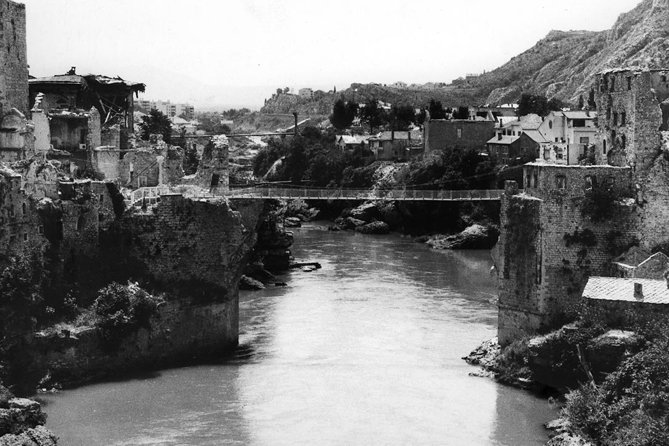
- First stop at Stari Most: real measurements and 16th-century building details you can picture while you walk.
- A sensitive burial-site park: Liska park connects the 1950s to the 1992–1995 war.
- Spanish Square’s UN story: the name is tied to 21 Spanish UNPROFOR troops killed in the last war.
- Kujundziluk craft streets: coppersmiths and tanners explain the old economy on the left bank.
- Carinski Bridge as a quieter crossing: historically important, but not as tourist-frequent as the Old Bridge.
- Crooked Bridge for comparison: a smaller, older prototype-like bridge over the Radobolja River.
Entering Mostar’s Story from Spanish Square
You start at Španski trg (Spanish Square), right by the skate plaza area (8RV4+9QM). That matters because Spanish Square isn’t just another city square. It’s named for a specific tragedy: in 1995, it was dedicated to 21 killed Spanish troops connected to UNPROFOR during the conflict in the 1990s.
From there, the tour builds your bearings fast. You’ll move through the center of Mostar and connect the architecture you see with the conflict that reshaped daily life. It’s not a history lecture that floats above the ground; it’s history with your feet on the street.
You can also read our reviews of more tours and experiences in Mostar.

Stari Most: The Old Bridge’s Real Numbers (and Why You’ll Remember Them)
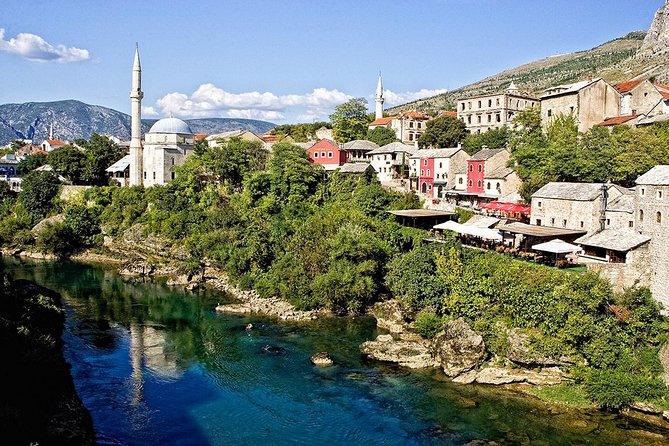
The walk’s headline moment is the Old Bridge (Stari Most). You’ll learn how the bridge area worked long before the current stone arch: there was a wooden crossing when the Turks invaded Mostar, and it hung on chains. The story is vivid for a reason. A bridge isn’t just scenery in Mostar—it’s literally a way to pass, trade, and live together.
Then comes the construction tale that turns the bridge into more than a postcard:
- The new bridge was commissioned after the worn-out wooden crossing became a problem.
- It was designed by Hajrudin, a pupil of Sinan, the famous 16th-century Ottoman architect.
- Completion is tied to July or August 1566.
The guide gives you a few engineering details that stick because they’re concrete while you look up:
- One big stone arch
- Span: 28.70 meters
- Width: 4.49 meters
- Height from summer water level: 21 meters
- Built from square stones, connected with iron hooks and cast in lead
This stop also sets the theme for the rest of the tour. The old town’s forts, towers, and gates grew around the bridge, creating an architectural whole rather than random landmarks.
A practical note: the Old Bridge area is where you’ll do most of your walking “around the viewpoint.” Wear shoes that work on uneven stone, and if it’s hot, bring water for the climb and pauses.
Liska Park: When a Green Space Becomes a War Marker
After the bridge, you’ll head to Mezarje / Groblje Liska park, a historic green space established in 1954. The war story here is stark and personal: during 1992–1995, the park became a burial site for civilians and soldiers of various nationalities because other cemetery space was lacking.
This is one of those stops where the timing (it’s short) doesn’t matter as much as your attitude. The goal isn’t to rush through. You’ll likely be quiet without being told to be, because the setting asks for it. If you’re the kind of traveler who gets uncomfortable with heavy scenes, you can still handle this stop by taking it slowly and remembering that the war didn’t just happen in headlines—it happened to families.
Also, since this is a sensitive site, it’s worth keeping your phone use respectful and brief.
Spanish Square and the Old Gymnasium: One Building, Two Eras
Back toward the center, the tour moves you through Spanish Square and the dominating building: Stara Gimnazija (Old Gymnasium).
Here’s what makes it more than a pretty facade:
- Construction finished in 1902
- It became one of the oldest schools in ex Yugoslavia
- It carried the name of poet Aleksa Šantić for a time
- Architecture is Moorish Revival (also described as Neo-Moorish)
- It’s listed as a national monument
This stop connects education and identity to the conflict. A school isn’t just a place where classes happen; it’s where a society shapes the future. By listening to the way the guide frames what happened after, you’ll understand why the square got its name in 1995 and why the building still matters.
If you like seeing cities through their institutions—who taught people, what languages and symbols lived on walls—this is a strong stop.
Kujundziluk (Bazar): Artisan Streets on the Left Bank
Next, the tour brings you to Bazar Kujundziluk, in the old quarter on the left bank of the Neretva. You’ll learn the name comes from coppersmiths (Kujundžije), and that the area was heavy with crafts beyond metalwork—especially tanners, who were described as masters for processing leather.
Even if you’re not shopping, this is a useful walk. It explains why Mostar’s old town feels like a workshop district rather than a museum corridor. You’ll see small artisan workshops and the kinds of handicrafts that grew out of those historical trades.
Drawback/consideration: this part can be more about wandering through shops than taking in grand monuments. If you prefer purely architectural sights, spend your time here watching how the craft is done (if you can) instead of only looking at product displays.
The Customs Bridge and Crooked Bridge: Perfect for Bridge-Lovers
After the busier center, you get two bridge stops that shift your perspective. They don’t have the fame of Stari Most, but that’s part of their value.
First is the Carinski Bridge (Customs Bridge). It spans the Neretva River, just north of the Old Bridge. You’ll hear that it was originally built during the Austro-Hungarian period and that it served as a vital crossing point linking different parts of the city. This is the kind of detail that makes your “Mostar bridge map” feel more complete.
Then comes the Crooked Bridge (Kriva Ćuprija) over the Radobolja River. You’ll learn it’s thought to be a miniature prototype of the famous Old Bridge, dating to the 16th century, with an arched form that feels familiar even though it’s smaller.
Why I like ending with these comparisons: you start seeing Mostar’s river crossings as a system. Different bridges, different eras, different purposes—yet all connected to how people moved, traded, and rebuilt.
The Film and the Guide’s Stories: Where the Tour Becomes Personal
One of the tour highlights is a short film about Mostar’s history. Even if you only catch it as background while you’re learning facts, it works because it gives you a shared baseline before the walk moves you site to site.
Then there’s the guide—often the main reason people rate this tour so highly. In the feedback I’m drawing from, names like Elma and Serdin come up with strong praise for being friendly, flexible, and knowledgeable. More than that, one guide story stood out: the person talking to the group described having lived through the atrocities of the war as an adolescent, and the conversation carried from those experiences to the city’s reconstruction and beauty.
That personal angle is exactly what turns a list of landmarks into something you understand emotionally. You’re not only learning what happened; you’re learning how it changed real people’s sense of home.
If you do this tour, I’d recommend asking one simple follow-up question after the war-related stops—something like what changed in everyday life, or what rebuilding efforts focused on first. Your guide can often point to specifics based on the narrative they’re sharing.
Price, Timing, and How to Plan Your 2–3 Hour Walk
The price is $47.66 per person, and the timing is about 2–3 hours. For Mostar, that’s a fair amount of time to cover several major points without turning it into a marathon.
Here’s why it feels good value: you’re paying for a professional authorized guide, a route with multiple key sites, and a short film. Most cities can charge this kind of amount for basic sightseeing; this one leans into meaning.
Also, the tour format is private for your group, which often makes the conversation easier—especially when topics get heavy. One other practical plus: it’s offered in English, and you can use a mobile ticket.
What to bring:
- Comfortable shoes (Old Bridge and the surrounding streets can be uneven)
- Water, especially in warmer months
- A mindset for solemn history at the burial-site park
What not to stress about: it’s only a few stops, and the duration keeps you from getting burned out mid-story.
Should You Book This Mostar War Heritage Walking Tour?
Book it if you want Mostar to make sense, not just look impressive. This is ideal when you care about why the city looks the way it does, and when you’re okay with learning the war’s impact through real places—bridge, school square, artisan quarter, and sensitive burial grounds.
Skip it only if you want a purely light, entertainment-style city walk. The tour includes war-linked stories and a cemetery-related stop, so it won’t stay on the surface.
If you’re visiting Mostar for a short time and you’d rather have one guided experience that connects architecture to history, this one is a strong bet.
FAQ
How long is the Mostar War Heritage Walking Tour?
The tour runs about 2 to 3 hours.
Where does the tour start, and what time?
It starts at Spanish Square (Španski trg) near the skate plaza, and the start time listed is 9:00 am.
Is the tour offered in English?
Yes, the tour is offered in English.
What’s included in the price?
The tour includes a professional authorized guide. A mobile ticket is offered as well. Lunch and tips are not included.
Are there any admission tickets included for the stops?
The Old Bridge stop is listed as ticket free, and the other listed stops also show admission ticket free for those points.
Can I cancel for a full refund?
Yes. Free cancellation is available if you cancel up to 24 hours in advance for a full refund.
Is this a private tour?
Yes. It’s listed as private, so only your group participates.
If you want, tell me your travel month and your comfort level with war-related topics, and I’ll suggest a good time of day and what kind of pace to aim for around the rest of your Mostar plans.