Herculaneum feels like a time capsule. This UNESCO site shows daily Roman life after Vesuvius buried it in 79 AD, and it’s shockingly intact compared to nearby Pompeii.
What makes it worth your time is the focus on streets, homes, baths, and even the waterfront—so you’re not just looking at stone, you’re tracing how people lived.
I love how the tour is built around entering and reading the city—doors, frescoed rooms, and household details you’d miss alone. I also like the small group size (max 10), which makes it easier to ask questions and stay oriented as the route moves from house to house.
One drawback to plan for: you’ll still need to budget extra for the Herculaneum entrance fee (€16 per person), and the pace is efficient rather than slow and lingering. Also, you’ll be walking on uneven ground and up/down steps, so good shoes matter; if your guide is on the quieter side, standing closer helps.
In This Review
- Key things to know before you go
- Herculaneum in 79 AD: the scale that makes it work
- Price and value: what you pay, and what costs extra
- Meeting at the Herculaneum Ticket Office: timing that affects the day
- The first walk through Parco Acheologico di Ercolano: streets, fresco rooms, and baths
- The ancient beach and Marco Nonius Balbo’s terrace (sea views with context)
- House of Deer, wooden partition rooms, and the Neptune mosaic
- House of Deer (Casa dei Cervi)
- Partem Domus lignea – House of the Wooden Partition
- Casa di Nettuno e Anfitrite
- Samnite House, the decumanus maximus, and how Romans planned streets
- Casa Sannitica (Samnite House)
- The decumanus maximus (main street)
- College of the Augustales and Casa d’Argo: worship and myth on display
- College of the Augustales
- Casa d’Argo
- Salone della Barca di Ercolano: the charred boat that survived
- Small-group guides: why the right talk makes the site click
- Where to grab food nearby (and how to keep your day easy)
- Who this tour is best for
- Should you book Secret Herculaneum?
- FAQ
- What’s included in the tour price?
- How long is the Secret Herculaneum tour?
- Is the tour offered in English?
- Where do I meet, and does it end nearby?
- Is there a group size limit?
- If I need wheelchair access, what should I do?
- What’s the cancellation policy?
Key things to know before you go
- Two hours, max 10 people: tight route, lots of stops, more conversation than a big bus tour.
- Archaeologist-led commentary: explanations that connect buildings to how Romans actually lived.
- You’ll see houses up close: fresco colors, room layouts, mosaics, and household features.
- Vesuvius details are part of the story: the eruption isn’t just background—it shapes what’s preserved.
- The boat pavilion is unforgettable: a charred boat preserved from the shoreline excavations.
- Compact site, but still steps: expect walking, some stairs, and a few longer gazes at carvings and floors.
Herculaneum in 79 AD: the scale that makes it work
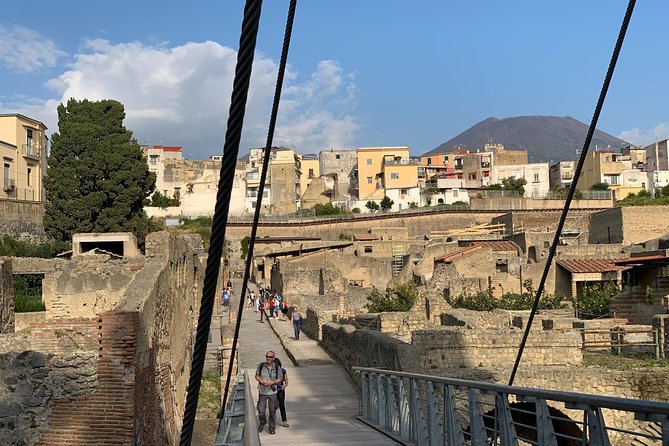
Herculaneum doesn’t feel like a far-off ruin. It feels like a city whose life was interrupted, then carefully preserved. Vesuvius buried it in 79 AD, and that sudden fate helped keep much more of the urban structure visible than you’ll find at many other Roman sites.
Here’s the practical payoff: the site is smaller than Pompeii, so you can actually absorb it in a short visit. That matters because most first-timers arrive with a list of “top sights.” This tour helps you trade that list for a real understanding of daily rhythm—where people ate, worked, bathed, socialized, and spent time along the sea.
And yes, the setting is emotional in a quiet way. You’re walking paved streets with guide context, so the place stops being “columns and walls” and starts being “a home with rooms and routines.”
You can also read our reviews of more tours and experiences in Naples.

Price and value: what you pay, and what costs extra
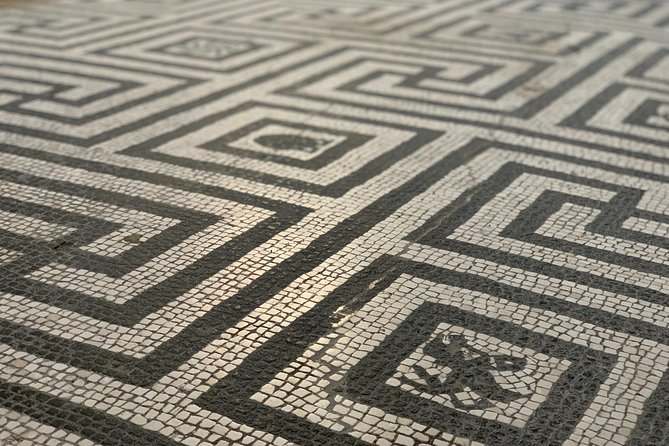
The tour price is $34.84 per person, and it includes a certified guide plus an archaeologist. That’s a meaningful chunk of value because the best part here is interpretation—turning carvings, floor patterns, and room layouts into a story you can picture.
The one extra cost is the archaeological entrance fee: €16 per person. So your total will be tour price plus that entry fee. Still, the math often works out well when you consider you’re getting two hours of guided time in a site where the details matter.
Also, this is a mobile-ticket experience and is offered in English. That’s not just convenience—it reduces stress when you’re dealing with a busy Naples-area visit schedule and want to spend your energy on the ruins, not paperwork.
Meeting at the Herculaneum Ticket Office: timing that affects the day
You meet at the Herculaneum Ticket Office (80056 Ercolano), and the tour ends back there. That keeps things simple: no confusing “meet somewhere random” moment, and you’re not forced into another long walk across the site at the end.
One thing to take seriously: show up on time. There have been cases where late check-ins caused the start to slide for a few people, and with a two-hour tour, that eats into your time fast.
If you’re flexible with your schedule, I’d lean toward later departures when offered. Since Herculaneum is compact, timing can help you avoid the heaviest crowd moments and make the street-by-street walk feel calmer.
The first walk through Parco Acheologico di Ercolano: streets, fresco rooms, and baths
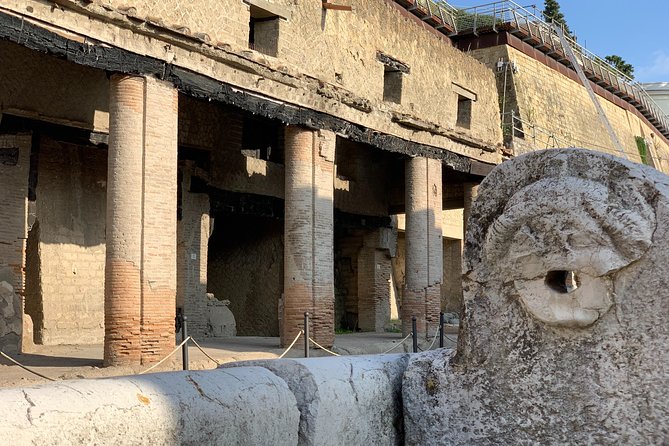
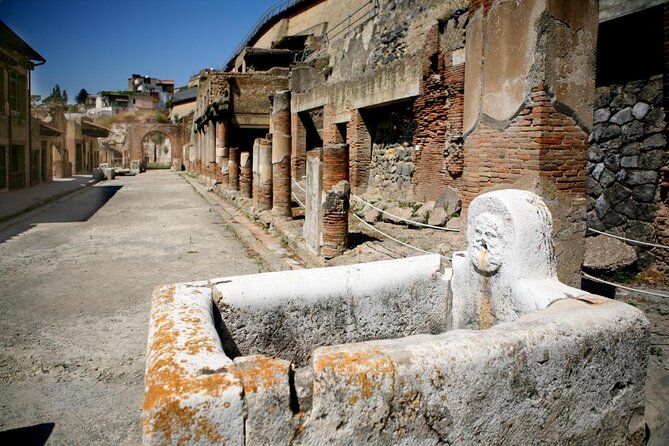
The tour’s opening hits Parco Acheologico di Ercolano, and this is where the whole experience clicks. Your guide leads you down paved streets and into the parts of the city that survived so well you can still read how rooms were arranged.
This stop is built around “look closer” moments:
- You’ll see houses with rooms and doors still visible.
- You’ll get a sense of the layout that suggests daily habits, not just decoration.
- Frescoed surfaces are described in a way that helps you understand what those colors would have meant in real life.
A major highlight is the focus on house-to-house daily function. Think bedrooms and workshops, plus the civic side of routine. The tour also includes the gymnasium and baths, where conversations weren’t only about fitness. People talked about business and politics too. That’s the kind of detail that changes how you read the space.
Practical note: even though the site is manageable, you’ll still move through areas that include stairs. Bring shoes you’d trust on rocky stone, not slick soles. If you have mobility needs, the tour requires wheelchair use must be reported 24 hours before—so plan that early.
The ancient beach and Marco Nonius Balbo’s terrace (sea views with context)
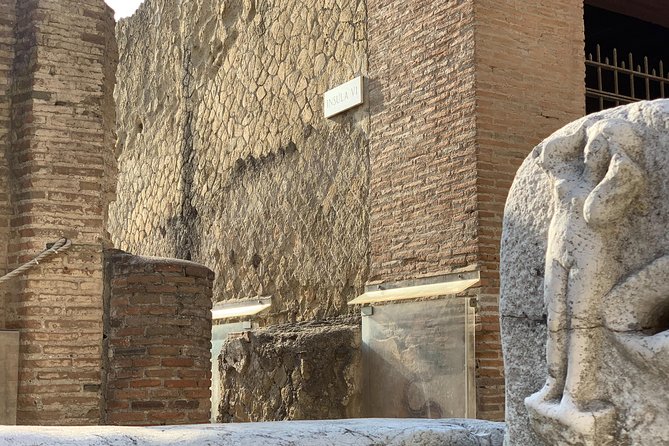
After the street-and-house opening, the route slips toward the city’s relationship with the water.
You’ll hit the ancient beach, the waterfront area of an almost entirely preserved Roman city. This is short—about 10 minutes—but it’s the kind of stop that makes the rest of the tour make more sense. When you understand where the sea is relative to homes and public spaces, the city stops being a diagram and becomes a place.
Next is the terrace of Marco Nonius Balbo. The tour frames it as a way the city honored one of its most prestigious citizens. The important thing isn’t only the view—it’s the idea that status and patronage were built into architecture. You’ll walk away seeing this as an urban statement, not just a scenic spot.


House of Deer, wooden partition rooms, and the Neptune mosaic
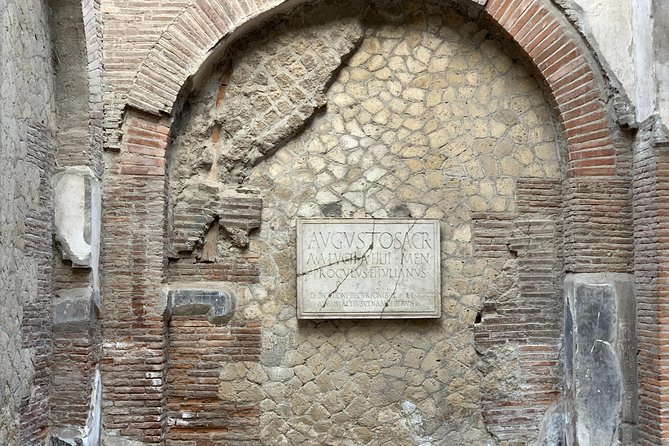
This is where Herculaneum turns into a personal experience. These are not “grand monuments” in the usual sense. They’re residences with identifiable tastes, household habits, and art that didn’t vanish.
House of Deer (Casa dei Cervi)
You’ll see the House of Deer, known for two marble groups showing deer attacked by dogs. The name is literal, and that’s helpful. Even if you’re not a sculpture expert, it gives you a focal point while your guide connects it to wealth, decoration choices, and what kinds of themes mattered to residents.
Partem Domus lignea – House of the Wooden Partition
Then comes the House of the Wooden Partition. The key detail is a folding wooden structure that separated the atrium from the tablinum (the homeowner’s study). This stop is small but important because it shows that “open-plan” wasn’t a modern invention—it was controlled space. Rooms could be defined, separated, or revealed depending on the moment.
This is one of the best “how did Romans use their homes?” stops on the route.
Casa di Nettuno e Anfitrite
Finally, you’ll reach the House of Neptune and Amphitrite for the mosaic featuring Neptune and his companion. Mosaics can feel like decoration until someone explains how they fit into a household’s identity. Here, the guide’s context helps you read the mosaic as part of the home’s message about culture and prosperity.
Samnite House, the decumanus maximus, and how Romans planned streets
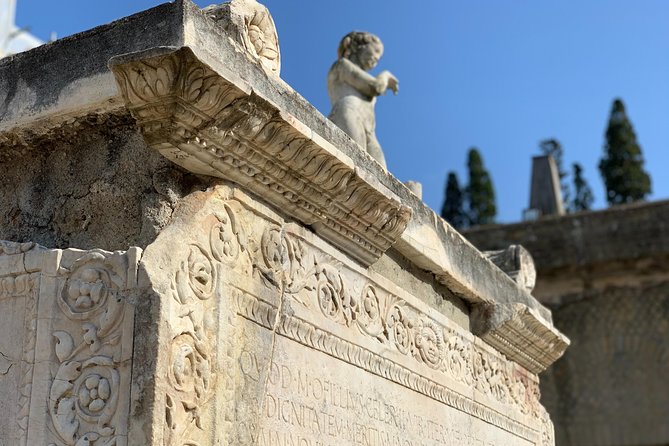
Not every stop is about luxury. The route also includes homes that anchor the timeline.
Casa Sannitica (Samnite House)
The Samnite House is one of the most popular remains because it’s considered among the oldest dwellings on the site. That gives you a sense of continuity: you’re not only seeing the final version of a city. You’re seeing layers of occupation and the way earlier structures connect to later life.
The decumanus maximus (main street)
The route also references the decumanus maximus, the main street of Roman cities, which lined up with prestigious houses. This is a “big city thinking” stop. You’re learning urban planning—where status clustered, and how movement through a city shaped social visibility.
It’s also a useful mental map builder. After this, the tour feels less like a list of rooms and more like a guided walk through a living grid.
College of the Augustales and Casa d’Argo: worship and myth on display
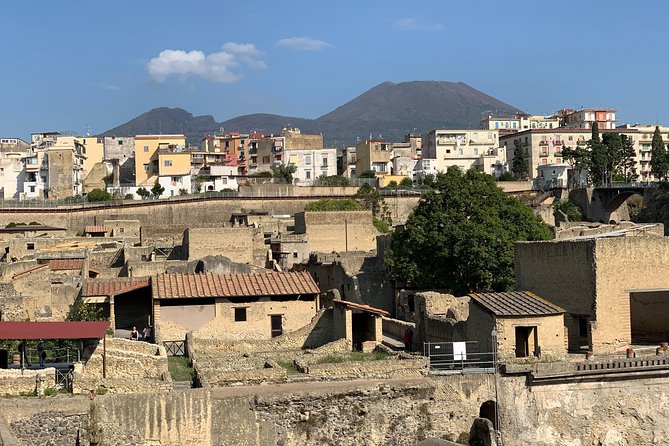
Herculaneum isn’t only about private houses. It also has the public/religious side of Roman culture.
College of the Augustales
At the College of the Augustales, you’ll visit the sacellum used for worship connected to emperors, supported by priests called Augustales. The important idea is how political power and religious ritual overlapped in everyday life. You’ll see how these institutions weren’t separate from the city’s rhythms—they were part of the cultural framework people moved through.
Casa d’Argo
Next is Casa d’Argo, named for a fresco of Argo Panoptes, the giant with a hundred eyes. This stop works because the guide explains why myth matters in domestic art. It’s not just a story image. It becomes a clue to what themes the household valued and how residents displayed identity through art.
If you like symbolism, this is a great stop to slow down for a few minutes and really scan the image details.
Salone della Barca di Ercolano: the charred boat that survived
The tour ends with one of its most moving sights: the Salone della Barca di Ercolano.
This is the boat pavilion, where a charred boat found along the beach during excavations in 1981 is preserved. The guide’s framing makes it more than an artifact behind glass. You start to picture what the shoreline meant to the city and how the eruption’s violence intersected with everyday movement.
This stop is short, but it’s the kind you remember later when you’re back home. It turns “ancient ruin” into “physical evidence of a specific moment,” which is what makes Herculaneum so powerful.
Small-group guides: why the right talk makes the site click
The tour runs with a maximum of 10 travelers, and that changes the vibe. You’re not shouting over noise. You can ask a question about a room layout or why one building type existed, and you’re more likely to get a direct answer.
In past groups led by guides such as Luigi, Ornella, Riccardo, Arcangelo, Raffaele, and Corrado, guests have praised a mix of humor and clarity. What you should take from that: arrive with curiosity, and you’ll get more out of the stops. If your guide goes quiet or speaks softly, try to position yourself where you can hear well—especially during the explanation moments before you move on.
Where to grab food nearby (and how to keep your day easy)
Because the site is compact, you may find you still have energy afterward. One practical tip from the area: there’s a small restaurant across from the park, and it’s a handy option if you want a break without commuting elsewhere. If you’re not hungry, even just walking a bit around Ercolano afterward can help you digest what you saw.
And don’t skip the mindset tool: get your bearings fast. If there’s a map available at the entry kiosk, pick it up. It helps you follow the logic of stops without constantly scanning signage.
Who this tour is best for
This is a great pick if you:
- Want a high-impact Roman experience without a long all-day trek.
- Like houses and everyday details more than huge battle monuments.
- Prefer a guide-led pace where you understand what you’re looking at.
It’s also a strong choice if you’re visiting only once and want your time to count. Herculaneum can be visited independently, but the value here is that you’re guided through the city’s “why,” not just the “what.”
You might want a different format if:
- You want a slow walk with lots of unhurried time in each room.
- You struggle with stairs or uneven stone. (The tour can work for many people, but sturdy shoes and planful pacing matter.)
Should you book Secret Herculaneum?
If you’re torn between Pompeii and Herculaneum, I’d lean toward booking this for at least one reason: Herculaneum is built for interpretation. The houses, frescoed rooms, bath/gym areas, and the boat pavilion make the city feel like a place where people actually moved through their day.
Book it if you want a short, smart tour that turns preserved walls into real context. Bring good walking shoes, arrive a few minutes early to avoid start delays, and budget the €16 entrance fee so there are no surprises.
If that sounds like your style, this is one of the best ways to spend a couple of hours in the Naples area—and walk away with a Roman city that actually makes sense.
FAQ
What’s included in the tour price?
The tour price includes a certified guide and an archaeologist. The Herculaneum entrance fee (€16 per person) is not included.
How long is the Secret Herculaneum tour?
It’s about 2 hours total.
Is the tour offered in English?
Yes, the tour is offered in English.
Where do I meet, and does it end nearby?
You meet at the Herculaneum Ticket Office in Ercolano, and the tour ends back at the same meeting point.
Is there a group size limit?
Yes. The tour has a maximum of 10 travelers.
If I need wheelchair access, what should I do?
Wheelchair use must be reported 24 hours before the visit.
What’s the cancellation policy?
You can cancel for a full refund if you cancel up to 24 hours in advance. If it’s canceled due to poor weather, you’ll be offered a different date or a full refund.