REVIEW · KARACHI
Southern Pakistan Tour:UNESCO World Heritage Trail
Book on Viator →Operated by Rocket Tourism · Bookable on Viator
A road of ruins and devotion. This southern Pakistan route links UNESCO sites with Sufi shrines, desert forts, and Mughal-era architecture, all paced like a real trip, not a checklist.
I love that it starts in Karachi with hands-on context right away, from Mohatta Palace’s Rajasthan-style pink stone to the nearby Abdullah Shah Ghazi shrine. I also love the guide-led approach—multiple clients specifically praise Fahd for turning dates and details into something you can picture on the ground.
One consideration: it’s a long drive-heavy itinerary across big distances, and lunch and dinner aren’t included, so you’ll want a plan for meals on the go.
In This Review
- Key highlights to look for
- Why this Southern Pakistan UNESCO route is a smart “from Karachi to Lahore” plan
- Karachi day: Mohatta Palace and Abdullah Shah Ghazi in Clifton
- Thatta’s heritage core: Chaukhandi Tombs, Makli Necropolis, and Shah Jahan Mosque
- Sehwan and Bhit Shah: Sufi shrines with daily rhythm
- Mohenjo-daro and Kot Diji: Indus Valley planning you can still map
- The Cholistan Desert segment: Derawar Fort and Uch Sharif’s Bibi Jawindi
- Multan shrine circuit: Rukn-e-Alam, Shams-i-Tabrizi, and mirror-work at Shah Yusuf Gardezi
- From archaeology to shopping: Harappa Museum and Lahore’s Food Street Fort Road
- Lahore UNESCO focus: Badshahi Mosque, Lahore Fort, Wazir Khan, and Wagah
- Final Lahore time: Lahore Museum and Anarkali Bazaar
- Price and comfort: is $2,850 per person good value?
- Should you book this UNESCO trail tour?
- FAQ
- How long is the Southern Pakistan UNESCO World Heritage Trail?
- Where does the tour start, and what time?
- Is pickup included, and is it private?
- What’s included in the tour price of $2,850 per person?
- Do I get a mobile ticket?
- What’s the cancellation and weather situation?
Key highlights to look for
- UNESCO routing that actually moves: Chaukhandi, Makli Necropolis, Mohenjo-daro, Lahore Fort, plus other major heritage stops along the way
- Sufi architecture with daily rhythm: Sehwan Sharif’s dhamaal happens each evening after sunset for about an hour
- Desert spectacle at Derawar Fort: a huge square fortress with forty bastions seen from far across the Cholistan Desert
- Indus Valley engineering at Mohenjo-daro: Great Bath, drainage systems, and distinct city zones you can still mentally map
- Guide quality repeatedly credited: Fahd is highlighted as professional and strong on historical context, not just logistics
Why this Southern Pakistan UNESCO route is a smart “from Karachi to Lahore” plan
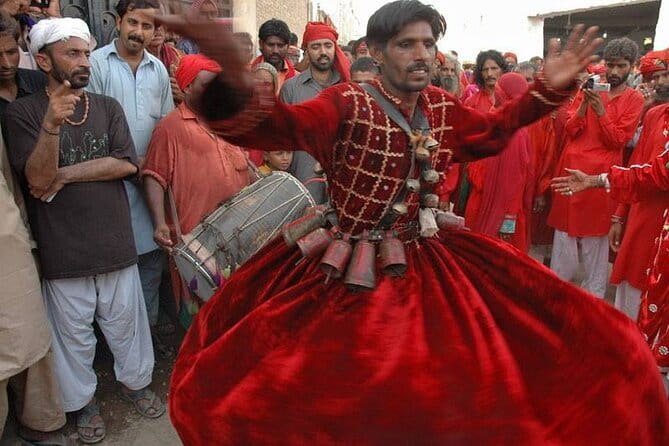
If you’re picturing southern Pakistan as all desert and dusty roads, this tour will gently correct that. You get major Islamic monuments, Indus Valley archaeology, and Mughal architecture in one continuous storyline—starting at sea-level Karachi, then working inland toward Thatta, Multan, and finally Lahore. It’s a real travel arc: coast → shrine country → ancient cities → desert drama → imperial Punjab.
You’ll also notice how the itinerary is built around big sites rather than constant quick photo stops. That matters because places like Makli Necropolis or Mohenjo-daro don’t reward rushing. They’re the kind of sites where you start seeing patterns—dynasties, tile styles, city planning—only after you’ve spent real time there.
The tour is private, so you’re not getting shuffled into a rigid mass timetable. That’s a big deal on longer days, especially when you’re spending time on UNESCO properties where entry flow and guided pacing can vary.
You can also read our reviews of more historical tours in Karachi
Karachi day: Mohatta Palace and Abdullah Shah Ghazi in Clifton
Your journey begins in Karachi, with two very different but complementary sights.
Mohatta Palace Museum (Clifton)
The palace itself is the first surprise. Built in 1927 in Clifton, it borrows the look of stone palaces from Rajasthan—especially the pink Jodhpur stone mixed with local ghizri stone. Once you treat the building as part of the experience, the museum visit makes more sense. You’re not just looking at artifacts; you’re stepping into a mansion that reflects how Karachi connected to wider architectural tastes in the early 20th century. Admission is included, and the visit is about an hour.
Abdullah Shah Ghazi Shrine
Then you pivot to devotion. Abdullah Shah Ghazi’s shrine is a major landmark in Karachi’s Clifton area, tied to an 8th-century Sufi mystic. The site has been modified over time, but it remains a central spiritual stopping point in the city, and the visit is short—about 30 minutes.
Tip: this is a good breather day to get your bearings fast. After the drive and museum-world context, a shrine gives you the local tone quickly.
Why this first day works: you start with architecture you can see (palace + tiles + stonework), then you shift to the living side of culture through a famous shrine.
Thatta’s heritage core: Chaukhandi Tombs, Makli Necropolis, and Shah Jahan Mosque
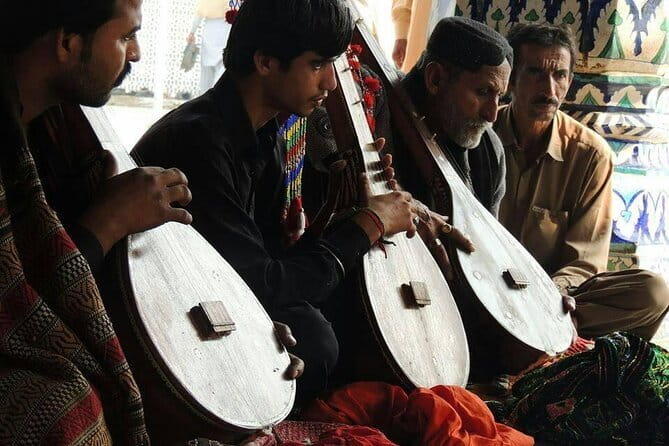
This is the itinerary’s first “UNESCO spine,” and the sites feel connected even when they’re different types of monuments.
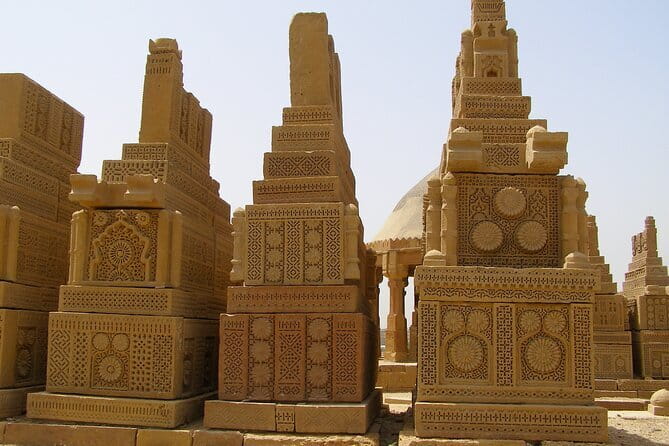
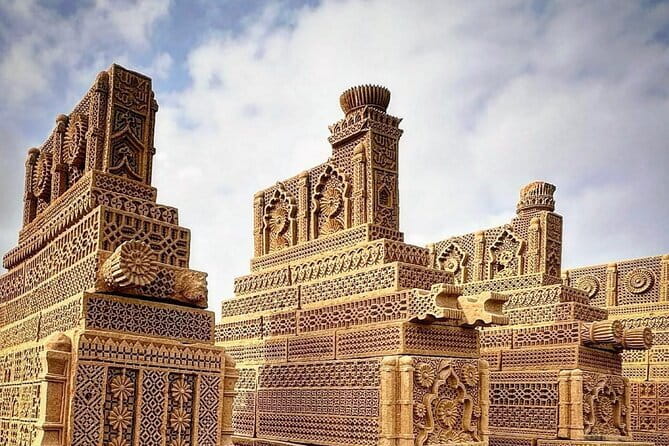
Chaukhandi Tombs (four-sided graves)
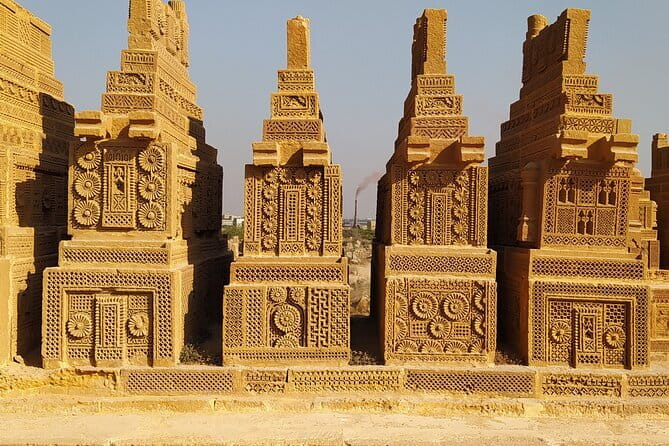
About 29 km northeast of Karachi, the Chaukhandi Tombs are older than 300 years. What makes them memorable is the stone carving—elaborate details on tombs associated with local Baloch, Jam, and Jokhis communities. They’re on UNESCO’s tentative list since 1993, and entry is free on the tour schedule. The visit takes about an hour, which is just enough time to appreciate the workmanship without feeling trapped in one spot.
Makli Necropolis (UNESCO World Heritage)
Just outside Thatta (around 100 km from Karachi), Makli is huge. It’s one of the largest funerary sites in the world, shaped in a diamond-like enclosure that stretches into surrounding areas. The cemetery use begins in the 15th century, tied to the Samma Dynasty (capital at Thatta, about 5 km east).
You’ll also notice the historic layering: an “old part” associated with Samma rulers, and a “new part” featuring Persian, Afghan, and Mughal rulers. The tour includes a golf cart segment, which helps because Makli is spread out. Expect about two hours here, and admission is included.
Shah Jahan Mosque (Thatta)
After Makli’s scale, the Shah Jahan Mosque feels precise and visually loud. Built during Mughal emperor Shah Jahan’s reign, it has a huge courtyard and architecture with Central Asian and Persian influence. One detail you’ll hear emphasized is the blue tile work—arguably the star of the decorative approach.
The tour frames it as a gift to the people of Thatta, connected to Shah Jahan during a tense period when he was hiding from his father Jahangir. Entry is free, and the visit is about an hour.
How to get the most out of this day: slow down at Makli and look for changes in tomb styles. That’s where you start sensing the political shifts—Samma to later influences—without needing a textbook.
Sehwan and Bhit Shah: Sufi shrines with daily rhythm
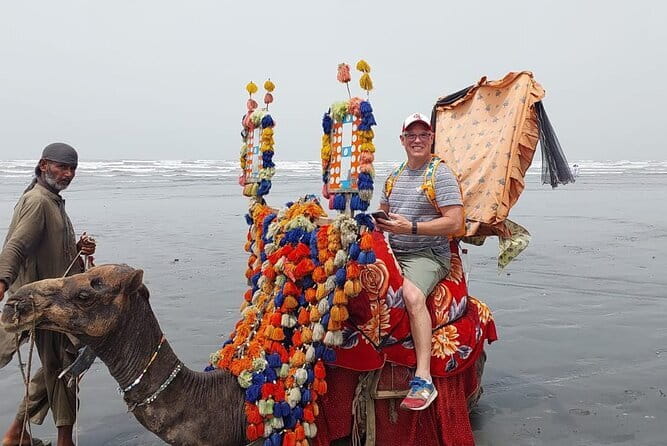
This section shifts the tone. Instead of UNESCO plaques and archaeology, you’re meeting living spiritual traditions.
Lal Shahbaz Qalandar Shrine (Sehwan Sharif area)
Lal Shahbaz Qalandar is a 13th-century Sufi saint associated with love and tolerance across religions and ethnicities. The shrine visit is free on the schedule and lasts about an hour.
Here’s the practical detail that changes everything: the dhamaal—meditative dancing—is held daily after sunset for about an hour. Timing matters. If you’re aiming for that devotional experience, plan your day with the evening rhythm in mind.
Shrine of Shah Abdul Latif Bhittai (Bhit Shah)
Bhittai was a Sindhi Sufi poet and saint known for his poetry collection, Shah Jo Risalo. The shrine complex is famous for its tile work with blue and white floral themes, using traditional Iranian qashani tiles with glazed colors like blue and turquoise.
The visit is free and about an hour. It’s near Hala, roughly 200 km from Karachi. The tour also notes that people of different faiths gather year-round around the tomb, with the highlight being the listening aspect of the visit (as described during the experience).
What I like about this day’s structure: it pairs one shrine known for movement and music (dhamaal) with another shrine built around tile artistry and poetic devotion. You’re not stuck in one mode the whole time.
Mohenjo-daro and Kot Diji: Indus Valley planning you can still map
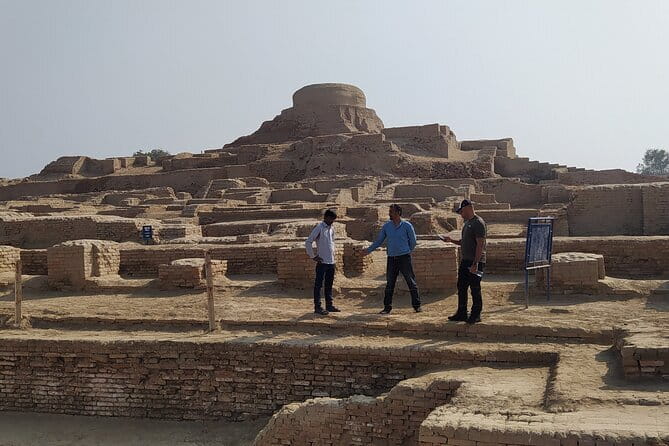
If you want one day that makes ancient history feel physical, this is it. The Indus Valley Civilization isn’t just “old stuff.” It’s organized city design—and Mohenjo-daro is the loudest example.
Mohenjo-daro (UNESCO World Heritage)
This site is the largest settlement of the Indus Valley Civilization. The tour describes the city in parts: a rich colony, an artisan colony, and a soldiers colony. There’s also a university site near the stupa area.
You’ll see details that are more than scenery: double-storied houses with their own water wells, a kitchen area and washroom, streets lined with burners at night, and covered sewerage systems. Even the idea of dust bins at street corners is part of the story you’ll be taught to look for.
The Great Bath is another anchor point. It was fed by the nearby Indus River for travelers and the public. The tour frames the decline: a sudden drop around 1900 BCE for unknown reasons, then abandonment—possibly tied to drying up of a major river.
Plan about three hours here, with entry included.
Archaeological Museum Mohenjo-daro
A short walk from the ruins, this museum (built around the 1960s) holds artifacts from excavations. You can expect pottery, jewelry, toys, ivory items, and other recovered pieces. It’s about 45 minutes, with entry included.
Kot Diji Fort
Then you pivot from prehistory to fortification. Kot Diji is built atop a limestone ridge at the edge of the desert, with irrigated fields on the other side fed by tributaries of the Indus. The fort is tied to the Talpurs, with the first Talpur Mir building it in the late 18th century (1785 to 1795).
The tour notes the fort was divided into three parts among different Talpur groups, showing how political control shaped built space. Admission is included and the visit takes about two hours. The drive time mentioned is about 1.5 hours from Mohenjo-daro.
Practical note: days like this work best when you’re not trying to “win the day” with photos. Give yourself time to look. Mohenjo-daro rewards attention to systems—water, sanitation, and how people lived.
The Cholistan Desert segment: Derawar Fort and Uch Sharif’s Bibi Jawindi
This is the itinerary’s most cinematic stretch. You’re moving through desert space and stepping into monuments that feel placed for defense, faith, or both.
Derawar Fort (square fortress with forty bastions)
Derawar Fort is a large square fortress in Bahawalpur, visible from a distance across the Cholistan Desert. It has forty bastions. The tour history is long and layered: built in the 9th century AD by Rai Jajja Bhatti (Bhatti clan), connected to Rajput rulers, then later taken over in the 18th century by Muslim Nawabs of Bahawalpur from the Shahotra tribe. Renovations followed under Abbasi rulers.
The tour includes a detail about artifacts found in debris near a decaying wall—1,000 year-old catapult shells. Entry is listed as free on the schedule, and the fort visit takes about two hours.
Abbasi Jamia Masjid Qila Derawar
Close by, there’s a mosque associated with the Abbasi family. The tour notes its design connection to Moti Masjid at Delhi’s Red Fort. Entry is free and the visit is about 30 minutes. This is a good stop for small-time contrast: you started with stone walls and bastions, then you look at how worship spaces sit inside the same fort world.
Tomb of Bibi Jawindi (UNESCO World Heritage area at Uch Sharif)
Finally, you reach the Tomb of Bibi Jawindi, one of the five monuments in Uch Sharif. The tour connects it to Jahaniyan Jahangasht’s great granddaughter and her piety. It dates to the 15th century, and there’s a haunting detail: the tomb has been washed by shifting river flow. Entry is free and the visit is about an hour.
What you’ll likely appreciate here: the way the tour places faith and power side by side. Fortifications and shrines aren’t separate worlds in southern Pakistan. They’re different answers to the same human needs.
Multan shrine circuit: Rukn-e-Alam, Shams-i-Tabrizi, and mirror-work at Shah Yusuf Gardezi
Multan is where the architecture shifts into something you’ll remember for its craftsmanship. The day is packed with Sufi shrines, and the tour keeps each stop to about an hour so you don’t get mentally exhausted.
Tomb of Bahaudin Zakaria (Shah Rukn-e-Alam, Tughluq architecture)
This mausoleum is described as the earliest example of Tughluq architecture and is one of the most impressive shrines in the Indian subcontinent, according to the tour framing. Entry is free and the visit is about an hour.
Tomb of Shah Shams Sabzwari Tabrez (credited as Rumi’s spiritual instructor)
This shrine is dedicated to Shams-i-Tabrīzī, described as a Persian poet and spiritual instructor of Jalāl ad-Dīn Muhammad Balkhi (Rumi). The visit is free and about an hour.
Even if you know little about the story, the structure of the visit makes it easy to follow: saint identity first, then how the site functions as a place of memory.
Shrine of Shah Yusuf Gardezi (ayina kari mirror-work)
Here’s a detail you’ll want to picture: the interior has extensive mirror-work called ayina kari. The tour also calls out the architecture as an early example of a tiled, flat-roof tomb dating from 1152.
Entry is free and the visit is about an hour.
If you like architecture that’s meant to be looked at up close, this day is for you. Mirror-work and tile techniques are the kind of thing that feel better in person than in photos.
From archaeology to shopping: Harappa Museum and Lahore’s Food Street Fort Road
After several days of heavy spiritual and heritage monuments, the tour gives you a transition day into Punjab’s modern energy.
Harappa Museum
The museum is tied to the broader Indus Valley story. It notes that by 2600 BCE, early Harappan communities developed into large urban centers, including Harappa, Ganeriwala, and Mohenjo-daro. It also references the 1920s excavation work. Entry is included and the visit is about an hour.
Food Street Fort Road (Lahore)
Then you get a break from ruins and shrines with a food-focused stop. The tour frames it as famous for sub-continent dishes and gives it about an hour. Entry is free on the schedule.
This pairing works because it gives you both mind and mood. You can switch from ancient city planning to everyday life in the span of one day.
Lahore UNESCO focus: Badshahi Mosque, Lahore Fort, Wazir Khan, and Wagah
This is the big finish. Lahore is the place where Mughal architecture becomes a full visual argument.
Badshahi Mosque
Badshahi Mosque is tied to Emperor Aurangzeb’s rule (1658 to 1707) and is described as one of the few significant monuments built during that period. It’s on a UNESCO tentative list and remains the largest mosque on the Indian subcontinent (as framed in the tour).
The visit is about 30 minutes, and entry is free on the schedule.
Lahore (Lahore Fort and Mughal architecture phases)
The tour positions Lahore Fort as the only place in Pakistan representing different phases in Mughal architecture development. Akbar’s reign is described as the point where it gained prominence, and later successors—Jahangir, Shah Jahan, and Aurangzeb—added buildings. Entry is free, and the visit is about an hour.
Masjid Wazir Khan
Built by Hakim Shaikh Ilm-ud-din Ansari, construction began in 1634, and the tour notes it was commissioned in the reign of Shah Jahan. The stop is about 30 minutes with free entry on the schedule.
Wagah Border beating retreat ceremony
End your day with a high-energy crowd event. The tour describes the daily beating retreat ceremony at the border, attracting crowds from both sides. It’s described as one of the most witnessed military ceremonies and says the tradition started in 1959. This stop is about three hours, with entry included.
How to handle this day: wear comfortable shoes and plan for a long outing at Wagah. It’s not a quiet monument stop; it’s a performance.
Final Lahore time: Lahore Museum and Anarkali Bazaar
Your last stretch keeps Lahore’s cultural rhythm going but shifts away from monumental architecture.
Lahore Museum
The tour describes it as the largest museum in all of Pakistan. Founded in 1864 by the British, it’s housed in a Mughal-style building on the Mall, built in 1894. The museum holds artifacts from many regions, and it notes the largest collection of Gandhara Buddhist artifacts after Peshawar Museum. Entry is included and the visit is about two hours.
Anarkali Bazaar
Then you get a shopping hour or two in the old-school Lahore bazaar setting. The stop is about two hours, with free entry.
This is a nice way to end because you can trade the grand architecture for everyday textures: fabric, souvenirs, and the city vibe—without needing to cram in another UNESCO site.
Price and comfort: is $2,850 per person good value?
At $2,850 per person, you’re paying for a private, long-distance run across multiple provinces and eras. The tour price includes private transportation, accommodation, breakfast, and all fees and taxes. It also includes admission for certain major sites (like Mohenjo-daro ruins/museum and Makli), while other stops are listed as free entry on the schedule.
Where the value shows up is the balance between logistics and time. You’re not spending energy figuring out intercity travel day-by-day. You’re also not losing hours to small, low-impact stops. The schedule is structured around meaningful sites: UNESCO properties plus major shrines and key Mughal landmarks in Lahore.
One tradeoff: lunch and dinner are not included. That’s not a dealbreaker, but it does mean you’ll want to budget meals separately or ask your guide what to plan for between stops.
If you care about having a guide who can connect the dots—Sufi tradition to architecture, Indus city systems to what you’re seeing—this is the kind of itinerary where that guidance matters.
Should you book this UNESCO trail tour?
Book it if you want a single trip that covers Karachi to Lahore with UNESCO stops you can actually spend time with: Chaukhandi, Makli Necropolis, Mohenjo-daro, and Lahore Fort. It’s also a strong match if you appreciate Sufi shrines and architectural details, from tilework to mirror decoration.
Don’t book it if you hate long drives and prefer a slower, fewer-stops pace. The days are designed for movement across big distances, and you’ll also be responsible for lunch and dinner.
One last practical check: the tour notes it requires good weather. If your travel dates are flexible, you might have an easier time with desert and outdoor sites.
FAQ
How long is the Southern Pakistan UNESCO World Heritage Trail?
The tour is listed as 10 days (approx.).
Where does the tour start, and what time?
It starts in Karachi, with a start time of 9:00 am.
Is pickup included, and is it private?
The tour offers pickup and it’s private, meaning only your group participates.
What’s included in the tour price of $2,850 per person?
The price includes private transportation, breakfast, accommodation, and all fees and taxes. Lunch and dinner are not included.
Do I get a mobile ticket?
Yes, the tour includes mobile ticket.
What’s the cancellation and weather situation?
You can cancel for a full refund up to 24 hours in advance. The experience requires good weather, and if it’s canceled due to poor weather, you’ll be offered a different date or a full refund.