REVIEW · CHICAGO
The Devil in the White City: A Haunting History Tour
Book on Viator →Operated by Chicago Hauntings · Bookable on Viator
H.H. Holmes meets the World’s Fair in Chicago. This half-day, bus-and-foot tour stitches together recognizable 1893 sites with chilling legend, using strong storytelling and famous landmarks to help you see Victorian Chicago like it’s right in front of you. I like that the experience is built around real places you can stand on, not just a generic lecture, and the guide Tony turns the route into a moving timeline of crime, architecture, and big-city ambition.
Two things I really enjoyed: you get a comfortable format (bus between stops plus short on-foot segments) and you also visit several major locations where admission is free. The main drawback to keep in mind is that the “haunting” angle and the pace can feel uneven if you want a strict, nonstop focus on the World’s Fair itself—one review noted the early portion didn’t match their expectations for depth, and a couple comments pointed to timing and routing hiccups.
In This Review
- Quick hits before you go
- Why this Chicago bus-and-walk tour feels different
- From the Congress Plaza Hotel to the first dark turn
- Prairie Avenue Historic District: where the story starts to make sense
- The USPS stop and the murder-castle legend
- Japan Park and Jackson Park: fair-world framing and photo-friendly pauses
- Union Stockyard Gate: industry, Upton Sinclair, and social consequences
- Museum of Science and Industry: the last fair-building you can still see
- Price and timing: what $64 buys you in real value
- The guide factor: why Tony gets so much credit
- Comfort level: what to expect on your feet
- Is this tour for you?
- Should you book The Devil in the White City: A Haunting History Tour?
- FAQ
- How long is the tour?
- How much does it cost?
- Where do I meet, and where does the tour end?
- Is the ticket mobile?
- What stops are included on the tour?
- Is there free cancellation?
- Does the tour run in bad weather?
Quick hits before you go
- Bus + short walks keep the spooky story moving without lots of strenuous foot time
- Tony the guide brings humor and energy to the tales, not just dates and names
- Prairie Avenue, Jackson Park, and the fair remnants help you connect 1893 ambition to modern Chicago
- A key stop at today’s USPS site connects an unassuming building to H.H. Holmes lore
- Free stops throughout mean you’re paying for the guide and the route, not extra entry fees
- Small tour size with a maximum of 52 people keeps the vibe manageable
Why this Chicago bus-and-walk tour feels different
This tour works because it treats Chicago like a living document. Instead of only “hearing about” 1893, you’re seeing the city blocks, parks, and institutional buildings where that era left fingerprints. The blend of The Devil in the White City inspired sites and H.H. Holmes legend gives you a story thread, but the real payoff is how the guide uses the settings to explain what made Victorian Chicago feel so risky and so inventive at the same time.
The bus element matters. Chicago can be spread out, and the tour starts at a central downtown landmark (the Congress Plaza Hotel & Convention Center). You get the practicality of riding between spots while still getting enough time at each stop to form mental pictures—what the street looked like, where the fair energy concentrated, and why certain corners became the stage for scandal.
And yes, the haunting theme is part of the pitch. But what you’ll actually experience is more like guided “storytelling on location.” Think: ghost stories used as a hook to understand real urban history.
You can also read our reviews of more tours and experiences in Chicago.

From the Congress Plaza Hotel to the first dark turn
You meet at the Congress Plaza Hotel & Convention Center at 520 S Michigan Ave, right by public transportation. The start time is 2:00 pm, and the tour returns to the same meeting point at the end. That round-trip simplicity is a big deal: you’re not hunting for a separate pickup or crisscrossing the city after dark.
This location also sets tone. The Congress Plaza is tied to the era of the Columbian Exposition, so the guide can frame the day with context before you head out. If you like getting oriented fast—who was here, what was built, and why it mattered—this starting point helps.
It’s also the kind of meeting spot that works for people who want structure without stress. A half-day tour isn’t trying to solve all of Chicago for you. It’s picking key stops and connecting them with a narrative.
Prairie Avenue Historic District: where the story starts to make sense
Stop one is the Prairie Avenue Historic District, with a focus on the historic Victorian district and the site of the Fort Dearborn Massacre. You’ll have about 30 minutes here, with admission listed as free.
Why this stop is useful: it gives you grounding before the tour turns into legend. Instead of jumping straight to “murders and mysteries,” you first get a sense of how Chicago’s growth created the conditions for power, inequality, and fear. Fort Dearborn is also a reminder that the city’s past is deeper than 1893. That matters, because H.H. Holmes lore sticks to an atmosphere—uneven growth, overcrowding pressures, and strangers passing through.
What to watch for: take a moment to look at what’s built around you and how the district reads as a status statement. Even if you don’t get every architectural detail, you’ll understand why the tour uses this part of town as a foundation.
The USPS stop and the murder-castle legend
Next comes a stop at the United States Postal Service, where the tour describes the former Murder Castle as the connection point for H.H. Holmes lore. You’ll spend around 25 minutes here, again with free admission.
This is one of the most fascinating stops because it uses contrast. An ordinary public-facing building today becomes a stage for a story about something far darker. The tour leans into the idea that the site carries restless legend—workers at this unassuming post office have heard stories tied to H.H. Holmes’ victims.
Even if you’re skeptical of ghost claims, you can still get value from the approach. Places like this show you how crime history gets layered into everyday life. You’re not just looking at a “museum site”; you’re standing in Chicago’s present while the guide helps you picture what was here during the Victorian era.
A practical note: this stop is a good place to ask yourself what you want from the tour. If you’re here for the story and the setting, you’ll likely enjoy it. If you only want documented history with minimal legend, you might feel the “haunting” framing more than you expect. It’s not a pure archive-style experience.
Japan Park and Jackson Park: fair-world framing and photo-friendly pauses
You’ll first hit Jackson Park’s Japanese Garden for about 15 minutes. Admission is listed as free, and the tour calls it an ideal spot for pictures as you hear ghost stories tied to Jackson Park and the 1893 World’s Fair.
Then you move to Jackson Park itself, with about 30 minutes there, also free. This is the core fairgrounds stop of the day: you’re learning about the World’s Fairgrounds of 1893 and how that landscape shaped the city’s image.
These two stops work well together. The Japanese Garden gives you a softer visual break, so the story doesn’t feel like it’s only chasing darkness. Then the main Jackson Park stop brings you back to scale—big outdoor space, fair-world planning, and the kind of optimism that made 1893 feel like a turning point.
What you should do with your time: use the Japanese Garden moments to get your bearings and take photos, then save your attention for what the guide says about the fairgrounds during the main Jackson Park segment. If you care about how Chicago marketed itself to the world, this is where it clicks.
Union Stockyard Gate: industry, Upton Sinclair, and social consequences
Stop five is the Union Stockyard Gate, with about 10 minutes here, again free. The tour connects this location to late 19th-century history and notes that Upton Sinclair based his groundbreaking work The Jungle on what he saw around the stockyards.
This is the part of the itinerary that often surprises people. It shifts the mood from fair spectacle to working-class reality. You’re seeing how Chicago’s economic engine could create harsh conditions—conditions that later writers helped expose. Even with the tour’s crime-and-ghost premise, this stop adds moral weight. It’s not just about famous people or infamous buildings. It’s also about systems.
Because time here is shorter, don’t try to “speed read” everything. Listen for what the guide says about why the stockyards mattered and what Sinclair was trying to show. Ten minutes is enough to get the point, especially if you’re paying attention rather than scanning for every detail.
Museum of Science and Industry: the last fair-building you can still see
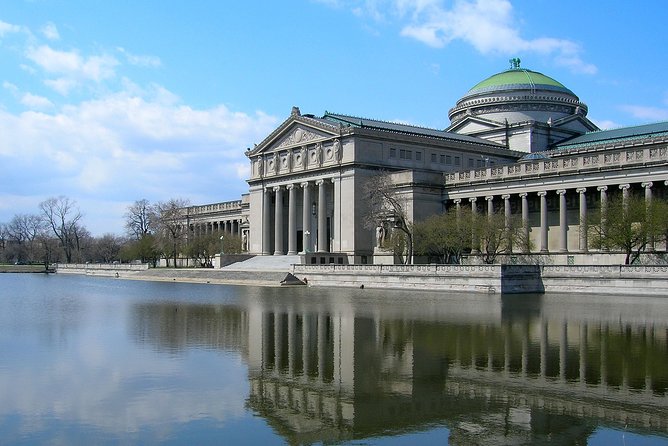
The final stop is the Museum of Science and Industry, with about 15 minutes on site, free admission listed in the tour info. This is framed as a place to hear ghost stories connected to the last remaining building from the 1893 World’s Fair.
If you like tangible leftovers, this is the stop that delivers. The idea here is simple: even after all the hype and all the construction boom, some structures outlasted the fair itself. That makes the narrative feel more grounded. You’re not only hearing legend—you’re ending the tour at a place where history is physically present.
One more reason this finale works: it helps you close the loop. Earlier stops are about backstory and darker legend. This stop gives you a final “hold on to this” moment—something you can later point to when you talk about why 1893 mattered beyond its own headlines.
Price and timing: what $64 buys you in real value
The price is $64.00 per person for about 3 hours. That’s not pocket change, so here’s the fair way to judge it: you’re paying for guided interpretation and for the route that strings together multiple major Chicago sites without you having to plan connections yourself.
In your favor:
- Many stops have free admission, so your money is mostly going to the guide and transportation rather than ticket fees.
- The group size max is 52, which usually keeps things from feeling like a giant crush.
- You get bus transport for sightseeing, which can save you time and fatigue.
Where you should calibrate expectations:
- This tour is half-day, so it’s not trying to cover all of the World’s Fair or all of Chicago architecture. It’s choosing highlights and connecting them into a story arc.
- If you want the World’s Fair focus to be dominant the whole time, you should know the itinerary balances fair sites with Holmes-related legend.
To me, $64 feels fair when the guide is strong and the route is tight. Based on the feedback tied to Tony’s humor and storytelling energy, this is the kind of tour where the guide can make a measurable difference.
The guide factor: why Tony gets so much credit
A recurring theme in the feedback is the guide. Tony shows up as funny, friendly, and energetic, with a talent for explaining details in a way that feels alive rather than memorized. More than one comment credits him with making Chicago feel real again and with bringing the gilded-age setting back to life.
That matters because this tour could go one of two ways: it could be a list of stops with dark names, or it could be a guided story anchored to place. The strong ratings point to Tony leaning into story. One comment even notes his ability to speak with meaning and belief, which is exactly what you want for a tour that mixes legend with urban history.
If your personal style is more reserved—if you prefer strictly academic tones—this tour might still work, but you may find the ghosty framing more pronounced than a textbook tour.
Comfort level: what to expect on your feet
The tour combines bus time with on-foot segments at multiple stops. Some people describe it as comfortable, with only limited walking. Still, you should plan like there will be sidewalks, crossings, and short waits while the group regroups.
Bring comfy shoes. This kind of Chicago afternoon can mean a bit more pavement than you expect, especially when your day has multiple “stand-and-listen” pauses.
Is this tour for you?
This fits best if you like story-led history and you’re curious about how Chicago reinvented itself in the 1890s. If you’re also into crime-history legend—without needing every claim to be purely documented—you’ll probably enjoy the blend of The Devil in the White City inspired locations and the Holmes-linked lore.
It’s also a good pick if you want a one-pass way to see key areas:
- Prairie Avenue Historic District
- Jackson Park and the Japanese Garden
- Union Stockyard Gate
- The Museum of Science and Industry connection to the 1893 fair
- Plus the USPS stop tied to Murder Castle legend
You might want to think twice if you’re after a strict, nonstop World’s Fair deep dive. One piece of feedback pointed out that the early portion didn’t feel as fair-focused as they wanted, and another comment mentioned the pacing running long relative to expectations.
Should you book The Devil in the White City: A Haunting History Tour?
Yes—if you want a guided afternoon where Chicago landmarks become story anchors, and you’re okay with a healthy dose of legend alongside history. The value hits when you care about how place shapes narrative, and the repeated praise for Tony suggests the tour’s biggest strength is its storytelling energy.
Book it if you:
- Want to connect the 1893 World’s Fair story with H.H. Holmes legend in real locations
- Prefer a bus route with short walking stops rather than a full walking day
- Like guides who make history feel like a live conversation, not a slideshow
Skip it or choose a different format if you:
- Need a strictly academic presentation with minimal ghost-story framing
- Are very sensitive to timing and want the schedule to feel perfectly tight the entire time
If you fall in the first group, you’ll likely leave with a clearer mental map of Chicago during the 1893 era—plus a few dark details you can’t un-know.
FAQ
How long is the tour?
It runs for about 3 hours.
How much does it cost?
The price is $64.00 per person.
Where do I meet, and where does the tour end?
You meet at the Congress Plaza Hotel & Convention Center, 520 S Michigan Ave, Chicago, IL 60605, and the tour ends back at the same meeting point.
Is the ticket mobile?
Yes, the tour uses a mobile ticket.
What stops are included on the tour?
The tour includes the Prairie Avenue Historic District, a stop at the United States Postal Service (linked to the Murder Castle legend), Jackson Park’s Japanese Garden, Jackson Park (the World’s Fairgrounds area), the Union Stockyard Gate (linked to The Jungle), and the Museum of Science and Industry (linked to a remaining 1893 fair building).
Is there free cancellation?
Yes. You can cancel for a full refund up to 24 hours in advance.
Does the tour run in bad weather?
The experience requires good weather. If it’s canceled due to poor weather, you’ll be offered a different date or a full refund.