REVIEW · ROME
Colosseum & Ancient Rome Guided Walking Tour
Book on Viator →Operated by Rome Walkers · Bookable on Viator
Three Roman icons, one smart route. This guided walk strings together the Colosseum, Palatine Hill, and the Roman Forum with admission handled and headsets to keep you on track. I also like the small-group feel, where the guide can answer questions instead of shouting into the crowd. One caution: expect lots of walking on cobbles and steps, and if you’re sensitive to accents, you may want to rely on the headset to catch every detail.
If you want the big Roman story in one outing, this is built for it. You’ll hit the places tied to entertainment, power, and everyday politics, all in about 2 hours 45 minutes, with a guide laying out how they connect.
In This Review
- Key Highlights You’ll Feel (Not Just Read)
- Colosseum, Palatine Hill, and Roman Forum: the best-hit route in Rome
- Entering the Colosseum: what the 1-hour stop is really for
- What I’d watch for at the Colosseum
- Palatine Hill in 45 minutes: Rome’s start, right where the elites built
- A practical note: steps and inclines
- Roman Forum in 45 minutes: where politics ran in public
- The drawback: time is tight
- Value for $65.33: what you’re paying for (and what you aren’t)
- Is it worth it for your travel style?
- Guide quality can make or break the experience
- A caution that’s worth taking seriously
- Pace, comfort, and what to bring for a smooth day
- Where this tour fits best in your Rome itinerary
- Should you book the Colosseum & Ancient Rome Guided Walking Tour?
- FAQ
- How long is the Colosseum, Palatine Hill, and Roman Forum guided walking tour?
- What is included in the $65.33 per person price?
- Are admission tickets included for all three sites?
- What language is the tour offered in?
- What group size should I expect?
- Where do we meet, and where does the tour end?
- Do I need to bring identification?
- Is food or drink included?
- What if my plans change and I need to cancel?
Key Highlights You’ll Feel (Not Just Read)
- Timed Colosseum entry with included ticket and reservation fees, so you spend less time waiting and more time seeing
- Headsets for clearer commentary through the crush of visitors
- A fast, logical route: Colosseum (shows) → Palatine Hill (power origins) → Roman Forum (public life)
- Concrete historical scale, like the Colosseum’s massive build and the emperor-funded games
- Small-group cap of 25, which helps the guide keep everyone together
- Guide variety with real personalities (I’ve seen names like David Battaglino, Radu, Lumi, and Kiara showing up in guide notes)
Colosseum, Palatine Hill, and Roman Forum: the best-hit route in Rome
Rome can be overwhelming fast. Street-to-street, it’s gorgeous and chaotic, and you can easily end up doing a lot of standing and guessing. This tour is different because it gives you a route—and the guide gives you the story thread so the ruins stop feeling like random piles of stone.
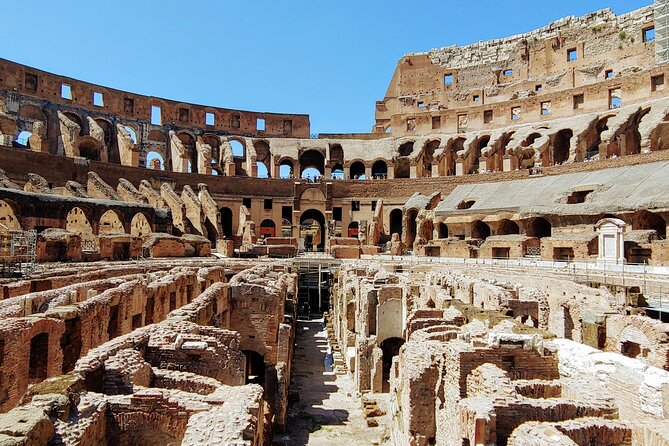
You cover three top Roman attractions in one go. The point isn’t to “do everything.” The point is to understand the why behind the what: why Romans built the biggest entertainment arena, why their elite palaces clustered on Palatine Hill, and why the Forum was where politics and justice actually happened.
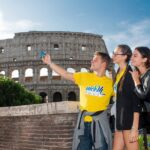
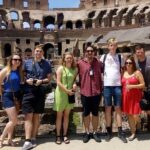
And the format helps. It’s a guided walking tour (English), capped at 25 people, and it comes with headsets, which matters in the Colosseum area where the sound can get swallowed by crowds.
You can also read our reviews of more walking tours in Rome


Entering the Colosseum: what the 1-hour stop is really for
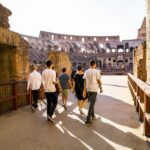
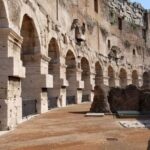
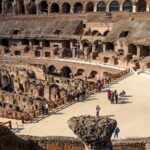
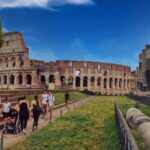
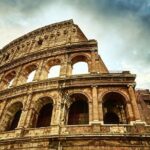
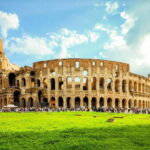
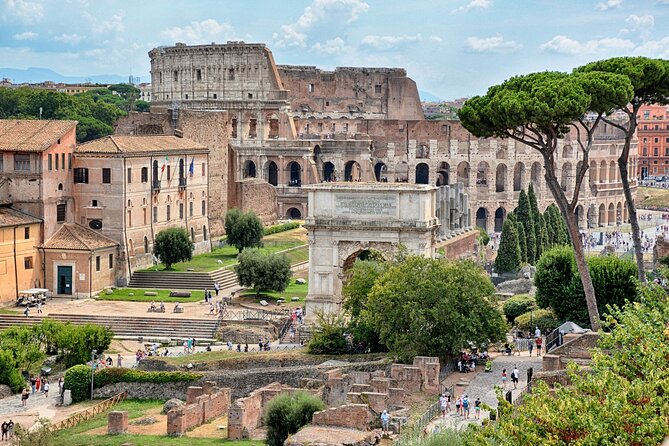
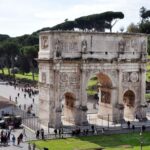
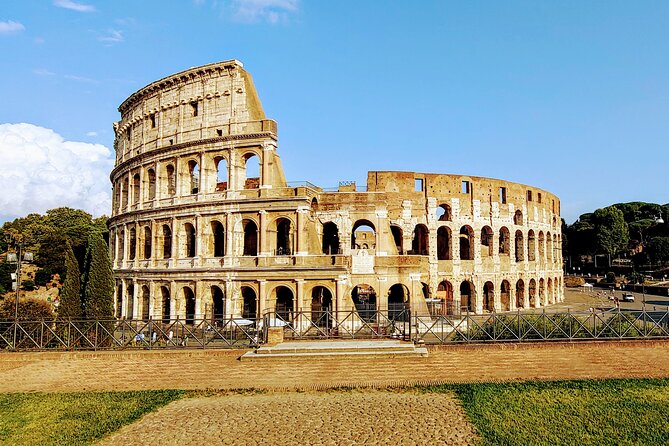
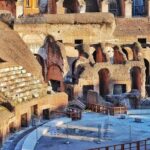
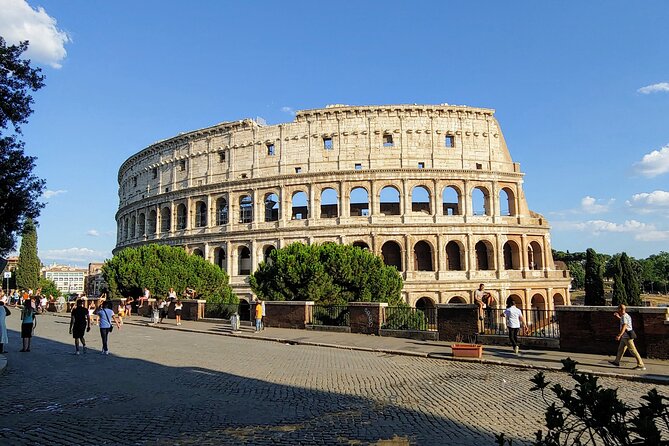
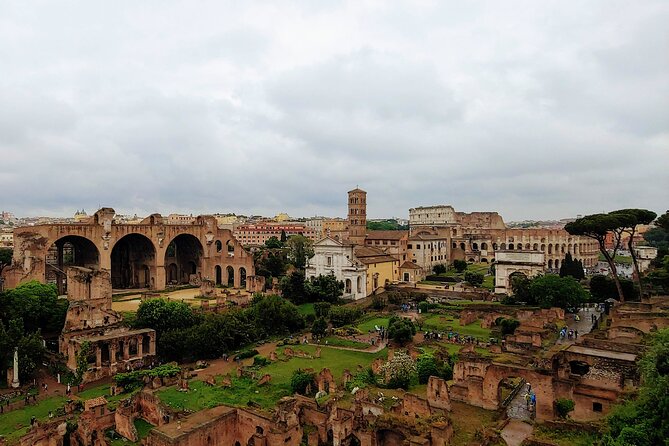
The Colosseum (officially the Flavian Amphitheatre) is the loudest silence in Europe. Even when you’re not inside the arena, you feel it: the scale, the engineering, the purpose.
Your visit is built around context. You’ll hear how it was commissioned by Emperor Vespasian and built between 72 and 80 AD. You also get the kind of details that change how you see the building: it was made with more than 1 million tons of materials, including travertine, marble, and cement. That’s not just trivia. It’s a reminder that this wasn’t a “cool stadium.” It was a political statement made out of stone.
A few history anchors you’ll likely hear along the way:
- About 200 entertainment venues like this existed across the Roman Empire.
- The games were funded by the emperor, so the public would see Roman power as something they received for free.
- Over roughly five centuries, gladiators, animals, and convicts fought here.
The tour also puts spotlight on the inauguration era: the games associated with Titus in 80 AD reportedly lasted 100 days. That helps you picture the Colosseum as an event machine, not a one-day attraction.
What I’d watch for at the Colosseum
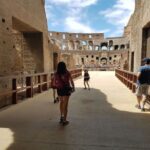
Crowds can swallow time. Even with timed entry, the Colosseum is busy, and moving safely through groups takes effort. You’ll also have only about 1 hour here, so this is a “best highlights” stop, not a slow, page-by-page museum experience.
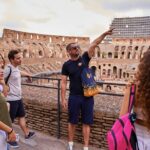
If you love photography, note that some guides work with good picture angles and will pause briefly for group shots. In guide notes I’ve seen, people specifically called out strategies for getting to better viewpoints near the rails and even time on the Colosseum floor area. Access can vary with on-site conditions, but it’s a sign of how guides try to make the most of the time you have.
Palatine Hill in 45 minutes: Rome’s start, right where the elites built
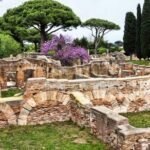
Palatine Hill is where Rome’s story begins—at least in the legend and the early settlement pattern. The tour gives you a grounded origin point: Rome is associated with Romulus and 753 BC, and archaeologists found evidence of settlements dating back to the Bronze Age, which supports the idea that the foundation timing is not purely invented.
Here’s why this stop is valuable: Palatine Hill makes the leap from “ruins are old” to “this is where power physically chose to live.” The guide explains why early settlements were often on higher ground near rivers: better defense and less trouble from floods. That practical logic matters because you can stand on the hill and understand why the location would be attractive before you even get into the imperial palaces.
Then the view changes your brain. You’re not just looking at stones. You’re looking at a strategic platform, and the tour points out what came later:
- Palaces of kings and emperors
- The homes of notable people
- The imperial power center that grew out of an early settlement choice
Palatine Hill is also one of those places where the “feel” is half the experience. Even in a short 45-minute window, you can sense that the elites weren’t scattered randomly. They gathered where the city’s story and authority met.
A practical note: steps and inclines
Palatine Hill includes uneven ground, steps, and climbs. Even when guides keep the pace comfortable, it’s still an active walk. If you’re visiting in summer, plan on heat management, because the hill areas can feel exposed.
You can also read our reviews of more guided tours in Rome
Roman Forum in 45 minutes: where politics ran in public
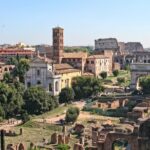
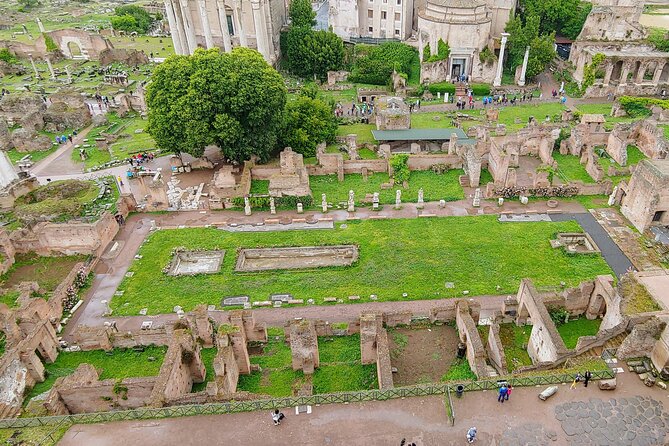
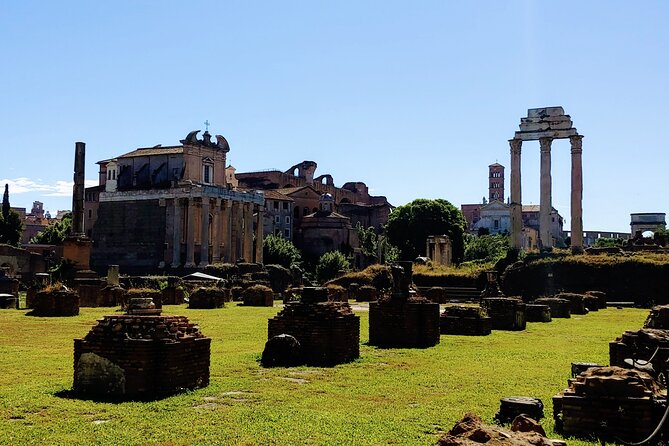
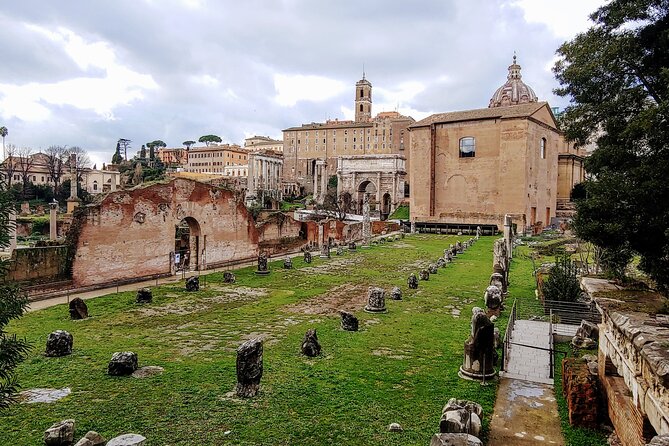
The Roman Forum is the center of the Roman “everyone watched” idea. It wasn’t a stadium for cheering; it was the outdoor plaza where people gathered to argue politics, handle civil life, and watch power operate at street level.
The guide helps you read the Forum as a system of functions:
- Temples and basilicas for religious and civic life
- Power structures for administration and elite presence
- Spaces where business and justice were handled
In other words, you’re seeing the stage where Roman society made decisions. The tour frames it as the shaping place for politics and daily governance—so when you look at what remains, you’re not guessing what it did.
You’ll also hear that the Forum contains some of the most important building types of ancient Rome, including Senate-related spaces and major temples. Even if you can’t reconstruct every wall in your head, the guide connects the dots so the ruins feel like they belong to a working city, not a decorative set.
The drawback: time is tight
The Forum stop is about 45 minutes, and that can feel short if you want to wander at your own pace or if you read slowly. This is a highlight tour. If you want extended exploring, you may need to budget extra time on your own after the guided portion ends.
The upside is that the guide helps you start with the right mental map. Once you have that, coming back later is much easier.
Value for $65.33: what you’re paying for (and what you aren’t)
At $65.33 per person, this tour isn’t trying to be the cheapest ticket on the street. It is trying to be a smart value for a high-demand area where lines eat your day.
Here’s how the pricing makes sense:
- You get Colosseum, Palatine Hill, and Roman Forum tickets and fees bundled in.
- The live guide and headsets reduce the main frustrations in Rome: confusion, crowd stress, and wasted time.
- Your Colosseum cost is specifically structured with an entrance ticket valued at €18 and a reservation fee valued at €2 (with the rest covering other tour services).
So you’re paying for more than access. You’re paying for time saved and context added.
What you don’t get is also clear: food and drinks aren’t included. That’s normal for a walking tour, but it matters because you’ll still want water and a plan for a quick meal after.
Is it worth it for your travel style?
This tour is especially worth it if:
- You want a guided framework for big sites
- You’re short on time and want three attractions connected in one outing
- You don’t want to figure out the Forum and Palatine “from scratch” while crowd pressure pushes you along
It may feel less worth it if:
- You prefer self-guided pacing only
- You want long, detailed time inside each area without a structured route
Guide quality can make or break the experience
This is one of those tours where the guide matters a lot. The subject matter is complex, and the crowds are real. When the guide is a good storyteller, the ruins click.
From guide notes I’ve seen tied to this tour, names like David Battaglino, Radu, Kiara, Lumi, Juliya, Giuseppe, Adnan, Alessandra, and Sam come up in positive feedback. People highlighted humor, patience, and clear explanations. One guide approach I noticed in the way people described it: using pictures or simple visual aids, like a book with images, to help you understand the Colosseum layout without needing to be an architecture student.
Another repeated practical theme: guides know how to manage the group in a crowd. People mentioned strategies like keeping everyone together quickly through bottlenecks and even pausing for photo breaks or a short rest.
A caution that’s worth taking seriously
There is also at least one report of a guide being hard to understand due to accent, and another complaint about the guide talking constantly rather than stopping at specific spots for key moments. Those are not deal-breakers if you’re flexible, but they’re a reason to arrive with realistic expectations and to use the headset.
Headsets help a lot. Still, if you’re very particular about narration clarity, this is where your best tool is your ears—keep the headset on and don’t be shy about asking for clarification if something’s not landing.
Pace, comfort, and what to bring for a smooth day
This is an active walking tour. The cobbled surfaces, steps, and inclines show up across the route. Based on guide feedback people shared, the tour often includes plenty of movement and it’s not just “stand and listen.”
Here’s how to prepare like a pro:
- Wear comfortable shoes with grip for cobbles and steps.
- Bring water, especially if you’re visiting in warmer weather.
- Plan for heat and sun. One guide was specifically praised for keeping people in the shade during extreme heat.
- Expect photo opportunities, and don’t be surprised if the guide directs you to rails or viewpoints for better shots.
Pace is usually described as comfortable, but it’s still 2 hours 45 minutes of doing Rome on foot. If you’re visiting with mobility concerns, you might find the steps challenging, even with a good guide and a small group.
Where this tour fits best in your Rome itinerary
I like placing this kind of tour early or mid-trip. Why? Because after you see the Colosseum, Palatine Hill, and the Forum with a guide, you can walk around Rome afterward and “read” what you’re seeing much faster.
If you’re also planning other big-ticket sites nearby, this route helps you connect the dots between entertainment, elite residence, and public power. It’s the kind of foundational tour that makes later exploring feel less like wandering and more like understanding.
Should you book the Colosseum & Ancient Rome Guided Walking Tour?
Book it if you want:
- The big three Roman sites in one outing
- Admission included with a guide and headsets
- A structured story so the ruins make sense fast
Consider skipping or pairing it differently if:
- You hate guided tours and prefer to wander slowly without stops
- You need lots of time per site, because each main area is relatively brief
My take: if you’re doing Rome for the first time and you want your day to feel efficient without feeling rushed, this is a strong choice. The best part is not only seeing the monuments—it’s understanding why they were built and how they shaped Roman life.
FAQ
How long is the Colosseum, Palatine Hill, and Roman Forum guided walking tour?
The tour is about 2 hours 45 minutes (approx.).
What is included in the $65.33 per person price?
The price includes Colosseum, Palatine Hill & Roman Forum tickets and fees, a live tour guide, headsets, and the Colosseum entrance ticket and reservation fee. Food and drinks are not included.
Are admission tickets included for all three sites?
Yes. Colosseum, Palatine Hill, and Roman Forum tickets and fees are included.
What language is the tour offered in?
This tour is offered in English.
What group size should I expect?
The tour has a maximum of 25 travelers.
Where do we meet, and where does the tour end?
You start at L.go Gaetana Agnesi, 5, 00184 Roma RM, Italy. The tour ends at Roman Forum, 00186 Rome.
Do I need to bring identification?
Yes. Each traveler must present a valid passport or ID document that matches the name provided at booking, and full traveler names must be provided.
Is food or drink included?
No. Food and drinks are not included.
What if my plans change and I need to cancel?
You can cancel up to 7 days in advance for a full refund.