REVIEW · PHILADELPHIA
Revolution and the Founders: History Tour of Philadelphia
Book on Viator →Operated by Grim Philly Twilight Tours · Bookable on Viator
Philadelphia’s founding story is close-up and walkable. This 2-hour Revolution and the Founders tour turns American history into a practical route through Old City, with a guide who has a history degree. I especially like how it hits the big icons early—Liberty Bell and Independence Hall—then keeps the thread going through the people and ideas behind them.
My second favorite part is the pacing: you get a lot of landmarks without feeling stuck at one museum desk, so the rest of your day stays open for your own exploring. Just note one real-world consideration: it’s largely outdoors and you’ll be on your feet, so colder or rainy days can make the “quick stops” feel longer.
In This Review
- Key things you’ll notice right away
- Why This Revolution-and-Founders Walking Route Works
- Meeting Point and the Start That Gets You Oriented
- Liberty Bell: More Than a Famous Icon
- Independence Hall and Timed Tickets You Must Plan For
- The First Washington-and-Adams Presidency House
- Congress Hall: Inaugurations, Law, and Capitol Life
- Franklin Court, Printing, and the Ideas Behind the Revolution
- The First Pentagon: Military Strategy’s Early Brain
- Carpenters’ Hall and the French Connection
- Hamilton’s Banks and the Politics of Money
- Franklin’s Institutions: Society, Lending, and the Post Office
- Dolley Madison’s House: Middle-Class Philadelphia
- How Long It Really Feels and How Much You’ll See
- Guides, Style, and the Difference Between a Lecture and a Walk
- Price and Value: Is $29 Worth It?
- Should You Book This Revolution and the Founders Tour?
- FAQ
- FAQ
- How long is the Revolution and the Founders history tour of Philadelphia?
- Where does the tour start and end?
- Is this tour mainly walking?
- What are the main stops on the tour?
- Do I need timed tickets for Independence Hall?
- Does the tour run in bad weather?
- What group size should I expect?
Key things you’ll notice right away
- History-degree guides with strong storytelling (and performance-style energy in the way they explain key moments)
- A tight route through the “1776 layer” of Philadelphia, with landmarks grouped for efficient walking
- Freedom to plan your afternoon since it’s short and designed to leave you time after
- Major sites that still require your attention to timing, especially Independence Hall with free timed entry
- A group kept small enough to ask questions, with a maximum of 24 people
Why This Revolution-and-Founders Walking Route Works
If Philadelphia feels overwhelming, this is the fix. In about two hours, you move through the city’s most recognizable founding landmarks and the lesser-known structures tied to the same story, all in a single, coherent walk.
This is also a good deal for first-timers. At $29 per person, you’re paying for an organized, historian-led route that helps you connect names to places—George Washington isn’t just a figure in a textbook, and Benjamin Franklin isn’t just a portrait.
You can also read our reviews of more historical tours in Philadelphia
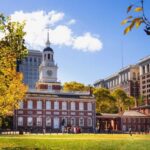

Meeting Point and the Start That Gets You Oriented
Your tour begins at Grim Philly Twilight Tours, 523 Market St, Philadelphia, PA 19106. The session starts with a quick check-in and an introduction that sets the theme of revolutionary Philadelphia, so when you hit the big stops, you’re not trying to guess what you’re looking at.
Expect a group format (maximum 24 travelers) and a guided walk. The tour runs every morning and every afternoon, and it operates rain or shine, so bring the weather gear you’d normally wear for an outdoor stroll.
Liberty Bell: More Than a Famous Icon
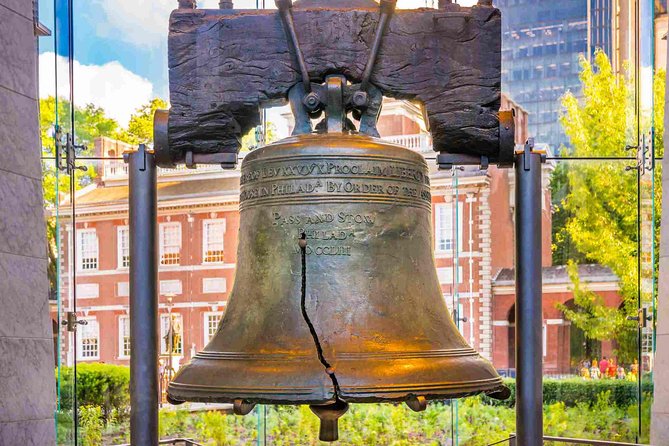
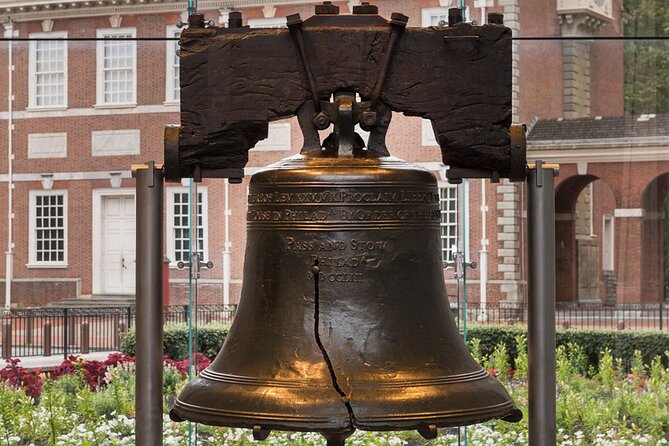
The tour kicks off with the Liberty Bell in the National Historic Park area. It’s one of those sights where the lines can be serious at peak times, and the tour smartly focuses on what you can learn from the exterior pavilion while keeping your timeline realistic.
You’ll hear the essentials of how the bell became a symbol. Commissioned in 1752, it cracked on its initial test ring and was recast about two years later by local workmen John Pass and John Stow. The lettering tied to the bell’s message comes from a biblical line about liberty—Proclaim LIBERTY Throughout all the Land unto all the Inhabitants Thereof—linked to the idea of jubilee, debts forgiven, and freedom every fifty years.
If you want more, there’s an option to spend extra time inside the pavilion (an additional hour free, based on what’s available). The practical move is to treat the bell as your “anchor stop,” then decide on the interior visit if lines and timing look friendly.
Independence Hall and Timed Tickets You Must Plan For
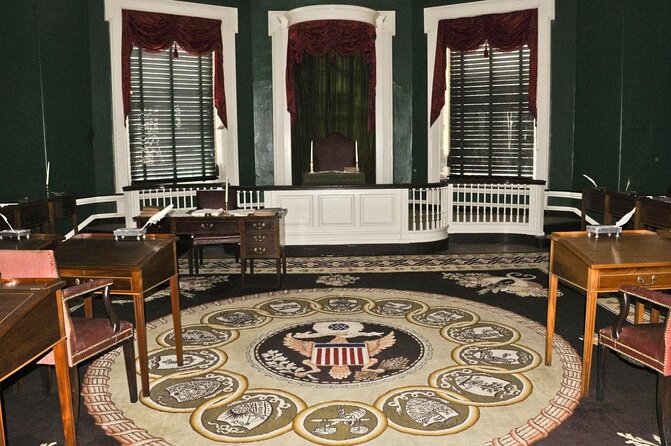
Next comes Independence Hall, the place where the Declaration of Independence and the U.S. Constitution were debated and adopted. This is the stop where your planning matters most, because the complex requires free timed entry passes, and access can involve crowds and closures.
The tour keeps things moving, aiming for the key highlights rather than turning this into a half-day mission. You’ll also get a quick inside moment in the East Wing of the Independence Hall complex, described as the oldest part of the structure and used as Supreme Court Chambers when Philadelphia was the nation’s capital.
If you want to explore everything inside at a slower pace, the tour setup assumes you may want to come back. The complex often works best when you give yourself extra time—around two hours—but on this tour you’ll primarily get the big points and clear direction on how to continue exploring after.
The First Washington-and-Adams Presidency House

After the hot spot of the Declaration/Constitution story, the route shifts into the everyday power of early government. You’ll visit the site of America’s first “White House,” where George Washington and John Adams both served when Philadelphia was the capital from 1790 to 1800.
This isn’t just a building stop—it’s a chance to understand the social side of power. The guide explains how foreign dignitaries and members of Congress and the Senate passed through the President’s House for official and unofficial business, and it also ties in the complicated wartime presence of Benedict Arnold, who lived there as Military Governor in Philadelphia after the British evacuation.
This is where good guides make the city feel smaller. The structure becomes a stage for the people, not just a sign on a street.


Congress Hall: Inaugurations, Law, and Capitol Life
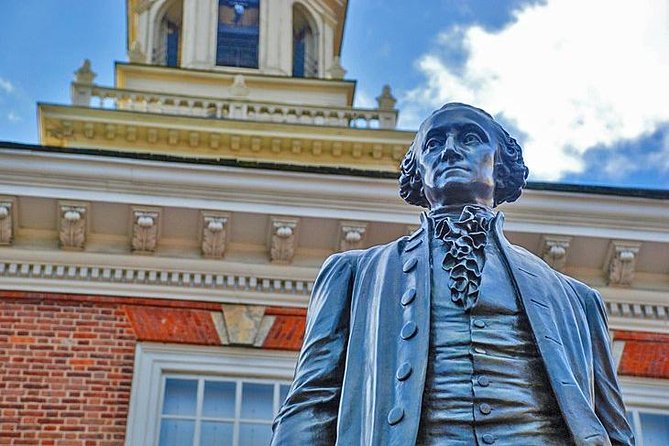
From there, you move to Congress Hall, another core component of the Philadelphia capital era. You’ll learn how this building hosted two presidential inaugurations—Washington and Adams—and served as the home of U.S. Congress from 1790 to 1800.
The value here is context. It’s easy to remember dates and names, but a place like Congress Hall helps you picture how decisions were made when the capital wasn’t Washington, D.C., yet.
The tour approach keeps the walking efficient, but you’ll still get enough detail to know what happened here and why it mattered for the next steps of the revolution and the new nation.
Franklin Court, Printing, and the Ideas Behind the Revolution

One of the most useful parts of this tour is how often it returns to Benjamin Franklin. You’ll visit Franklin Court inside Independence National Historical Park, and the guide connects Franklin’s life to the Constitutional Convention era.
You’ll also hear the line that captures Franklin’s view of unity—Gentlemen we must hang together, or surely we will all hang separately. It’s not just a nice quote; it works well as a “theme sentence” for why revolution became a serious long game.
The tour also includes Franklin-linked sites in a way that helps you separate myth from structure. Instead of treating Franklin as one stop, you’ll see how his work touched communication, institutions, and public service across multiple locations.
The First Pentagon: Military Strategy’s Early Brain
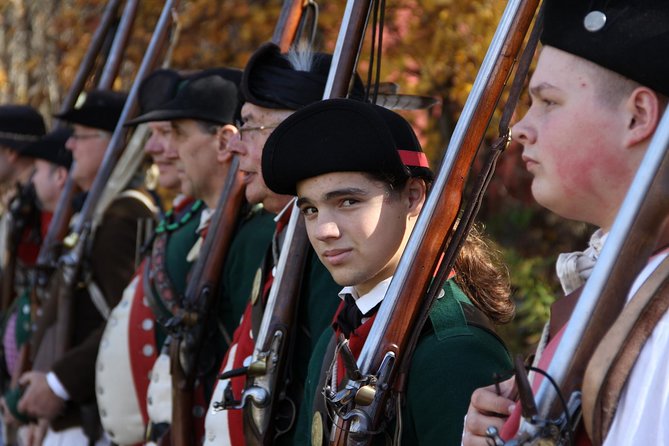
You’ll also visit the location of America’s first “Pentagon,” tied to how American military strategy and intelligence were formulated during the Revolution.
This stop is a reminder that the revolution wasn’t only speeches and papers. It involved planning, information, and decisions that shaped what happened on the ground.
Carpenters’ Hall and the French Connection
Carpenters’ Hall brings the story from broad ideals to international leverage. This is where the First Continental Congress met in 1774, and the tour connects the site to secret winter meetings in December 1775 involving Benjamin Franklin, John Jay, Francis Daymon, and the French spy Julien Achard de Bonvouloir.
The point is simple and important: without French support, colonists likely would have struggled to win the Revolutionary War. Later, when British forces occupied the American capital during the war, this building was taken over, tying the site to both diplomacy and occupation.
If you want a memorable “how did they pull it off” moment, this is it.
Hamilton’s Banks and the Politics of Money
Next comes the early national economy—First Bank of the United States and then the Second Bank site. You’ll learn how Alexander Hamilton championed the first bank, founded in 1797, and why the architecture matters as part of the story.
Then the tour shifts to the second bank era under James Madison (chartered 1816) and how it later lost its charter during Andrew Jackson’s presidency in 1834. The guide also connects Hamilton and Jackson through politics and famous duels, helping you see that early America’s conflicts weren’t only military.
This section is great if you think the revolution is purely about independence. It’s also about building a country that can pay for itself.
Franklin’s Institutions: Society, Lending, and the Post Office
This tour is unusually strong on Franklin’s institutions—because those institutions show how ideas turned into systems.
You’ll pass by the American Philosophical Society, founded by Franklin in 1743 (two years after the University of Pennsylvania). The guide points out the connections: early members included George Washington, John Adams, Thomas Jefferson, Alexander Hamilton, Thomas Paine, David Rittenhouse, and others, with the tour also noting a surgical center adjacent to the site.
You’ll then hear about the Library Company, founded by Franklin in 1731 as the first institution to lend materials to the public.
And one of the most fun, practical stops is the Benjamin Franklin Post Office & Museum—described as the only Colonial-themed post office operated by the U.S. Postal Service. There’s special detail here: it’s the only active post office in the U.S. that does not fly the American flag because it wasn’t yet around in 1775 when Franklin became Postmaster General. The tour also mentions the postmark name, B. Free Franklin, and that the museum upstairs covers postal history and memorabilia.
Even if you’re not a postal-history nerd, this stop helps you see how public life worked before standardized everything.
Dolley Madison’s House: Middle-Class Philadelphia
Near the end of the walk, you’ll visit the home of Dolley Madison, where she lived with her first husband, John Todd, from 1791 to 1793. The Dolley Todd House site is built in 1775, and the guide uses it to show what middle-class life in 18th-century Philadelphia looked like.
This matters because too many founding tours focus only on government buildings. This adds a human scale—who lived where, how people spent days, and how “history” played out beyond committee rooms.
How Long It Really Feels and How Much You’ll See
On paper it’s about 2 hours. In practice, the best part of this tour format is that it covers a lot of ground while staying focused on the revolution-and-founders thread.
It’s also designed with the idea that you’ll return later. After this kind of route, you often know exactly what you want to see at deeper level—whether it’s Independence Hall’s interior complex, Franklin-related museum spaces, or nearby sites that match your personal interests.
One practical note from experience with walking tours in general: the time you lose isn’t the walking, it’s the stopping. On colder days, expect that standing around for exterior explanations can feel longer than you’d like, even when the guide works hard to keep things moving.
Guides, Style, and the Difference Between a Lecture and a Walk
This tour is led by people with a history degree, and the teaching style tends to be story-driven rather than just dates on a map. In recent experiences, guides such as Josh, Kyle, Ted, Joseph, and Vince have been praised for keeping the group engaged with enthusiasm, humor, and animated presentation.
Some guides lean into role-style acting and dramatic reenactments, while others focus on clear sequencing and straightforward explanations. Either way, the goal is the same: you should walk away understanding why each place belongs to the broader 1776 story.
Price and Value: Is $29 Worth It?
At $29 per person, this tour lands in the “good first purchase” category for Philadelphia. You’re not just paying for access—you’re paying for someone to connect sites into a usable mental map.
The value is strongest if you’re short on time or your trip has a tight schedule. Since it runs morning and afternoon and ends after the main walk, you can keep your day flexible. You also come away with clear directions for what to do next, which can save money later by preventing random or repetitive site visits.
Should You Book This Revolution and the Founders Tour?
Book it if you want a fast, guided orientation to Philadelphia’s founding core and you like learning history through people, places, and cause-and-effect. It’s a strong choice for first-time visitors, history buffs, and groups that want a lively walk with a structured route.
Skip it or adjust expectations if you’re mainly interested in going inside lots of major buildings. On this tour, Independence Hall access depends on timed entry, and the focus is on essential highlights rather than long museum time. If you’re visiting in rough weather, dress for being outside for portions of the walk.
FAQ
FAQ
How long is the Revolution and the Founders history tour of Philadelphia?
It’s about 2 hours (approx.).
Where does the tour start and end?
It starts at Grim Philly Twilight Tours, 523 Market St, Philadelphia, PA 19106 and ends at the Merchant Exchange Building, 143 S 3rd St, Philadelphia, PA 19106.
Is this tour mainly walking?
Yes. It’s described as a walking tour, and the stops are designed to be seen in about a couple of hours.
What are the main stops on the tour?
The tour includes the Liberty Bell, Independence Hall, and several other founding-era sites around Old City, including Congress Hall and Franklin-related locations.
Do I need timed tickets for Independence Hall?
Yes. Independence Hall requires free timed entry passes, and the tour notes you may want extra time for interior exploration on your own.
Does the tour run in bad weather?
It runs rain or shine. The experience notes it requires good weather, and if it’s canceled due to poor weather you’ll be offered a different date or a full refund.
What group size should I expect?
The tour has a maximum of 24 travelers.