REVIEW · ATHENS
Full Day Biblical Ancient Corinth Canal Mycenae Epidauvro Nafplio
Book on Viator →Operated by Yomadic.Tours & Transfers · Bookable on Viator
Ruins meet seaside drama in one long day. This trip strings together Ancient Corinth, Bronze Age Mycenae, and the photogenic hilltop fortresses of Nafplio—plus a Bible-linked stop in the Corinth region.
I especially like two things. First, the day is built around real geography: the canal that slices the Peloponnese, the steep ascent to Acrocorinth, and the view scramble up Palamidi. Second, it’s genuinely easy to do because you’re in a modern private car with WiFi, A/C, and bottled water, with an English-speaking driver who can explain what you’re seeing as you go.
One thing to consider: this is a full day with lots of walking and steps, and you should budget extra for site tickets where needed since entrance fees aren’t included.
In This Review
- Key things to know before you go
- Starting in Athens: private comfort beats a long day of stress
- Corinth Canal: the shortcut that took centuries to build
- Kenchreai and the New Testament trail around Corinth
- Ancient Corinth’s forum spaces: Paul’s trial and the Bema tradition
- Corinth Archaeological Museum: quick context that makes ruins click
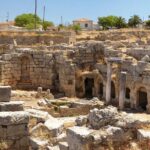
- Temple of Apollo and the layered city walk
- Acrocorinth: the fortress that watches over the isthmus
- Mycenae Citadel: Bronze Age power, Cyclopean walls, and a wow gate
- Museum time at Mycenae: use it to understand what you just walked through
- Treasury of Atreus: the Tomb of Agamemnon and a seriously heavy door
- Palamidi Castle in Nafplio: the view is the point, and the steps are real
- Nafplio old town and sea-side lunch: where the day softens
- Bourtzi fortress-islet: the tiny postcard stop
- Syntagma Square, Acronauplia, and the Lion of the Bavarians
- Price and value: what $277.09 buys you (and what it doesn’t)
- Who this tour suits best
- Should you book this tour?
- FAQ
- How long is the tour?
- What does the tour cost?
- Is pickup offered, and where can I be picked up?
- Is this tour private?
- What languages are available?
- Are entrance fees included?
- Will I have a licensed guide inside the archaeological sites?
- Is lunch included in Nafplio?
- Is the tour good for people who struggle with steps?
- What’s the cancellation rule if weather is bad?
Key things to know before you go
- Private door-to-door pickup from your Athens hotel, Airbnb, or the port, with return to your starting point
- Corinth Canal context: a 19th-century build for a 2,000-year-old dream that once forced ships to sail around the Peloponnese
- Paul-era connections in Corinth: Kenchreai’s Bible link and the Bema tradition connected to Saint Paul’s trial
- Mycenae must-sees: Lion Gate, Cyclopean-style fortification walls, and the Treasury of Atreus (Tomb of Agamemnon)
- Nafplio’s Palamidi climb: Venetians built the fortress; locals joke about the 999 steps, with the stairs tall either way
- Driver-led flexibility since it’s private and customizable for pacing and priorities
Starting in Athens: private comfort beats a long day of stress
If you’ve ever done a Peloponnese day trip on public transport, you know the main enemy is time. Here, you skip the scramble. Your driver meets you in the hotel lobby, at your apartment entrance, or at the port gate with your name sign, then you head out in a modern Mercedes Taxi–style vehicle or Skoda luxury car. WiFi, A/C, and bottled water make the ride feel less like a transfer and more like part of the experience.
I like that the tour is set up for small groups. If you’re 1–3 people, you’re in a sedan; 4–7 people go in a mini van. Either way, it stays conversation-friendly because you’re not packed shoulder-to-shoulder like a bus tour.
One more practical point: many stops have only short time windows, so the driver’s pacing matters. A good driver helps you see the key stuff without feeling rushed, and the service is built around that—especially if you tell them what you care about most.
A few more Athens tours and experiences worth a look
Corinth Canal: the shortcut that took centuries to build
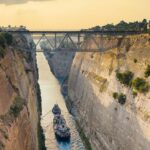
Corinth Canal is one of those places where you instantly see why people dreamed about it for so long. The canal cuts across the narrow isthmus of Corinth, linking the Gulf of Corinth to the Saronic Gulf. In other words, it literally separates the Greek mainland from the Peloponnese, turning the peninsula into an island for ships.
What makes it more interesting than just a scenic ditch is the long timeline. Ships once had to go the long way around the Peloponnese—about 185 nautical miles extra—just to cross between sea areas. The canal was finally executed in the late 19th century, but the idea was around far earlier. The story goes that Periander, tyrant of Corinth around 602 BC, first conceived it. Since cutting a canal was beyond the technical ability of the day, he built the diolkos: a stone road that allowed ships to be transferred over land on wheeled platforms.
You’ll spend about 15 minutes here, so treat it like a quick orientation stop. Bring your camera and aim for angles that show both sides of the isthmus. This is the kind of place where a short stop still pays off because the geography does most of the storytelling.
Kenchreai and the New Testament trail around Corinth
Next comes the Corinth region and a stop tied closely to early Christianity: Kenchreai (also linked to the biblical name Cenchreae). It’s a village in the Corinthia area and the place is tied to an ancient port town believed to sit on the same location.
The connection is specific in the New Testament. According to Acts, Paul stopped at Kenchreai during his second missionary journey. He had his hair cut to fulfill a vow—often understood as a Nazirite-style vow. And Paul also mentions Phoebe in connection with the local assembly in Romans, which adds another human detail to what can otherwise feel like ruins-with-a-side-of-history.
This is also a good time to reset mentally. The day can feel dense—ancient places layered on ancient places. A stop like Kenchreai helps the day feel more personal because it’s not only about architecture. It’s about people moving through places, making choices, and forming communities.
Expect around 15 minutes at this stop. That’s enough time to take in the setting and listen for the story thread your driver connects back to the sites ahead.
Ancient Corinth’s forum spaces: Paul’s trial and the Bema tradition
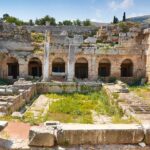
Ancient Corinth is where the day starts feeling like you’re walking in a chapter book. You’ll spend time around the Roman-era city center and hear the story of the trial connected with Paul and the proconsul Lucius Junius Gallio Annaeanus (Gallio).
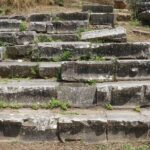
In the tradition tied to this area, Paul is brought before Gallio on accusations related to teaching. Gallio doesn’t treat it as a state matter, viewing it as a religious dispute. The key site detail here is the Bema—an elevated rostrum in the center of the Roman Forum where officials addressed the public. Because of the association with Saint Paul, the Bema was later transformed into a Christian church during the Byzantine period.
You’ll have about 45 minutes at Ancient Corinth in this stretch. That’s a solid window if you focus on three things: the forum layout, the public speaking symbolism of the Bema idea, and how the Christian reuse of a Roman civic feature shows how later generations reinterpreted earlier spaces.
Note: this stop (and some others) may require additional tickets that aren’t included. Your driver can help you plan so you don’t lose time at the gate.
Corinth Archaeological Museum: quick context that makes ruins click
After the open-air pieces, the Archaeological Museum of Ancient Corinth is scheduled for about 30 minutes. The museum was constructed between 1931 and 1932 to display findings from excavations at the Ancient Corinth site.
This kind of short museum time is not about hours of study. It’s about getting your bearings fast. Once you see objects and local finds, the shapes you’re walking past outdoors start making stronger sense—especially around urban features like roads, fountains, and the civic space logic that Roman Corinth used.
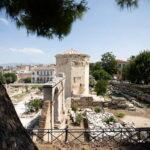
From the museum setting, you’re in the larger archaeological area, with notable elements in and around the complex such as the Hadgimoustafa spring, the Lechaion Road area, a basilica, and features like the Fountain of Peirene, stoa, Agora, and the Odien. Even if you don’t read every label, this stop helps you understand that the city wasn’t random. It was organized.


Temple of Apollo and the layered city walk
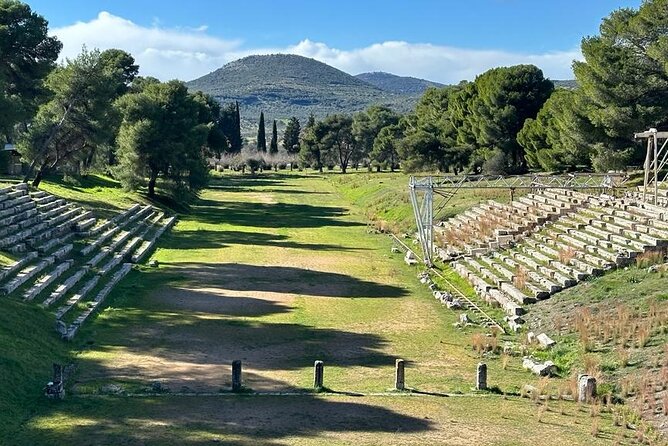
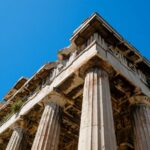
You’ll then pause at the Temple of Apollo, described as one of the earliest Doric temples in the Peloponnese and Greek mainland, built around 550 BC. A standout detail here is that the temple used monolithic columns—rare in the ancient world.
You also get time around the Ancient Corinth complex components such as the Agora: a rectangular arrangement about 160 m long and 70 m wide, with central shops, small temples and an altar, plus that famous Bema/podium connection to Paul’s presence in Corinth around 52 AD.
This portion is shorter (some stops are 10 minutes). So I’d treat it like: look, locate, and connect. Your driver’s job here is to tie the pieces together so you don’t feel like you’re hopping from one stone to another with no map in your head.
If you’re someone who likes to linger, tell your driver early. With a private setup, you may be able to shift a few minutes rather than losing the whole stop.
Acrocorinth: the fortress that watches over the isthmus
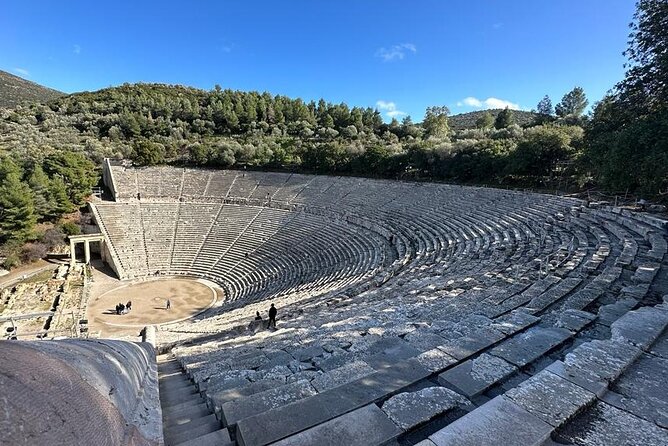
Then you climb (without necessarily doing the full marathon of the summit hike) to Acrocorinth, meaning Upper Corinth. Acrocorinth is an acropolis on a monolithic rock overlooking ancient Corinth, and it was fortified with a secure water supply that made it a last-line defense for southern Greece.
Why it matters: this place isn’t just scenic. It tells you how Corinth controlled movement. The fortress commanded the Isthmus of Corinth, repelling foes from entering the Peloponnese by land.
This stop is scheduled for about 15 minutes. That doesn’t sound like much, but it’s enough to appreciate the strategic logic: once you understand the view, the defense makes sense.
Wear shoes that handle uneven surfaces. The ground around fortresses can be rough, and a short stop still deserves stable footing.
Mycenae Citadel: Bronze Age power, Cyclopean walls, and a wow gate
Mycenae is where the day turns into full-on Bronze Age. You’ll see the fortified citadel, associated with the mythical King Agamemnon. The site is also tied to the Mycenaean civilization—so when you walk here, you’re walking through the naming source of an entire era (roughly 1600 BC to 1100 BC).
You’ll have about 1 hour at Mycenae (with entry marked free in the schedule for this main stop). What makes it impressive isn’t one single object. It’s the way everything reinforces the story of strength: the citadel’s walls, its major monumental entrance, and the sense that this was a power hub dominating large areas in its peak.
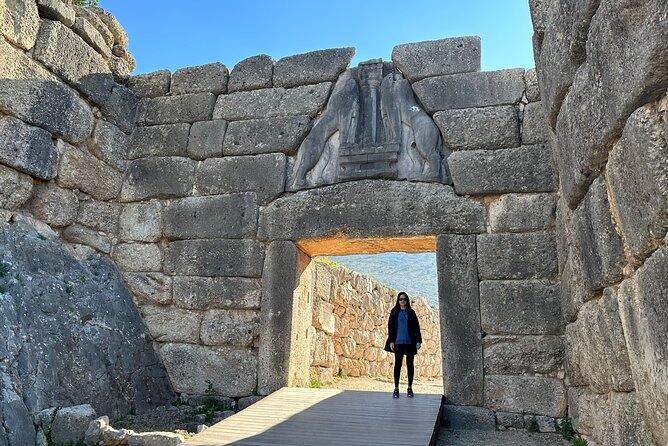
One of the top moments is the Lion Gate, erected around the 13th century BC (around 1250 BC). It’s named for the relief sculpture of lionesses (or lions) in a heraldic pose above the entrance. The gate is also described as the only surviving monumental piece of Mycenaean sculpture and the largest sculpture in the prehistoric Aegean. It even has a relief image described in classical antiquity literature, meaning it was well known before modern archaeology.
You’ll get a separate short stop for Lion Gate itself (about 19 minutes). If you want one photo that sums up Mycenae, this is it.
Museum time at Mycenae: use it to understand what you just walked through
The Archaeological Museum of Ancient Mycenae is on the schedule for about 15 minutes. Here, the focus is the fortified acropolis plus surrounding funerary and habitation sites, mainly to the west and southwest.
Most visible monuments date to the city’s floruit between 1350 and 1200 BC. The museum time is short, but it helps you translate what you saw outside—especially the big structural elements like the near-triangular acropolis and the access route through the Lion Gate.
Since some sites aren’t included for entry, plan for extra cost if you’re going to be ticketing on the day. Even if you skip one internal museum moment later, you’ll still get the core Mycenae experience outdoors.
Treasury of Atreus: the Tomb of Agamemnon and a seriously heavy door
Next is the Citadel and Treasury of Atreus, also called the Tomb of Agamemnon. It’s a tholos (beehive) tomb on Panagitsa Hill, constructed around 1250 BC. If you’re the type who likes construction feats, this is a great payoff.
A detail that grabs your attention: the stone lintel above the doorway weighs about 120 tons. The provided dimensions are about 8.3 x 5.2 x 1.2 meters. For most people, that’s the kind of fact you remember long after you leave because it makes scale feel real.
You’ll have about 15 minutes here. Again, treat it like a “see and orient” stop, then connect it to the gate and walls you already saw at the citadel.
Palamidi Castle in Nafplio: the view is the point, and the steps are real
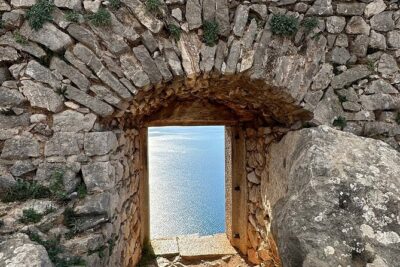
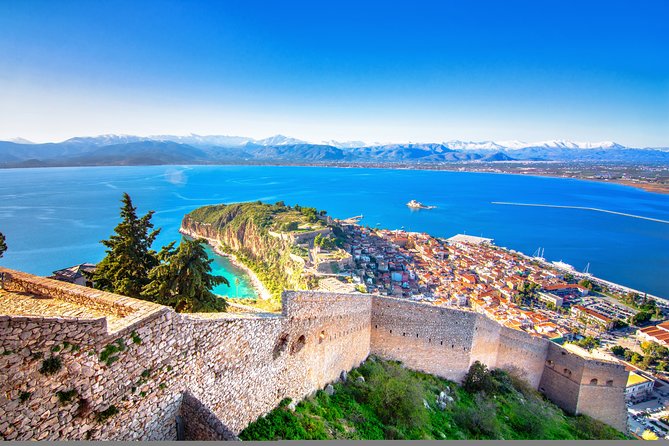
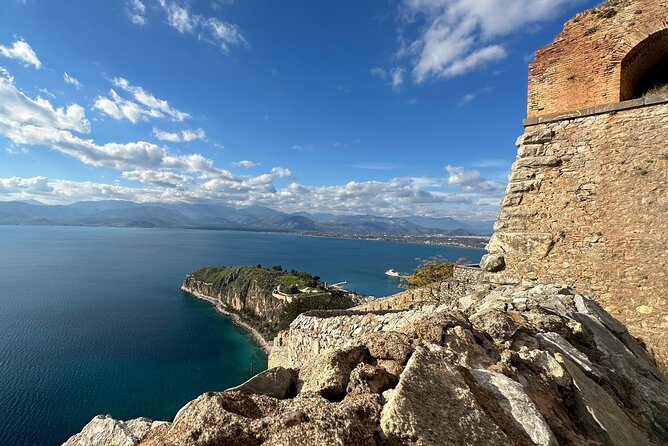
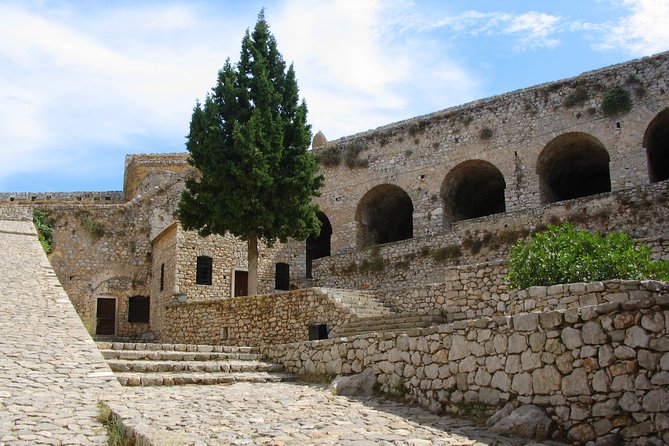
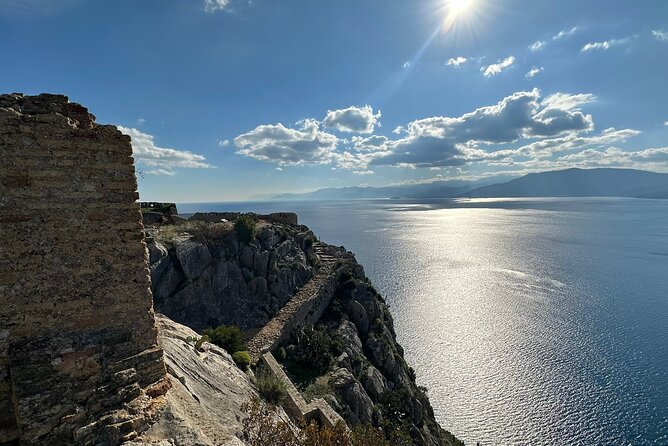
Now you shift from Bronze Age walls to Venetian-era drama. Palamidi Castle overlooks Nafplio from a hilltop about 216 meters high, and it was built by the Venetians during their second occupation (1686–1715).
The scheduled time is around 30 minutes, and you’ll likely feel why people come here: the views over the Argolic Gulf, Nafplio, and the surrounding country are the star of the show.
But let’s be honest about the stairs. There’s a famous climb from Nafplio up to the fortress with “999 steps” as the local nickname. Your info notes that there are 913 steps in the winding stair to reach the fortress, but locals will tell you there are over a thousand—still landing on 999 in their telling. Either way, this is a stop for strong legs or smart pacing.
If you hate stair climbs, tell your driver. You may still be able to enjoy the area with a reduced walking plan, but you should set expectations ahead of time.
Nafplio old town and sea-side lunch: where the day softens
After the fortress climb, the schedule gives you about 2 hours in Nafplio. This is old-town time: cobbled streets, doll-like mansions, flowered balconies, and those small stone steps that seem to lead to different neighborhoods every few minutes.
You’ll also hear about Syntagma Square as the zero point of the old town, with a central openness that helps you orient. From there, it’s easy to spend your attention on the mix of architecture—Venetian, neoclassical, and oriental elements—because the streets sort of invite wandering without needing a map.
Lunch is scheduled at a traditional tavern by the sea, but the meal itself isn’t included. This is your moment to refuel without turning it into a major detour. If you’re traveling in shoulder season or on a windy day, eating near the water can feel extra nice.
Also: if you want photos, aim for late afternoon light. Nafplio rewards slow glances at building details as much as it rewards skyline shots.
Bourtzi fortress-islet: the tiny postcard stop
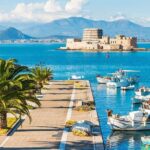
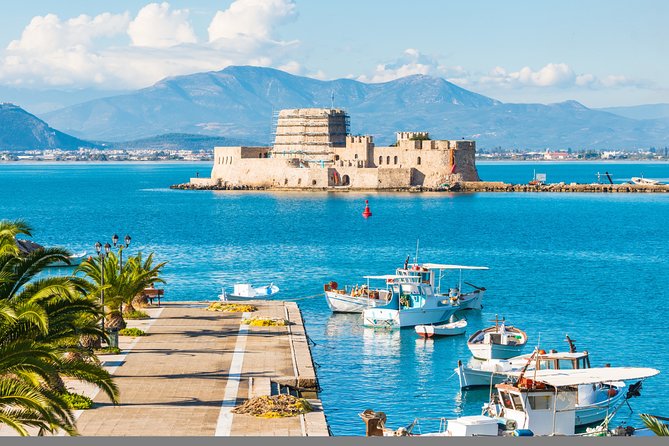
Then it’s Bourtzi—the small fortress on an islet (Agioi Theodoroi). It was built by the Venetians in 1473 and was called Castello dello Soglio, meaning Castle of the Throne. Later, Ottomans used the name Bourtzi, basically meaning fortress, and it stuck.
This stop is about 1 hour. The key point is that it’s a visual knockout: today Bourtzi is known as a perfect postcard backdrop, especially for sunset photos. You reach it by boat in less than 10 minutes.
Entrance details aren’t included, but even without going “all in,” you’ll get the setting value here. Plan your photos so you don’t lose your lunch-time energy.
Syntagma Square, Acronauplia, and the Lion of the Bavarians
The final stretch is more about character than monuments.
You’ll spend around 30 minutes at Syntagma Square and the area near the Parliament. The story told here involves Venetian treasure hunting and Ottoman-era intrigue, then transitions into the Greek state building period under Kapodistrias when the Parliament of the newly formed Greek state was constructed. There’s also mention that the Municipal Gallery of Nafplio can be visited on the ground floor today.
Next is Acronauplia Fortress, described as the oldest part of Nafplio, transformed over time by Venetians and Franks into fortifications. Part of it was used as a prison, and later a hotel complex was built there so tourism could benefit from the views.
You’ll finish with a stop for the Lion of the Bavarians, carved into the rock above Michael Iatrou Street. It’s a large sculpture by German sculptor Christian Ziegel, commissioned by King Louis, father of Otto, in memory of Bavarian soldiers who died in Nafplio in 1833 due to a typhoid epidemic. Locals even have an unofficial nickname tied to what they say caused the soldiers’ suffering.
These stops are short, but they help the day land with personality. You go from “ancient power” to “modern city stories” in a way that feels satisfying.
Price and value: what $277.09 buys you (and what it doesn’t)
At $277.09 per person for a 9–10 hour private day, you’re paying for three big things: transport, pacing, and low-stress logistics.
- You get a private vehicle (and the comfort add-ons like WiFi, A/C, and bottled water).
- You get an English-speaking driver with historical storytelling, which matters on a day with many short stops.
- You get pickup and drop-off flexibility from Athens hotels, Airbnb residences, or the port.
What’s not included is important. Entrance fees aren’t included, and the schedule also notes that there’s no licensed guide who goes inside archaeological sites with you. That doesn’t ruin the day, but it means your driver becomes your main interpretive layer.
So your real budget picture looks like:
- Your tour price plus
- Site tickets where required plus
- Lunch costs at the sea-side tavern
If you’re traveling with a small group, this private format can be a strong value compared with piecing together multiple buses and separate entrance costs.
Who this tour suits best
This is a great fit if you want:
- A Bible-and-ancient-world themed day without doing planning math all morning
- Big-name sites in a single sweep: Corinth Canal, Ancient Corinth spaces, Mycenae gate and tomb highlights, then Nafplio fortresses
- A private, driver-led format where you can speak up if you want more time at a specific view
It’s also ideal for couples or small groups who don’t want to negotiate meeting points. You get one-to-one attention from your driver, and the private setup makes it easier to adjust pacing when you hit crowds or when weather changes.
Should you book this tour?
Yes, if you want a structured but not rigid day across Corinth, Mycenae, and Nafplio, with the comfort of private transport and a driver who can connect the dots between locations. The best reasons to book are the combination of Corinth Canal geography, Paul-linked Corinth context, and the payoff views from Palamidi’s climb.
I’d skip or at least rethink it if you hate stairs or know you’ll struggle with walking. Also, plan for extra costs for site entries and lunch, because those aren’t bundled in.
If you’re good on your feet and you like history that’s tied to real places, this is one of those “full day, worth it” Peloponnese routes.
FAQ
How long is the tour?
It runs about 9 to 10 hours.
What does the tour cost?
The price is listed as $277.09 per person.
Is pickup offered, and where can I be picked up?
Yes. Pickup is offered from Athens hotels, Airbnb residences, or the port. Your driver will meet you in the hotel lobby, at your apartment entrance, or at the port gate with a name sign.
Is this tour private?
Yes. It’s described as a private tour/activity, with only your group participating.
What languages are available?
It’s offered in English.
Are entrance fees included?
Entrance fees are not included. Some items may be shown as free in the schedule, but you should budget for tickets where admission is required.
Will I have a licensed guide inside the archaeological sites?
No. The information provided notes that a licensed guide to accompany you into archaeological sites is not included.
Is lunch included in Nafplio?
Lunch is scheduled at a traditional tavern by the sea, but meal costs are not included.
Is the tour good for people who struggle with steps?
Palamidi is a major walking component with the well-known 999-steps climb. If stairs are a problem for you, you should consider that before booking.
What’s the cancellation rule if weather is bad?
Free cancellation is offered up to 24 hours in advance. If it’s canceled due to poor weather, you’ll be offered a different date or a full refund.