REVIEW · YEREVAN
Yerevan: Garni, Geghard, Symphony of Stones & Lavash Baking
Book on Viator →Operated by ONE WAY TOUR · Bookable on Viator
Ararat views in just one morning. I like the Ararat viewpoint at Charents Arch, and I really enjoy how local guides turn each UNESCO stop into a story you can actually follow. It’s a packed half-day route, but it doesn’t feel like a race.
You’ll move between sites by minibus, with a group size capped at 20 people, and the day is set up to keep you outdoors at the right moments. If you care about ancient Armenia plus real scenery near Yerevan, this hits that sweet spot.
The only real drawback is weather. Cloudy skies or snow can limit the Ararat viewpoint and, at times, affect whether you can fully make the Symphony of Stones stop. Entrance fees at two sites are also extra.
In This Review
- Key highlights worth your time
- Getting oriented: Komitas Conservatory pickup and a 9:00 start
- Charents Arch: the Mount Ararat viewpoint that frames the whole day
- Geghard Monastery: rock-cut UNESCO walls and the Spear legend
- Symphony of Stones at Azat Canyon: the basalt organ effect
- Garni Temple: Mithra, the 1679 earthquake, and a rebuilt pagan shrine
- Lavash baking master class: turning bread-making into a hands-on moment
- Price and value: what you pay for, what costs extra
- How the day runs in real life: timing, pacing, and transit comfort
- Who this Garni–Geghard–Stones day trip is best for
- Should you book this tour?
- FAQ
- How long is the Yerevan Garni, Geghard, Symphony of Stones & lavash tour?
- What time does the tour start?
- Where is the meeting point?
- Does the tour include entry to Garni and the Symphony of Stones?
- Is lavash baking included?
- Is the Mount Ararat viewpoint included?
- Are tickets included for Geghard Monastery?
- Is the tour offered in English?
- What happens if the weather is poor?
- How many people are on the tour?
Key highlights worth your time
- Charents Arch viewpoint with Mount Ararat Temple roots and big poem lettering
- Geghard Monastery carved into rock, plus the Spear legend behind its name
- Symphony of Stones in Azat Canyon, where hexagonal basalt forms a natural organ look
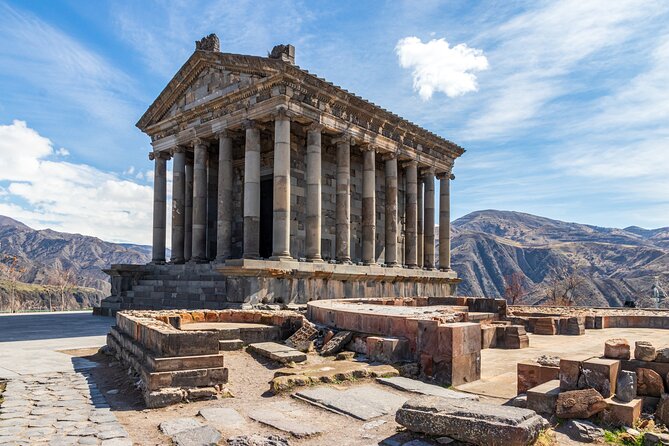
- Garni Temple, a 1st-century Mithra shrine rebuilt after the 1679 earthquake
- Lavash baking master class included, with time to taste and learn the basics
- Small-group pacing (max 20) that keeps you from feeling lost at each stop
Getting oriented: Komitas Conservatory pickup and a 9:00 start
This is a classic short Yerevan excursion with a 9:00 am start, about 6 hours total. You meet near the Komitas Yerevan State Conservatory (1a Sayat-Nova Ave, Yerevan 0001). The tour uses a mobile ticket, and it’s described as easy to reach by public transport.
The small group size matters more than it sounds. With up to 20 people, the guide can actually manage the flow between stops. That shows up at places like Geghard, where you want time to look around without getting swallowed by a crowd.
English is the main language, but on some departures you might hear another language in the mix. Either way, you’ll get the story at each site before you’re left to explore.
You can also read our reviews of more tours and experiences in Yerevan.
Charents Arch: the Mount Ararat viewpoint that frames the whole day
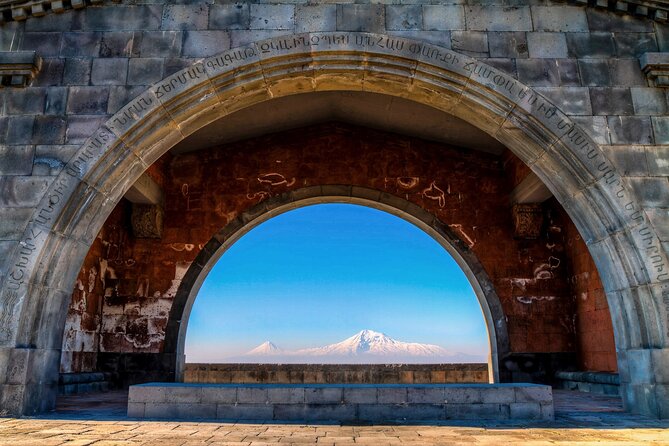
Your first stop is Charents Arch, also tied to the Mount Ararat Temple idea. The viewpoint sits above the village of Voghjaberd, and the structure was completed in 1957 by architect Rafael Israelyan. It later became widely known as the Arch of Charents because of Yeghishe Charents’s poem, whose final line is engraved in large letters at the front.
I like this opening stop because it gives you context immediately. Armenia’s mountains are not background scenery here. Mount Ararat is a symbol, and seeing it from Charents Arch helps you understand why later sites (like Geghard and Garni) carry such strong meaning.
Practical note: this is a viewpoint stop with free admission, and it’s also the one most affected by weather. If the sky is hazy, don’t panic. You’ll still learn the history and still enjoy the setting, but you may get a weaker Ararat moment.
Geghard Monastery: rock-cut UNESCO walls and the Spear legend
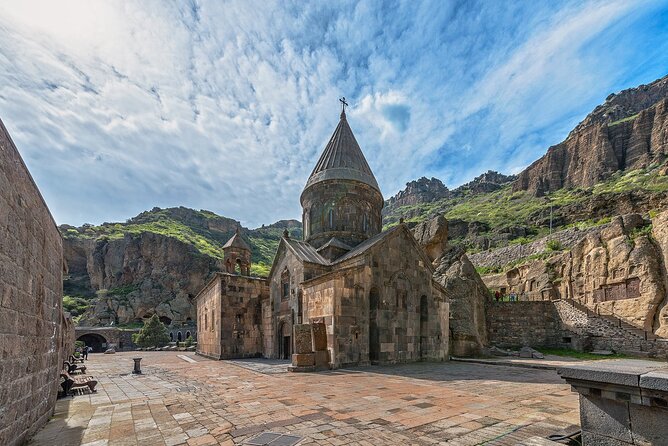
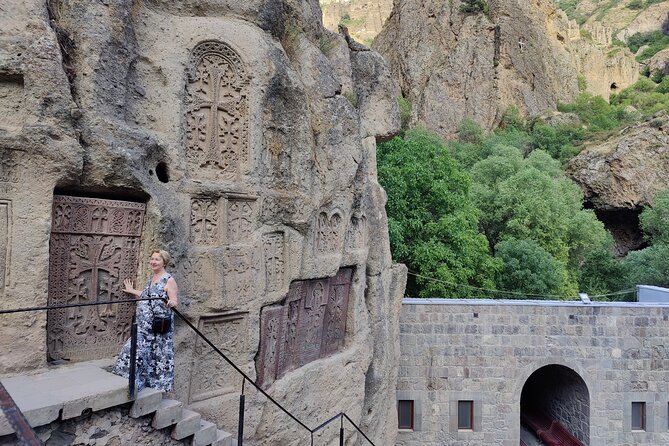
Next comes Geghard Monastery, one of Armenia’s most striking medieval sites. It’s in Kotayk Province and built partly into the adjacent mountain—so you’re literally moving through architecture that feels carved and protected at the same time. The complex sits within cliffs, which makes the whole place feel more enclosed and quiet than you might expect.
The name Geghard (Geghardavank) means “Monastery of the Spear.” That comes from a religious story: the spear associated with Jesus’s crucifixion is linked to Armenia through Apostle Jude, sometimes named Thaddeus. According to the tradition explained here, the relic was stored among others and is displayed in the Echmiadzin treasury.
This stop is free entry and lasts about 1 hour, which is a good length for Geghard. You don’t just rush through dark corridors and rock chambers. You get enough time to pause, look at the carving details, and let the guide’s connections between story and stone sink in.
One more thing I appreciate: this is a UNESCO-listed site with enhanced protection status, so it’s not just a pretty ruin. It’s treated like something serious—by the caretakers and by the way the guide frames it.
Symphony of Stones at Azat Canyon: the basalt organ effect
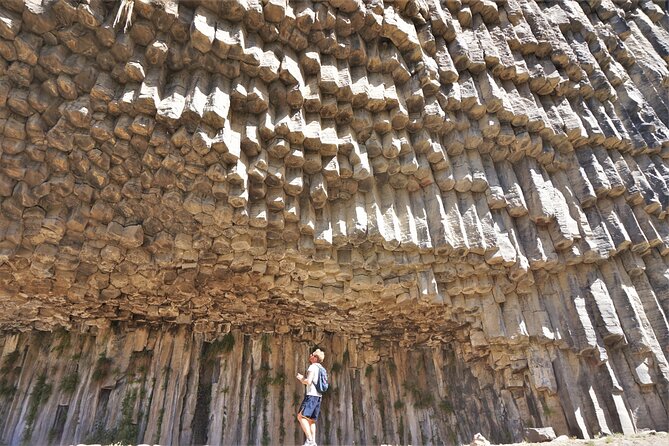
After Geghard, you head to the Symphony of Stones. The idea is simple, and the result is wild to look at: natural basalt columns and hexagonal stones stretch across the canyon in a line. From certain angles they resemble an organ—hence the nickname Symphony of Stones.
This stop is about 1 hour, and entrance is 300 AMD (not included). I’d budget that extra cost up front so you don’t have to decide on the spot.
What makes it special is the setting. Azat Canyon gives you that “out of the city, into geology” feeling. You’re not indoors, and you’re not in a museum hallway. You’re looking at stone patterns shaped by nature, and the guide helps you see the structure rather than just snapping photos.
Weather can be a factor here. Some departures have had changes due to snow or visibility, and in some cases the Symphony stop might not happen. If this is the main reason you booked, keep your expectations flexible and go with the plan for the day you actually get.
Garni Temple: Mithra, the 1679 earthquake, and a rebuilt pagan shrine
Then it’s Garni Temple, a standout for anyone who wants Armenia beyond medieval monasteries. The temple dates to the 1st century and is dedicated to Mithra, the sun god. What makes it extra meaningful is that it’s described as the only preserved pagan temple in Armenia and in the territory of the former USSR.
It also has a comeback story. The temple was destroyed by a devastating earthquake in 1679, then restored in the period 1968–1975. That mix of long history and physical rebuilding helps you understand why Armenia’s heritage includes both survival and careful restoration.
You’ll get about 1 hour here, and admission is 1500 AMD (not included). This is the stop where I recommend slowing down a bit, even if you’re tempted to sprint for photos. The guide’s narration makes more sense once you’ve looked at the temple from a couple of angles and noticed the scale.
Lavash baking master class: turning bread-making into a hands-on moment
The day ends with a lavash baking experience. It’s about 40 minutes, and it is included in the tour price.
This is the practical, satisfying part of the day. You’ll watch how Armenian lavash is baked and learn what makes it different from the flatter breads you might know. Many people also mention the tasting side—because bread is involved, not just storytelling.
That said, lavash experiences can vary in how participatory they feel. Some people loved it as an engaging demo; others described it more like watching for a short stretch before getting to try. Either way, it’s still a good cultural add-on because it connects history (food traditions last) to a real skill you can recognize later.
Price and value: what you pay for, what costs extra
At $23 per person, the value is solid—especially because you’re not just paying for entrance fees.
What’s included:
- Guide service
- Transport service
- Lavash baking master class (included)
What’s not included:
- Garni entrance fee: 1500 AMD
- Symphony of Stones entrance fee: 300 AMD
Charents Arch and Geghard are both listed as free. So your main “pay later” moments are those two tickets. When I think about value for tours like this, I don’t just look at the base price. I look at how much transport saves you, and how much guide context you get while you’re at each UNESCO site. For a half-day cluster of major landmarks, the pricing makes sense.
Also, because the group is capped (max 20 people), you tend to get better pacing than larger tours. That matters at sites where the guide needs everyone to regroup.
How the day runs in real life: timing, pacing, and transit comfort
This is a stop-by-stop day: viewpoint, monastery, canyon geology, pagan temple, bread-making. Each major site is timed at about 1 hour (except lavash at 40 minutes). That structure keeps you from feeling stuck in any one place too long.
Transit is by minibus, and multiple guides and drivers show up in the experience reports for this route. People often highlight that the guides are good at storytelling and that drivers handle road conditions carefully—especially in winter weather. Still, if you’re sensitive to cold or heat, you may want to dress in layers. Some people have wished for stronger air conditioning in the vehicle on certain days.
Another small tip: arrive a few minutes early at the meeting point. This tour depends on regrouping on time, and a calm start makes every later stop smoother.
Who this Garni–Geghard–Stones day trip is best for
I’d point you toward this tour if you want:
- A first-time Armenia snapshot without spending a full day on logistics
- UNESCO sites packed into one drive (Geghard plus Symphony of Stones, with Garni Temple as a major companion)
- A guide who explains what you’re looking at, not just where to stand
- A short day that still includes something local and practical (lavash)
It can also work well for solo visitors, because small-group tours give you easy conversation moments without forcing it. Just expect a social, guided rhythm rather than quiet roaming.
If you’re the type who wants maximum hands-on participation everywhere, double-check the lavash format before you go. Some people experienced it as a more demo-forward session, while others found it engaging and tasty.
Should you book this tour?
Yes, I think you should book it if your priority is a high-value UNESCO-and-culture day that leaves Yerevan without fuss. The combination of Geghard, Garni Temple, and the Symphony of Stones is a great use of time, and the included lavash experience gives the day a more human ending than another photo stop.
Book with one expectation-setting mindset: weather can change what you see, especially the Ararat viewpoint and possibly the Symphony stop. If Ararat visibility is your top obsession, pick your date thoughtfully and stay flexible.
One last practical check: keep a bit of cash for entrance fees at Garni and the Symphony of Stones. Those are not included, and paying on the spot is easiest when you’re prepared.
FAQ
How long is the Yerevan Garni, Geghard, Symphony of Stones & lavash tour?
It runs for about 6 hours (approx.).
What time does the tour start?
The start time is 9:00 am.
Where is the meeting point?
You meet at Komitas Yerevan State Conservatory, 1a Sayat-Nova Ave, Yerevan 0001.
Does the tour include entry to Garni and the Symphony of Stones?
No. Garni entrance is 1500 AMD and Symphony of Stones entrance is 300 AMD, and both are not included.
Is lavash baking included?
Yes. The lavash master class is included, lasts about 40 minutes, and has no separate ticket listed.
Is the Mount Ararat viewpoint included?
Yes. The tour includes a viewpoint stop at Charents Arch, with free admission.
Are tickets included for Geghard Monastery?
Yes. Geghard is listed as free admission for this tour.
Is the tour offered in English?
Yes. This activity is offered in English.
What happens if the weather is poor?
This experience requires good weather. If it’s canceled due to poor weather, you’ll be offered a different date or a full refund.
How many people are on the tour?
The group is capped at a maximum of 20 travelers/people.