REVIEW · LISBON
Private Full-Day Historical Tour of Medieval Évora
Book on Viator →Operated by Outing Portugal · Bookable on Viator
Medieval Évora, packed into one day. This private full-day tour runs about 8 hours and takes you through Évora’s most famous layers, from the Roman Templo Romano de Evora to the power of the Portuguese monarchy at Palácio de Dom Manuel. I like the UNESCO City-Museum feel of the historic center, and I like how the guide encourages questions and connects the buildings to the bigger story of Portugal’s changing governments (Diogo is specifically praised for this kind of back-and-forth).
One consideration: two big-ticket sights charge extra, so plan for Cathedral of Évora (€4 per person) and the Chapel of Bones (€6 per person) on top of the tour price.
In This Review
- Key highlights worth planning for
- Évora’s UNESCO City-Museum makes the day feel bigger
- From Roman Temple to Praça do Giraldo: your bearings in the historic center
- Cathedral of Évora: granite walls with a start date that stretches for decades
- Chapel of Bones: the stop that hits fast, then stays with you
- Aqueduto da Água de Prata: water infrastructure you can actually picture
- Roman Temple revisit energy: Liberalitas Julia and the commercial pull
- Palácio de Dom Manuel: where royal power shows up in plain sight
- A private tour pace that turns questions into part of the experience
- Price and value: what you’re really paying for at $187.84
- Getting from Lisbon to Évora without the stress spiral
- Who this tour suits best (and who may want a different plan)
- Should you book this Medieval Évora day tour?
- FAQ
- How long is the Private Full-Day Historical Tour of Medieval Évora?
- What is the price per person?
- Are tickets included for the Cathedral of Évora and the Chapel of Bones?
- Do I get pickup from my accommodation?
- Is this a private tour or shared group?
- Is the tour in English, and can service animals join?
- What happens if the weather is poor?
Key highlights worth planning for
- UNESCO World Heritage setting: Évora’s historic center is treated like an open-air museum, not a checklist.
- A tight order of stops: Roman roots, the main square, then cathedral and bones, so the city’s story reads in sequence.
- Two famous interior visits (extra fees): cathedral + Chapel of Bones are included as stops, but you’ll pay entrances separately.
- Prata Aqueduct engineering: you get the short, high-impact version of a 16th-century infrastructure story.
- Royal lineage at Palácio de Dom Manuel: even with a brief visit, it helps you understand where power lived.
Évora’s UNESCO City-Museum makes the day feel bigger
Évora is one of those rare places where you don’t feel like you’re “traveling between sites.” You feel like you’re walking through time, block by block. The historic center is recognized as a UNESCO World Heritage Site, and it earns the City-Museum nickname for good reason: the buildings look like they were collected over centuries and left standing in the open.
This matters because your day doesn’t hinge on one monument. You get a run of landmarks that represent different eras—Roman, medieval Christian, and the later Portuguese monarchy—so the city reads like a timeline. It’s also a relief that you’re not doing this hopscotch under your own steam. With private transportation and pickup offered, you can focus on looking closely rather than figuring out logistics.
One more thing I like about the approach here: the stops vary in size and mood. You’ll go from grand stone architecture to a heavily symbolic chapel, then back to open-air views with the main square and aqueduct. That pacing helps the day stay interesting rather than tiring.
You can also read our reviews of more private tours in Lisbon



From Roman Temple to Praça do Giraldo: your bearings in the historic center
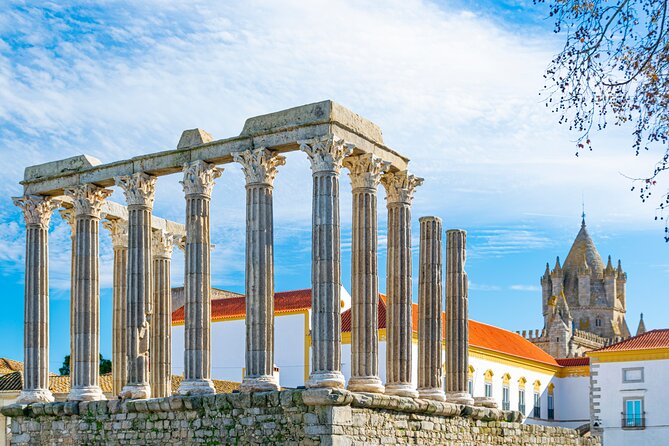
The day starts by centering you in Évora’s core, beginning at the Templo Romano de Évora (also known as the Templo de Diana). Even if you only spend about two hours here, it’s a smart opening move. Roman-era remnants set the tone: this city mattered commercially long before Portugal became the Portugal you learn in textbooks.
From there, you’re positioned for a simple but powerful transition: you move from ancient structure to the social heart of the city at Praça do Giraldo, the main square. This stop is short, but it has a job. It helps you calibrate scale—how close everything really is, how people move through the center, and how the monuments sit within everyday life.
If you like a clear visual map, this itinerary order helps. You’re not wandering randomly. You’re getting your bearings fast, then going deeper into the big religious and civic landmarks.
Cathedral of Évora: granite walls with a start date that stretches for decades
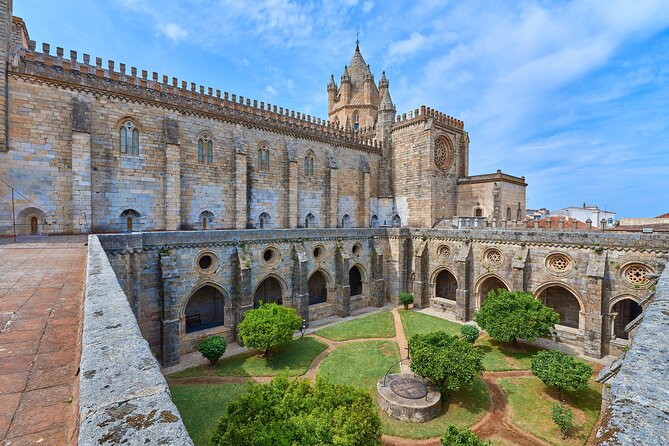
The Se Catedral de Evora (Cathedral of Évora) is designated a National Monument, and the building’s timeline alone feels like a story. Work began in 1186, it was consecrated in 1204, and it wasn’t completed until 1250. That is not a quick project, and it shows in how medieval architecture often carries layers of intent.
Expect a visit focused on understanding the place, not just walking through it. The cathedral’s granite presence anchors the day in medieval Portugal, and it pairs well with the earlier Roman stop. You see how architectural styles and political priorities shift across time, without leaving the same compact area.
Budget note: cathedral entry is not included and costs €4 per person. If you’re trying to keep the day simple, keep that extra cost in your pocket so you’re not calculating mid-tour.
Chapel of Bones: the stop that hits fast, then stays with you
The Capela dos Ossos (Chapel of Bones) is integrated into the Convent and Church of São Francisco, and it’s one of Évora’s most well-known sights. It’s also emotionally intense. This is not just an art object; it’s a visual message, and you’ll likely need a minute to let it land.
The time window is about an hour, so you’re not rushed through it, but you also won’t linger all day. That’s a good balance for most people. If you’re sensitive to heavy imagery, you can still appreciate the architectural and historical setting while moving at a slower pace inside.
Like the cathedral, Chapel of Bones entry is not included—it’s €6 per person. Adding that cost up front makes the visit feel less stressful and more like a chosen experience rather than an unexpected bill.
Aqueduto da Água de Prata: water infrastructure you can actually picture
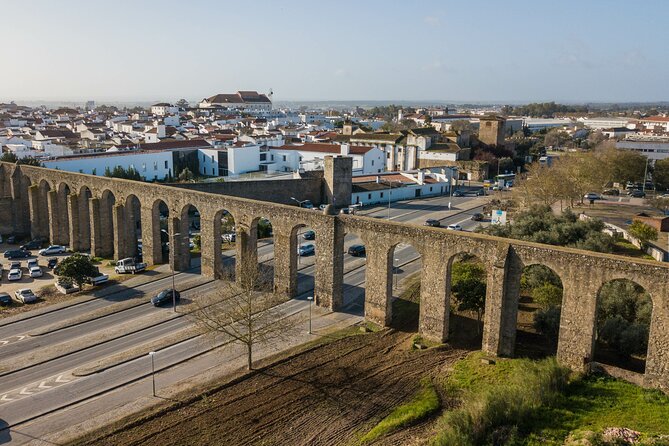
The Aqueduto da Água de Prata is the kind of sight that rewards curiosity. It’s an aqueduct, but it’s also a story about planning, engineering, and public life. It was inaugurated on March 28, 1537, and it was built in a comparatively fast six years under the direction of royal architect Francisco de Arruda.
The aqueduct extends for around 18 km to Herdade do Divor, where it supplied water. Your visit time is short—about 30 minutes—so you won’t be walking the entire length. Instead, you’ll get the key context: why this construction mattered, what it meant for a growing city, and how Portuguese ingenuity showed up outside royal palaces.
Admission is free for this stop, which is great when you’re building value into a day with several paid monuments. If you’re the type who likes practical history—the things that made daily life possible—this will land better than you might expect.
You can also read our reviews of more historical tours in Lisbon






Roman Temple revisit energy: Liberalitas Julia and the commercial pull
The day doesn’t treat the Roman stop as a quick photo moment. It frames Roman-era Évora as an important commercial hub. The area connected to the Templo Romano de Evora is linked with Liberalitas Julia, and it highlights how the city functioned under the wider influence of Julio Cesar’s empire.
That context matters because it changes what you see. You’re not just looking at old stones; you’re thinking about trade, movement, and how wealth and governance left physical marks. Even if your time inside is limited, the takeaway can be big: Évora’s later Christian monuments weren’t built from nothing. A strategic place tends to keep getting reused.
This part is about two hours, and it’s one of your better windows for slower looking. If you tend to skim, you’ll miss the meaning. If you like asking questions, this is exactly where your guide’s conversation style can help.
Palácio de Dom Manuel: where royal power shows up in plain sight
The Palácio de Dom Manuel ties the day to Portugal’s monarchy. You’ll meet the palace that belongs to King D. Manuel I, described as part of the direct lineage of the Portuguese monarchy. For many people, a palace visit can feel like a short stop with a big label. Here, the value is the context: it places the cathedral and religious institutions in a wider picture of who held influence.
Your time is about 30 minutes, and that’s exactly right for a palace stop within a full-day schedule. It keeps the day moving, but it also prevents the palace from being rushed into a single exterior glance.
Admission is free, which is another plus for value. Combined with the free visits elsewhere, it helps offset the paid entrances at the cathedral and Chapel of Bones.
A private tour pace that turns questions into part of the experience
This is a private tour/activity, meaning only your group participates. That matters more than it sounds. When you can tailor the pace and ask questions without worrying about the rhythm of a larger group, the day becomes conversational rather than mechanical.
That comes through in the best reviews. People describe the guide—often mentioned by name as Diogo—as passionate about tying buildings to the story of Portugal across centuries. You also get encouragement to ask follow-up questions and get straight answers.
You may also leave with practical ideas for food. One review calls out a local recommendation for black pork, which is the kind of tip that makes a day feel connected to real life rather than just sightseeing.
If you’re traveling with history fans, this format is especially good. If you’re traveling with someone who needs a break now and then, private pacing helps too.
Price and value: what you’re really paying for at $187.84
At $187.84 per person for an about 8-hour day, the price is easiest to evaluate based on what’s included versus what you pay at the monuments.
Included items:
- Private transportation (with parking fees covered)
- Air-conditioned vehicle
- WiFi on board
- Mobile ticket
Excluded items:
- Cathedral of Évora entry at €4
- Chapel of Bones entry at €6
So your main add-on costs are essentially those two entrances. Everything else in the itinerary is free admission. For many visitors, that balance makes the total feel fair, because you’re not adding a long list of paid tickets throughout the day.
There’s also a quieter value here: you’re coming from Lisbon and you’re given the convenience of pickup offered from your accommodation. That reduces wasted time and stress, which is a real cost even when it isn’t measured in euros.
Finally, this tour tends to be booked fairly in advance, averaging about 37 days. If your dates are limited, it’s worth securing a slot so you don’t end up with a half-day compromise later.
Getting from Lisbon to Évora without the stress spiral
The itinerary is built for a full day, so timing matters. With private transport and pickup, you avoid the worst part of long trips: hunting down transit connections while you’re tired.
Your day includes multiple stops, but not all of them are long. Some are short by design—like Praça do Giraldo (about 30 minutes) and the palace (about 30 minutes). That keeps the day from turning into constant walking with no breathing room.
The longer blocks are where you’ll appreciate the context:
- Évora historic center (about 2 hours)
- Cathedral (about 1 hour)
- Roman Temple (about 2 hours)
That distribution is practical. You get enough time to look and learn, but you don’t lose the whole day to a single site.
If weather is off, remember the experience is described as requiring good weather. If conditions are poor, you may be offered a different date or a full refund, which is useful to keep in mind when planning a tight Lisbon schedule.
Who this tour suits best (and who may want a different plan)
This works best if you like a city where monuments are close enough to form a coherent story. You’ll also enjoy it more if you ask questions. Reviews highlight that the guide conversation is a big part of the experience, not just narration.
You’ll likely appreciate the format if you:
- Want a private guide feel without spending all day on logistics
- Prefer a mix of architecture + historical context
- Are curious about how Portugal evolved across Roman, medieval, and royal periods
If you’re looking for something purely hands-on or highly athletic (lots of hiking, outdoor scrambling), this isn’t that kind of day. The focus is classic sightseeing with structured time blocks.
Should you book this Medieval Évora day tour?
I’d book it if you want one full day that meaningfully covers Évora’s biggest eras without making you run around on your own. The included transportation and the mostly free admissions (with only cathedral and bones as paid add-ons) make the pricing feel workable, especially for a private experience.
If your travel style is fast and flexible, you might find this schedule reassuring rather than restrictive. It’s paced in a way that gives you time at the major landmarks, plus short stops for orientation and mood.
My only caution is to plan for the two extra entrance fees. If you dislike surprise costs at museums, budget that €10 per person in advance so you can enjoy the day without thinking about it.
FAQ
How long is the Private Full-Day Historical Tour of Medieval Évora?
The tour runs for about 8 hours.
What is the price per person?
The listed price is $187.84 per person.
Are tickets included for the Cathedral of Évora and the Chapel of Bones?
No. The Cathedral of Évora costs €4 per person, and the Chapel of Bones costs €6 per person. Other stops have free admission based on the tour details.
Do I get pickup from my accommodation?
Pickup is offered. You’ll need to identify your accommodation location to arrange the pickup.
Is this a private tour or shared group?
This is a private tour/activity, so only your group participates.
Is the tour in English, and can service animals join?
The tour is offered in English, and service animals are allowed. Most travelers can participate, and a baby chair is available for children 0–2 years with a €10 extra fee.
What happens if the weather is poor?
The experience requires good weather. If it’s canceled due to poor weather, you’ll be offered a different date or a full refund.