REVIEW · SIEM REAP
2 Days Guided Historical Tour in Angkor
Book on Viator →Operated by Angkor Wat Shared Tours · Bookable on Viator
Angkor Wat is prettier before the crowds. This 2-day guided tour plans your long days around the big moments, starting with an early sunrise and ending with a sunset at Angkor’s temples.
I like two things a lot: the small group size (max 15) keeps the experience more personal, and the tour provides comfort basics like cold water and a wet towel plus hotel pickup.
One thing to consider: the $35 tour price does not include temple admission. You’ll need to budget the $62 per person entrance fee on top, plus meals.
In This Review
- Key highlights to know before you go
- How This Two-Day Angkor Tour Really Plays Out
- Price and Logistics: The Real Cost (and Why It Still Makes Sense)
- Comfort Matters: Water, Wet Towel, and Hot-Day Reality
- Day 1 Morning: Angkor Wat Sunrise to Ta Prohm’s Atmosphere
- Stop 1: Angkor Wat (sunrise + guided interior time)
- Stop 2: Angkor Thom South Gate (carved faces + causeway statues)
- Stop 3: Bayon Temple (four smiling faces)
- Stop 4: Ta Keo (temple-mountain of sandstone)
- Stop 5: Ta Prohm (the famous jungle temple vibe)
- Day 2: Pre Rup, Preah Khan, and Quieter Angkor Time
- Stop 1: Pre Rup (a Hindu state temple)
- Stop 2: Ta Som (smaller, steady, and atmospheric)
- Stop 3: Neak Pean (temple on an artificial island)
- Stop 4: Preah Khan (temple built for a royal dedication)
- Stop 5: Phnom Bakheng (temple mountain at the end of the route)
- What the Guide Adds (Beyond Facts)
- The Itinerary Coverage: Why 11 Temples Over 2 Days Works
- Practical Tips So You Enjoy It More
- Who This Tour Is Best For
- Should You Book This 2-Day Angkor Guided Tour?
- FAQ
- What time does the tour start?
- Is hotel pickup included?
- How long is the tour?
- How many temples are included?
- Are entrance tickets included in the price?
- What is included during the day for comfort?
- Can I cancel for a full refund?
Key highlights to know before you go
- Sunrise start at 4:30 am so you can see Angkor Wat while it’s still calm
- Max 15 travelers for easier pacing and more chances to ask questions
- Hotel pickup and drop-off with an air-conditioned vehicle
- 11 temples across two days, including both the headline sites and quieter ones
- Comfort touches like cold water and a wet towel during the day
How This Two-Day Angkor Tour Really Plays Out
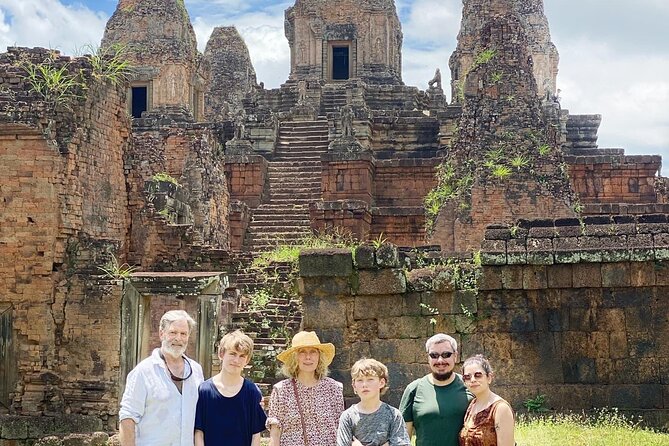
This is the kind of Angkor plan that helps you get your bearings fast and then slow down. You’re not just ticking off temples. You’re getting the story behind the stones, plus a route designed for early light and late-day views.
The early start matters. Angkor Wat sunrise is the moment almost everyone has on their mental postcard. Here, you’re at the temple early enough to see it properly, not after the first big wave of buses arrives.
You also get a practical advantage: someone else handles the logistics between sites. With hotel pickup, an air-conditioned vehicle, and a tight itinerary that still leaves time to walk inside, the day doesn’t turn into a heat-fueled scavenger hunt.
You can also read our reviews of more tours and experiences in Siem Reap.
Price and Logistics: The Real Cost (and Why It Still Makes Sense)
The tour itself is $35 per person for two days with a guide, air-conditioned transport, hotel pickup/drop-off, and 11 temples. The part that often surprises people is the entry fee.
Temple tickets are not included, listed at $62 per person. That means your likely total is $97 per person, before meals and any extras you choose to buy.
Is it good value? For me, the answer is yes if you want guided context and a route that covers a lot of ground without you doing the planning. You’re paying for three things: a guide to make sense of what you’re seeing, transport that saves time, and a schedule built around sunrise/sunset rather than just daylight hours.
Also, the group size limit (max 15) is a quiet quality upgrade. When groups are bigger, you spend more time waiting. Here, you’re more likely to keep moving.
Comfort Matters: Water, Wet Towel, and Hot-Day Reality
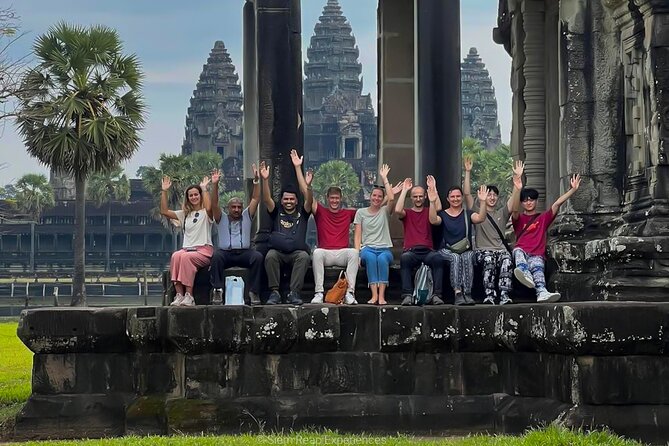
Angkor is walking, sun, and dust—sometimes all in the same hour. This tour acknowledges that with small comfort features that make a real difference over two days.
You’ll have:
- Cold water during the day
- A wet towel to cool off
- Air-conditioned vehicle between temples
- Hotel pickup and drop-off
In the day-to-day rhythm, those things keep you from turning “temple time” into “survive time.” A lot of guides are good at history; fewer are good at pacing and staying responsive when the heat hits. Several praised guides on this tour are described as keeping the group going in the heat and being helpful with small needs like sitting breaks and water.
Day 1 Morning: Angkor Wat Sunrise to Ta Prohm’s Atmosphere
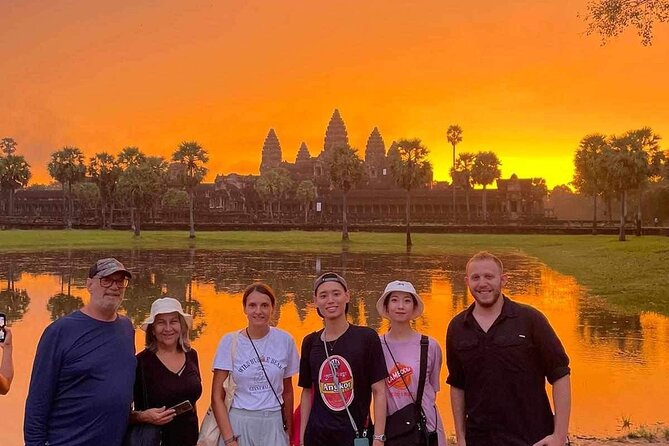
Day 1 is built for the classic hits. It’s early, it’s active, and it’s the day you’ll feel most impressed by how much you can actually see in one go.
Stop 1: Angkor Wat (sunrise + guided interior time)
You start at 4:30 am with hotel pickup, then head to Angkor Wat for sunrise viewing. After the sunrise moment, you explore inside with the guide explaining what you’re looking at.
This is where a good guide pays off. Without context, Angkor Wat can blur into “big temple, lots of carvings.” With context, you notice alignments, recurring themes, and the way the design signals power and devotion.
A practical note: one early-morning review mentions a flashlight being provided for the darker start. Even if you don’t get one, it’s smart to wear something that feels safe in low light and bring a small light source if you’re the type who likes certainty.
Admission ticket not included here—so you’ll be using your entrance pass (the $62 fee) during the tour.
You can also read our reviews of more historical tours in Siem Reap
Stop 2: Angkor Thom South Gate (carved faces + causeway statues)
Next up is the South Gate of Angkor Thom, a 12th-century city gate known for carved faces and stone figures lined along the causeway.
This stop is a good breather from the big open spreads of Angkor Wat. It also sets the tone for what comes after: Angkor isn’t one monument—it’s a whole world of temples linked by roads, walls, and meaning.
Stop 3: Bayon Temple (four smiling faces)
Then you move to Bayon, the richly decorated Khmer temple tied to Buddhism at Angkor. It’s known for the faces that look out over the temple grounds.
Bayon is one of those places where the details hit you gradually. At first you spot the iconic faces. Then you start seeing the pattern of decoration and how the temple feels like it’s constantly watching you back.
Stop 4: Ta Keo (temple-mountain of sandstone)
After that, you take a break for breakfast before going inside Ta Keo. Breakfast isn’t included in the tour price, so plan for your own meal here.
Ta Keo is described as a temple-mountain that may be the first built entirely of sandstone by the Khmer. Even if you’re not a stone-nerd, sandstone buildings have a different feel in the light—less weathered than later stone, and often crisp enough for close viewing.
Stop 5: Ta Prohm (the famous jungle temple vibe)
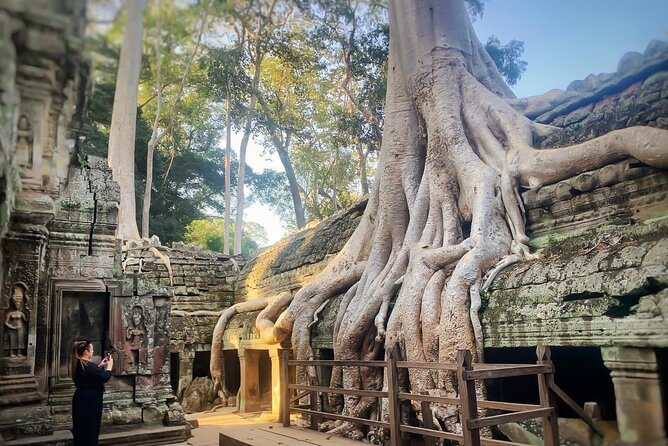
Day 1 finishes with Ta Prohm, the temple famous for its roots and atmospheric look. It’s also built in the Bayon style, and it tends to give people that wow feeling right away—because you can literally see how nature and stone share the space.
Ta Prohm can get crowded, so starting your day early helps. By the time you reach it, your morning momentum usually keeps you in a good mood, not a sweat-soaked slog.
Day 2: Pre Rup, Preah Khan, and Quieter Angkor Time
Day 2 shifts away from the loudest crowd magnets and into temples that feel more relaxed. You’ll still see major sites, but the pacing often feels easier.
Stop 1: Pre Rup (a Hindu state temple)
You begin with Pre Rup, a Hindu temple-mountain built as a state temple of Khmer King Rajendravarman and dedicated around 961/962. The guide time here is where the temple’s purpose becomes clearer—this isn’t just a pretty ruin, it’s built to express belief and rank.
Stop 2: Ta Som (smaller, steady, and atmospheric)
Next is Ta Som, a smaller temple built at the end of the 12th century for King Jayavarman VII.
This stop is valuable because it lets you breathe. In Angkor, big temples can overwhelm you with scale. Smaller ones help you focus on carvings, doorways, and the way the site holds space.
Stop 3: Neak Pean (temple on an artificial island)
Then comes Neak Pean, an artificial island with a Hindu temple on a circular island in Jayatataka Baray. It’s associated with the Preah Khan temple complex.
This is one of those stops that makes you slow down. The setting is part of the message. Instead of staring at one façade, you’re seeing a whole plan: water, island, and structure working together.
Stop 4: Preah Khan (temple built for a royal dedication)
After that, you visit Preah Khan, built in the 12th century for King Jayavarman VII to honor his father.
Preah Khan is usually appreciated more when you understand why it was built. A good guide connects the temple to the larger Angkor story—who built what, when, and why it mattered.
Stop 5: Phnom Bakheng (temple mountain at the end of the route)
Finally, you reach Phnom Bakheng, a Hindu temple-mountain dedicated to Shiva.
This is typically the kind of end-stop that rewards you if you’re still paying attention. It’s not just the final temple—it’s a chance to see Angkor’s spiritual geography from another angle before you wrap up.
What the Guide Adds (Beyond Facts)
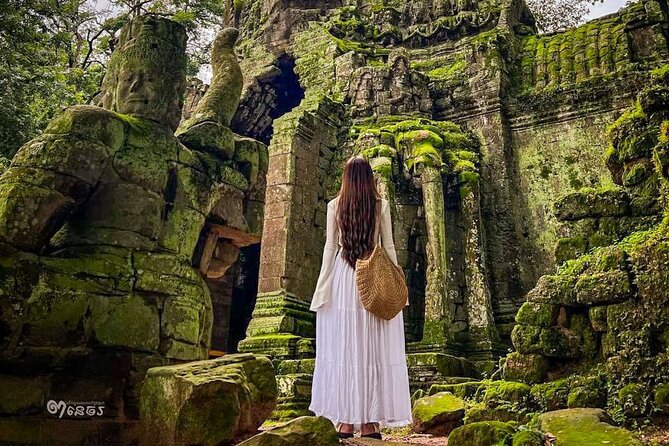
The tour’s structure is solid: you move between major sites, you get guided explanations, and you’re not stuck trying to figure out what matters by yourself.
The best guides on this tour are praised for a mix of:
- Clear history explanations tied to what you’re seeing
- Patience in the heat and time pressure
- Storytelling that makes Khmer Empire context feel usable
- Good group pacing, so you’re not stuck waiting
You’ll also likely get genuine back-and-forth. Several praised guides (names you might see listed like Sok, Vone, Sam, Ho Heang, Sary, Sayon, and Pheap) are mentioned as being willing to answer questions and help with practical needs like photo stops and breaks.
Even if you know a bit about Angkor already, a strong guide helps you notice what your eyes otherwise skip.
The Itinerary Coverage: Why 11 Temples Over 2 Days Works
A two-day Angkor visit always involves trade-offs. You can either see fewer places in more detail or cover more ground with less time at each stop. This tour does the second option, but smartly.
Day 1 focuses on the headline trio-plus (Angkor Wat, Bayon, Ta Prohm, plus key gates and Ta Keo). Day 2 keeps the momentum but swaps in more lesser-visited temples like Ta Som and Neak Pean, then closes with Preah Khan and Phnom Bakheng.
That mix is what helps you feel like you actually understood Angkor, not just wandered through it.
Also, the maximum group size of 15 matters here. When you’re moving between temples, a big group means gaps in attention. A smaller group makes it easier to keep the experience feeling guided instead of chaotic.
Practical Tips So You Enjoy It More
You can’t control the sun, but you can control your readiness.
Bring:
- Sun protection (hat, sunscreen, sunglasses)
- Comfortable walking shoes with grip
- A light layer for mornings and late-day temple interiors
- Cash or card readiness for meals, since meals aren’t included
Pacing is part of the experience. Wear good footwear and accept that you’ll be walking a lot over two days. If the heat gets intense, use the breaks and air-conditioned rides without guilt. This tour includes water and a wet towel for a reason.
Who This Tour Is Best For
I think this fits best if you:
- Want a guided plan instead of DIY map chaos
- Like seeing both the most famous temples and some quieter ones
- Prefer smaller groups (max 15) over bus loads
- Value sunrise and sunset timing more than extra free time
If you want a super slow, photography-only vacation with long pauses at each temple, you might find the schedule a bit full. But if you want a structured two-day Angkor experience with real explanations, this is a strong match.
Should You Book This 2-Day Angkor Guided Tour?
If your priority is a well-paced route through 11 temples with hotel pickup, cold water, a wet towel, and a guide who can explain what you’re seeing, I’d book it.
Do it especially if you’re the type who wants sunrise without figuring out transport at 4:30 am. The schedule is built for that moment, and the small group size helps keep the experience personal.
The only real reason to hesitate is the total cost once you add admission and meals. But if you’re coming to Angkor anyway, the guide-driven structure is what makes this more than just a long day of walking.
FAQ
What time does the tour start?
The tour start time is 4:30 am.
Is hotel pickup included?
Yes. Pickup/drop-off is included, and you’ll travel in an air-conditioned vehicle.
How long is the tour?
It’s 2 days (approx.).
How many temples are included?
The tour includes 11 temples over the two days.
Are entrance tickets included in the price?
No. Admission tickets are not included, and the entrance fee listed is $62 per person.
What is included during the day for comfort?
You get cool water and a wet towel, plus a tour guide and transport between sites.
Can I cancel for a full refund?
Yes. Free cancellation is available up to 24 hours in advance for a full refund.