REVIEW · ATHENS
Ancient Corinth Half Day Tour
Book on Viator →Operated by H.P.Tours - Hellenic Private Tours · Bookable on Viator
Corinth in one tight, smart half-day. This Ancient Corinth Half Day Tour packs the highlights between Athens and the Peloponnese: the Corinth Canal, the ancient city of Corinth, the clifftop fortress of Acrocorinth, and the old port area of Kechries. It’s built for people who want serious history without blowing an entire day.
I really like the private, up-to-2-group format. You get round-trip air-conditioned transportation from your Athens hotel area (or Piraeus port), plus bottled water and WiFi on board. And the driver gives context and myth-bits while you ride—useful when you’re trying to make sense of what you’re about to see.
One thing to think about: entrance fees aren’t fully handled for you. Ancient Corinth has a stated admission cost (€15 per adult) and an optional licensed on-site guide is extra (260 euros in cash), since the driver can’t legally walk inside the sites with you.
In This Review
- Key things to know before you go
- Why Corinth Canal + Ancient Corinth + Acrocorinth makes sense
- Getting from Athens without the usual stress
- Stop 1: Corinth Canal—history you can actually see
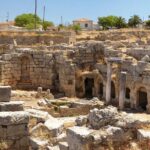
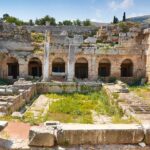
- Stop 2: Ancient Corinth—what to prioritize at the Agora, Apollon Temple, and Lechaion Street
- The city’s big picture
- Temple of Apollo: monolithic columns, 6th-century presence
- Agora and the rostrum: politics, courts, and a famous story
- Lechaion Street: a walkable “shopping mile”
- Stoa and Peirene: buildings with function, not just photos
- Two performance spaces: Odeion and the theatre complex
- Stop 3: Acrocorinth fortress time—views worth the climb
- Stop 4: Kechries port remains—small stop, big context
- Price and logistics: what $363.71 per group really buys
- The driver factor: explanations without taking over your site time
- What I’d do to make the most of your 5 hours
- Is this the right tour for you?
- Should you book the Ancient Corinth Half Day Tour?
- FAQ
- How long is the Ancient Corinth Half Day Tour?
- What’s included in the price?
- Are entrance fees included?
- Do you need an English-speaking licensed guide?
- Where does pickup happen for cruise passengers?
- Can I cancel for a full refund?
Key things to know before you go
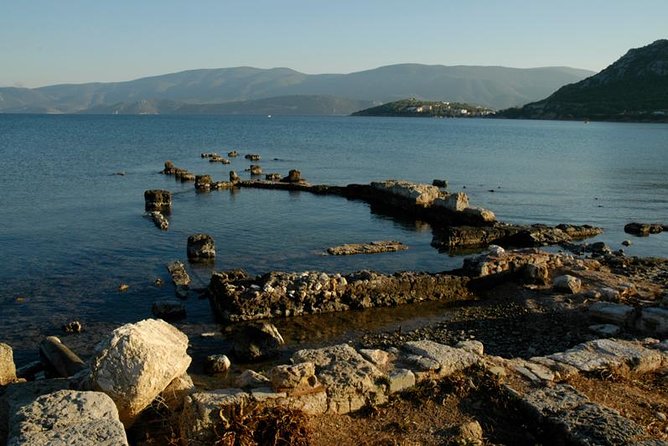
- A four-stop route: canal views, Ancient Corinth’s main ruins, Acrocorinth’s fortress rock, then Kechries port remains
- Private door-to-door pickup: Athens hotel/Piraeus port transfers included, no mixed group
- Driver-guided context: your driver explains along the way, but isn’t allowed to accompany you inside sites
- Site time is practical: short but meaningful stops (about 1 hour at Acrocorinth, 1+ hour at Ancient Corinth)
- Budget for entry fees: Ancient Corinth admission is listed as not included
- Bring your own snacks: snacks aren’t included, so plan for lunch timing
Why Corinth Canal + Ancient Corinth + Acrocorinth makes sense
Corinth is one of those places where the geography does half the storytelling. You’re seeing the “why” behind the “what.” The canal explains why ships wanted a shortcut. Ancient Corinth explains why people fought over control of that narrow strip of land. Acrocorinth shows the “how,” sitting high above everything like a fortress that refuses to move.
Doing it as a half-day tour also fits real vacation schedules. This is the kind of outing you pick when you’re in Athens for only a few days—or you’re on a cruise and want something big without turning your day into a transportation marathon.
You can also read our reviews of more tours and experiences in Athens.

Getting from Athens without the usual stress
This tour is designed around comfort and simplicity. You get pickup from your Athens hotel area or the Piraeus cruise port area, and drop-off back the same way. The van is air-conditioned, and you also get WiFi on board and bottled water. For a day that includes walking around ancient ruins, those small comfort perks matter.
It’s also private. Only your group is in the vehicle—no unknown passengers, no awkward “where is everyone?” shuffle. For cruise passengers, that can be a big deal because time is tight and terminals can be confusing.
Practical tip: if you’re coming from Piraeus, note that the driver meets you at the exit for the correct terminal (A, B, or C). If your ship docks at Terminal B or C and that exit gate is closed, you take a shuttle bus to Terminal A (about a 3-minute ride) to meet the driver. That’s the difference between a smooth start and a late start.
Stop 1: Corinth Canal—history you can actually see
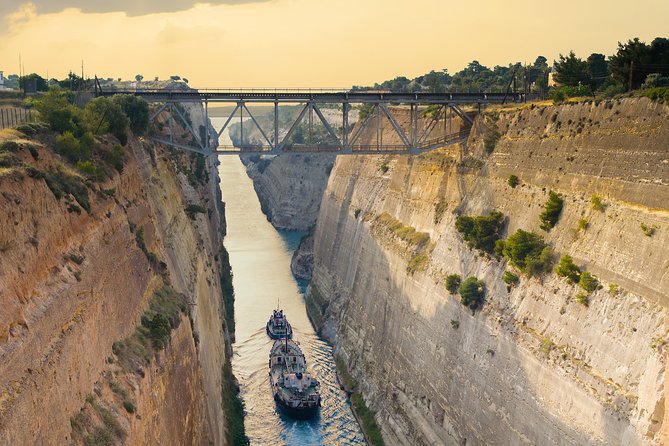
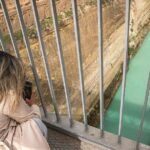
You start with a drive described as about 45 miles along the national highway, then you reach the Corinthian Canal area (or the Isthmus canal area). The canal project is late 19th century, but the idea goes back much farther—really much farther.
Here’s what makes this stop more than just a pretty road. The canal was called a 2000-year dream. Before it existed, ships that wanted to cross between the Aegean and toward the Adriatic had to sail around the Peloponnese, adding about 185 nautical miles to the trip. That’s not trivia—it’s how trade, travel time, and power all shift when a shortcut becomes possible.
Your driver’s context includes the myth-history thread: Periander (the Corinth tyrant) is linked to the idea, and because digging the canal was too complex for the time, he built a diolkós—basically a stone road used to move ships on wheeled platforms. Later, Emperor Nero attempted construction in 67 AD with a force of 6,000 slaves, but he was murdered before the plans reached completion. The canal finally got finished in the last decade of the 19th century.
Visit tip: even if you only get around 20 minutes here, take the time to look for sightlines that show the scale. You’re not walking a museum—you’re viewing the corridor that changed how ships moved across Greece.
Stop 2: Ancient Corinth—what to prioritize at the Agora, Apollon Temple, and Lechaion Street
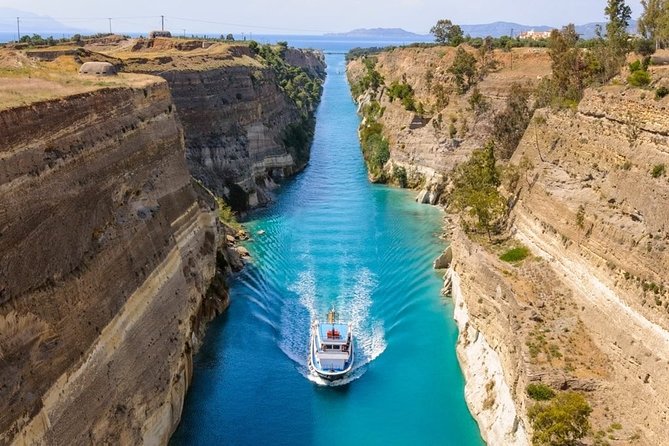
Ancient Corinth is big, layered, and easy to feel overwhelmed by—so this tour’s approach (structured time with a clear sequence) helps you see the important pieces without wandering for hours.
The city’s big picture
Corinth rose on trade and traffic over the Isthmus, the narrow strip connecting the Peloponnese to mainland Greece. It competed with Athens in wealth and fame, and it exported black-figured vases before its fortunes shifted over time. The sanctuary of Aphrodite on the Acropolis (Acrocorinth) made the city famous as a cult center for the goddess of love—part of why Corinth’s influence wasn’t only economic.


Temple of Apollo: monolithic columns, 6th-century presence
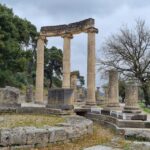
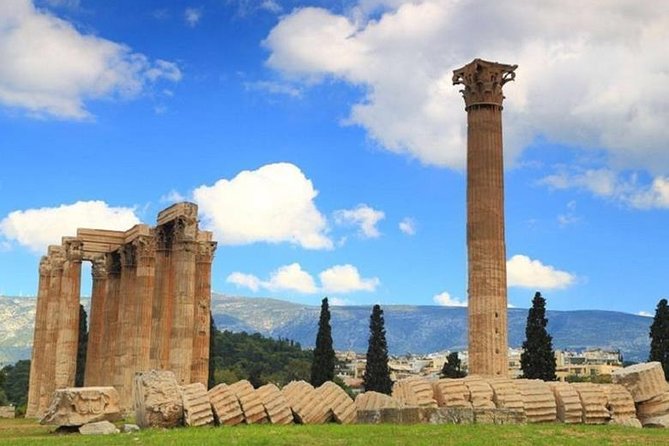
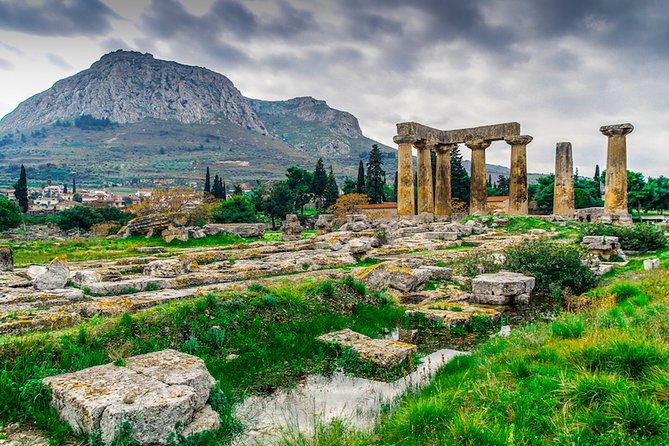
One of the standout ruins is the Temple of Apollon, built in the middle of the 6th century BCE. A notable feature: it used monolithic columns rather than column drums. Today, seven columns remain standing, and even with only a portion of the ruins excavated, the scale helps you feel what this place looked like when Corinth mattered across the eastern Mediterranean.
Agora and the rostrum: politics, courts, and a famous story
In the heart of the site, you’ll spend time around the agora area (with roots in the 4th century BCE). Near it is the Basilica Iulia—described as a courthouse built by Emperor Claudius in 44 CE. In the center, there’s the bēma (rostrum), a platform for public legal and political announcements.
You may hear a well-known Christian story tied to this area—claims that Paul was questioned here by Gallio. The tour information is clear that archaeological and historical research doesn’t support the strong version of that claim, and it also notes the site was overbuilt by a church in the Middle Ages. If you like separating myth from evidence, this is a perfect place to do it.
Lechaion Street: a walkable “shopping mile”
If you want a sense of daily life rather than only temples, walk the Lechaion Street area. An elaborately decorated arched gateway marks the beginning of this 1st-century CE stretch, and the paved route was preserved in its original state until the 10th century. It’s described as a shopping mile, bordered by galleries with shops carrying products from across the Roman Empire and beyond.
Look out for the latrine mentioned as well-preserved. It sounds odd, but it’s part of what makes ruins feel real—people needed places to do everyday things, not just places to worship and debate.
Stoa and Peirene: buildings with function, not just photos
In the south, the agora is bordered by a long stoa (154 meters) built by Philip II of Macedonia after 338 BCE as a guest house for deputies of the Corinthian Confederation. Under Roman rule, the southern portion served administrative needs tied to the Isthmian Games.
Nearby is the well house of the spring of Peirene, famous for clear water. It was lavishly decorated and linked in stories to Pegasos, the swift-winged horse. Poets came to drink here looking for inspiration—so yes, you can treat this like a brief nature-of-the-mind stop as much as a physical stop.
Two performance spaces: Odeion and the theatre complex
North-west of the parking/entrance area are two buildings worth noting: the Odeion (concert hall) from the 1st century CE, enlarged during the 2nd century by Herodes Attikos (the same name linked with the Odeion in Athens). There’s also a theatre with Greek origins (from the 4th century BCE with later changes), which under Romans was replaced by an arena setup where even naval battle performances (naumachiai) were possible.
If you’re short on time, pick one route: either prioritize temples and public spaces, or prioritize performance and city-scale engineering. This tour keeps you moving, so you’ll have to choose what you want to slow down for.
Stop 3: Acrocorinth fortress time—views worth the climb
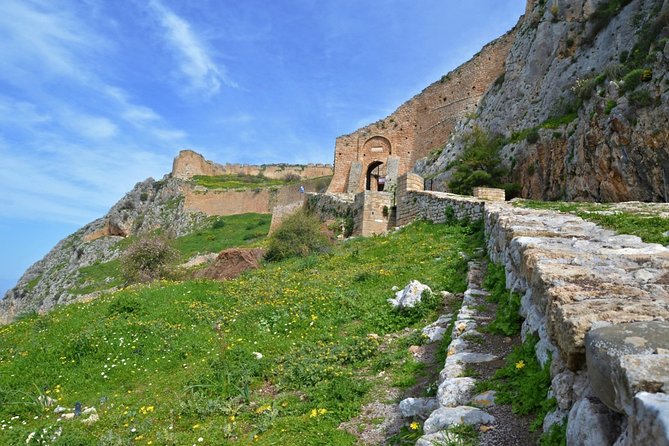
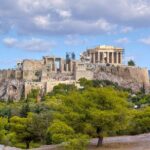
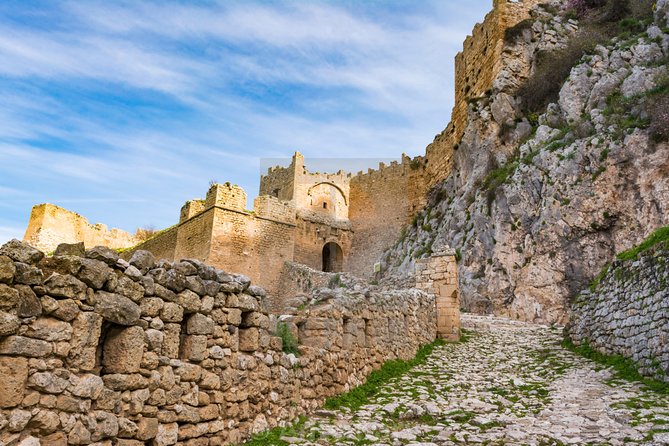
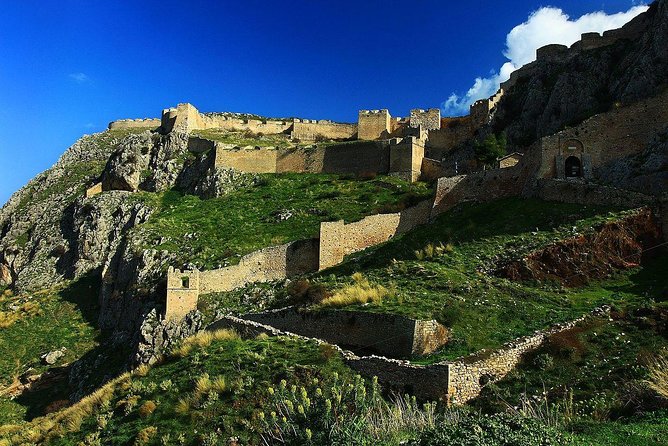
Acrocorinth is the upper rock above Ancient Corinth: a monolithic rock that served as the city’s acropolis and later became an important medieval castle site. What’s striking is the continuity—described as continuously occupied from archaic times to the early 19th century. That’s not a short-lived monument. It’s a landscape with centuries of people living, defending, and reshaping it.
Because your time here is about an hour, pacing matters. Go with the expectation that you’re not “seeing everything.” You’re getting the sense of control and command—this is where you understand why Corinth mattered.
Practical tip: wear shoes with real grip. Fortress ground can be uneven, and you’ll want sure footing when you’re looking for viewpoints.
Stop 4: Kechries port remains—small stop, big context
After you leave Ancient Corinth, you get the chance to visit the remains of the ancient port of Kechries. It’s described as one of the two ports of Corinth and tied to eastern trade routes via the Saronic Gulf.
It’s also linked to Apostle Paul, described as arriving at Kechries during his second missionary. Even if you’re not focused on religious history, ports give you a different kind of understanding: they bring the story back down to movement of goods and people.
Time is brief—about 15 minutes—with free admission. So use it as a context stop. Look, orient, then move on with the bigger picture in your head.
Price and logistics: what $363.71 per group really buys
The price is listed as $363.71 per group (up to 2), for about 5 hours. For a private tour with round-trip, air-conditioned transport and pickup/drop-off, that can be good value—especially if you’d otherwise pay for separate transfers or try to coordinate a complex DIY plan from Athens.
What’s included:
- Bottled water
- Air-conditioned vehicle
- Private transportation with Athens Hotel/Piraeus port pickup and drop-off included
- WiFi on board
- Professional drivers (but not licensed to accompany you into sites)
Where costs can appear:
- Ancient Corinth entrance fee is listed as not included, €15 per adult
- A licensed English-speaking tour guide is optional, listed at 260 euros in cash (subject to availability)
- Snacks are not included
Here’s the key value point: this tour is built around a driver-led explanation plus your time inside the sites. If you’re the type who likes deep, inside-the-ruins interpretation—especially at Ancient Corinth and Acrocorinth—consider adding the optional licensed guide. If you prefer a lighter touch and are happy reading signs while you walk, you can often keep costs controlled by skipping that extra guide.
The driver factor: explanations without taking over your site time
The information here is very specific about driver rules: your English-speaking driver will explain ancient monuments, ancient Greek history, and interesting facts about historical and modern-day Greece, but they are not allowed by law to accompany you inside the sites. That matters because it keeps the tour legal and also changes how you should plan.
You’ll get stronger context on the road and at the arrival points, then you go explore on your own inside. If you want someone to point out details while you’re actually in the ruins, that’s where the optional licensed guide comes in.
One detail from the feedback that stands out: the driver name Planos shows up with high praise for being great and informative. Another recurring name in company leadership is Frank Kotsiopoulos, mentioned in feedback as friendly and on time. You can’t bank on specific names, but the general pattern is clear: the company leans hard on good communication.
What I’d do to make the most of your 5 hours
This is a tight schedule, so you’ll enjoy it more if you travel prepared. I’d treat Ancient Corinth as your main “slow walk,” then let Acrocorinth be the “bigger view” stop.
A few practical moves:
- Bring snacks or plan where you’ll buy them after lunch, since snacks aren’t included.
- Dress for sun and stairs. Even if the tour pacing is guided, you’ll still climb and walk.
- Expect multiple ancient layers in a single site. Corinth wasn’t one era—it was many, then rebuilt, then reshaped again.
If you’re trying to decide between spending extra time inside one ruin versus getting panoramic views from Acrocorinth, pick the one that matches your trip personality. Temple-and-street people usually lean toward Ancient Corinth. View-and-fortress people lean toward Acrocorinth.
Is this the right tour for you?
This tour is ideal when you’re:
- In Athens and don’t have a full day to spare
- Looking for a private, comfort-first format with pickup and drop-off
- Interested in Corinth as a whole story—trade routes, civic life, and defensive power
- Traveling with someone you can share the group price with (it’s up to 2)
It’s less ideal if you want a slow, museum-style day with long stays at every ruin. This is structured for momentum. Also, if you hate the idea of paying separate entrance fees and possibly adding a licensed on-site guide, factor that into your expectations.
Should you book the Ancient Corinth Half Day Tour?
If you want a smart, private route that connects geography to history—then yes, book it. The combination of Corinth Canal, Ancient Corinth’s major public spaces, Acrocorinth’s fortress rock, and the quick Kechries port stop is exactly the kind of high-value sequence that works when time is tight.
I’d especially recommend it for first-time Corinth visitors and cruise passengers who need an organized plan. Just go in knowing two things: bring your own snacks, and budget for Ancient Corinth admission (€15 per adult). If you want deeper interpretation inside the sites, add the optional licensed guide. Done right, this is the kind of half-day that leaves you feeling like you finally understand why Corinth mattered.
FAQ
How long is the Ancient Corinth Half Day Tour?
It runs for about 5 hours (approx.).
What’s included in the price?
The tour includes bottled water, air-conditioned transportation, WiFi on board, and private pickup and drop-off from Athens Hotel/Piraeus Port. It also includes professional drivers (not licensed to accompany you into the sites).
Are entrance fees included?
Ancient Corinth entrance fees are not included, and the stated cost is €15 per adult. Acrocorinth’s admission is also listed as not included, while the Corinth Canal and Kechries stops are free.
Do you need an English-speaking licensed guide?
A licensed English-speaking tour guide is optional (260 euros payable in cash, subject to availability). Your driver speaks English and explains during the tour, but they can’t legally accompany you inside the sites.
Where does pickup happen for cruise passengers?
Your driver meets you at the Piraeus cruise ship terminal holding an H.P. Tours sign with your name. The driver will match the correct terminal (A, B, or C), and if Terminal B or C’s exit gate is closed, you’ll take a shuttle bus to Terminal A to meet the driver.
Can I cancel for a full refund?
Yes. You can cancel up to 24 hours in advance for a full refund.