REVIEW · POMPEII
Ancient Pompeii Private Tour: Skip the Line & Kid-Friendly Option
Book on Viator →Operated by Leisure Italy · Bookable on Viator
Pompeii feels personal with the right guide. This private walk through Pompeii is built around quick entry, so you spend more time seeing the big scenes—Forum life, Roman baths, star houses, and the famous casts—rather than queueing.
I love two things most: the skip-the-line style ticket handling, and the family setup that turns ruins into a game.
One consideration: even with a private pace, it’s still real walking in sun and stone, so plan for heat and take breaks if anyone in your group has mobility limits.
In This Review
- Key Highlights at a Glance
- Why Skip-the-Line Matters in Pompeii (and how private pacing helps)
- A Family-Friendly Pompeii Plan for Ages 6–11
- Your 2-Hour Walk Through Pompeii’s Most Important Stops
- Stop 1: Archaeological Park of Pompeii (orientation + eruption context)
- Stop 2: Forum of Pompeii (politics, religion, commerce in one plaza)
- Stop 3: Via dell’Abbondanza (the city’s main street)
- Stop 4: Terme del Foro (Roman baths, step by step)
- Stop 5: Temple of Apollo (Greek-Italic fusion)
- Stop 6: Basilica (big civic building energy)
- Stop 7: Casa dei Vettii (the flashy “Sistine Chapel” of Pompeii)
- Stop 8: Teatro Grande (from Greek roots into Roman style)
- Stop 9: Antiquarium di Pompei (casts of victims)
- Beyond the Headliners: what Pompeii teaches if you know where to look
- Price and Value: what you’re paying for at $165.05 per person
- Booking Tips: how to make the heat manageable and the route work
- Should You Book This Private Pompeii Tour?
- FAQ
- How long is the Ancient Pompeii Private Tour?
- Is this a private tour?
- Is skip-the-line access included?
- What’s included for families traveling with kids?
- Where does the tour start and end?
- Are admission fees included?
- Do kids need identification?
- Is free cancellation available?
Key Highlights at a Glance
- Skip-the-line access so you start your highlights sooner (with fast-track help on site)
- Private-guide flexibility to tailor the route when you care about specific spots
- Forum to Via dell’Abbondanza to understand politics, commerce, and daily street life
- Family option for ages 6–11 with a Pompeii4kids kit: map, stickers, clues, and games
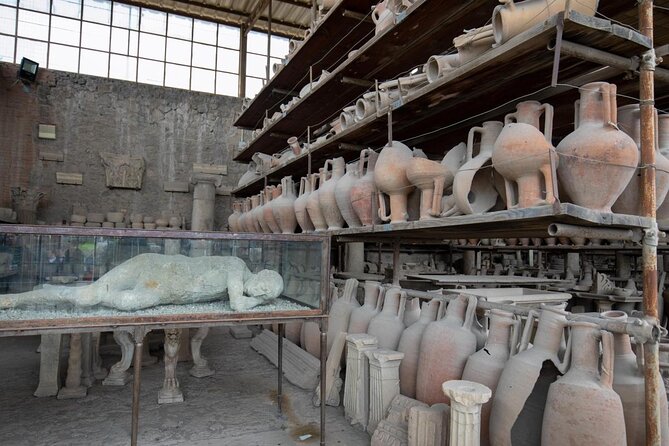
- Antiquarium casts for a powerful, emotional final stop that explains what the eruption did
Why Skip-the-Line Matters in Pompeii (and how private pacing helps)
Pompeii is one of those places where time vanishes fast. The site is huge, and lines can chew up your day before you even reach the ruins you came for. This tour’s whole point is to get you moving quickly with skip-the-line tickets and a guide who can handle entry efficiently.
Because it’s private, you’re not stuck matching someone else’s pace. You can ask for more explanation at the Forum, slow down near a floor mosaic, or spend a little extra time where you’re actually curious. That matters in Pompeii, where the details are the story—bathroom plumbing, street runoff, wall art, and all the everyday stuff that makes this ancient city feel less like a textbook.
The other practical win: the tour is about 2 hours. That’s a sweet spot for a first visit. You get a real hit list of major sights without turning your body into a sore souvenir.
You can also read our reviews of more private tours in Pompeii
A Family-Friendly Pompeii Plan for Ages 6–11
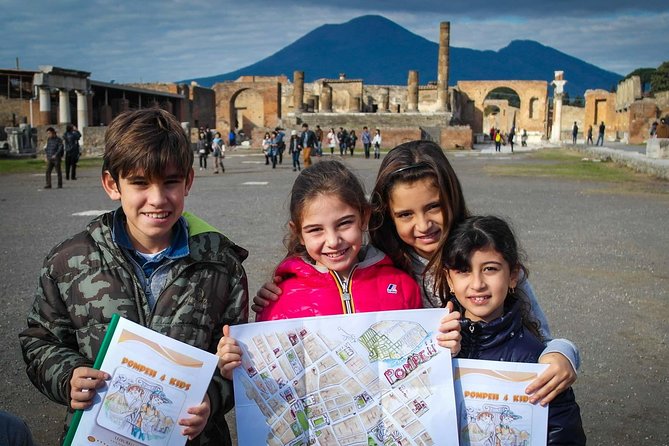
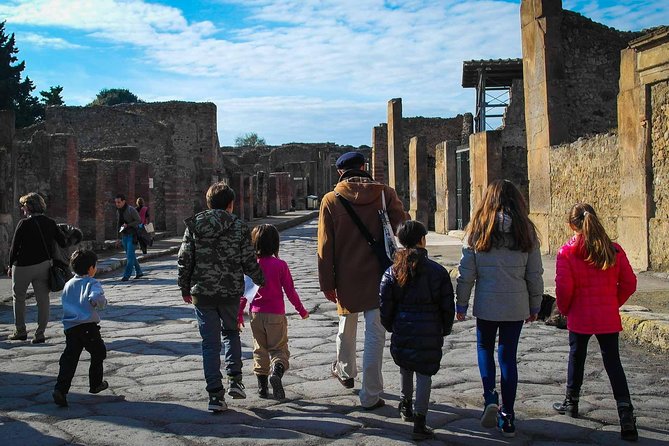
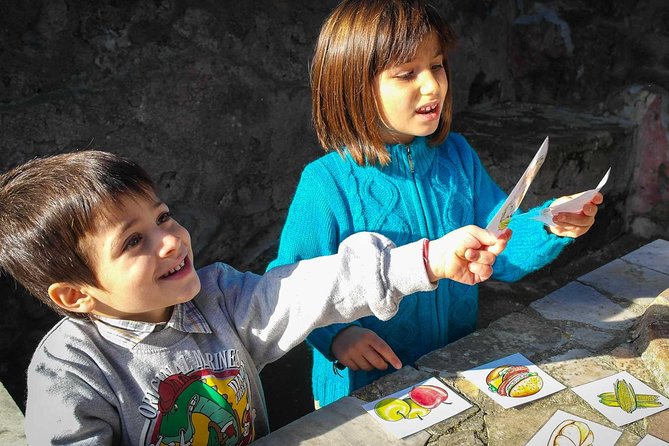
If you’re traveling with kids, this is where the tour earns its keep. The family option includes a Pompeii4kids kit with a kid-focused map, stickers, and activities, plus a guide who tailors the route toward younger attention spans.
What I like about this approach is that it doesn’t treat kids like small adults. Instead of hoping they’ll stare at stones and feel inspired, it gives them a job: find clues, connect characters to buildings, and learn life in Pompeii through play. That’s how you get “I didn’t know ancient Rome was like this” moments.
Two things to keep in mind for family planning. First, Pompeii can be intense in warm months—heat and bright sun are real. Second, the tour includes Roman life topics that may include sensitive areas like an old brothel, though a good guide can help handle that age-appropriately. If you want to adjust boundaries, tell your guide at the start so the route matches your family.
Practical note: the tour info says children under 18 need a current valid passport on the day of travel.
Your 2-Hour Walk Through Pompeii’s Most Important Stops
This is a walking tour, and the itinerary is structured like a guided story: from the eruption context, to the political and street grid, to baths and major buildings, and finally to the casts in the museum.
You’ll meet at Via Villa dei Misteri, 2, 80045 Pompei NA, Italy, and you’ll end back at the starting point. It’s convenient that it’s near public transportation, because you won’t be stuck improvising a long transfer plan in a place that’s already busy.
Below is what you can expect stop by stop, plus what to watch for.
Stop 1: Archaeological Park of Pompeii (orientation + eruption context)
This start is where your guide sets the mental framework. You’ll learn how Pompeii was preserved after Mt. Vesuvius erupted in AD 79, covering the town with ash and molten lava. That preservation is why you can still walk streets, see mosaics, and understand daily life with surprising clarity.
You’ll also get a tour of highlights like the city walls and the Porta Marina gate (once connected to Pompeii’s harbor entry). From there, the guide ties what you’re seeing to how Romans lived: wall paintings, floor mosaics, shops, and the layout of the city.
What you’ll enjoy most here: the pictures. Pompeii’s colors and textures make great photos, but the guide’s job is to point out what’s worth photographing—like the “why this is here” details rather than just the prettiness.
Possible drawback: early in Pompeii, people rush. If you’re prone to sprinting, build in a habit: pause for 20 seconds before each main photo so you actually see what’s in front of you.
Stop 2: Forum of Pompeii (politics, religion, commerce in one plaza)
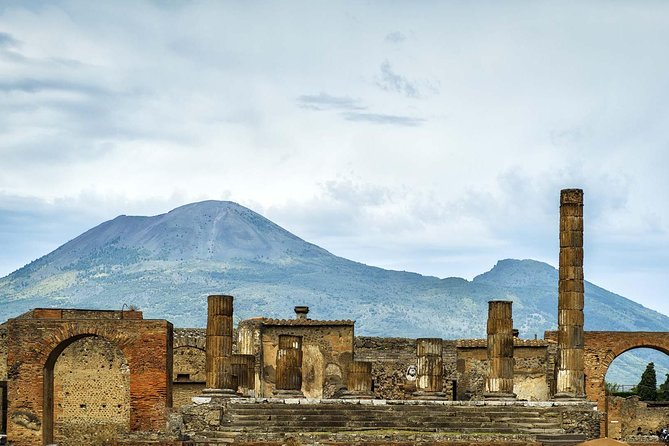
The Forum was the heart of the city—roughly a rectangular plaza measuring about 157 by 38 meters, and not a place for chariots. Here, you’ll learn what the Forum did: political decisions, religious life, and commercial activity all in the same central space.
Look for how the buildings and open square work together. It helps you understand why Pompeii’s city life wasn’t just “streets and houses.” It had a civic core that structured everything else.
This stop is also where kids often start to enjoy the tour because it’s open and you can play the kit’s sticker-and-clue games without climbing through tight corridors.
Stop 3: Via dell’Abbondanza (the city’s main street)
Next comes the main commercial and social artery: Via dell’Abbondanza, the long Decumanus Inferior from the Forum toward the Sarno Gate. This street gives you the feeling of “daily Pompeii,” not just the big monuments.
You’ll walk through a part of the city that helps explain why Romans loved organized streets with activity along both sides. It’s also a strong stop for visual learners: storefronts, street-level life, and the city flow connect quickly.
If you’re visiting in a hot month, this can be sun-heavy. Ask your guide where the shade tends to fall, and plan to drink water before you feel thirsty.
Stop 4: Terme del Foro (Roman baths, step by step)
The Forum Baths (Terme del Foro) are one of the best-preserved public bath complexes in Pompeii. Built around 80 BC, they were still operating in 79 AD when Vesuvius erupted.
This is one of my favorite stops because the tour walks you through the bath sequence: the Apodyterium (changing room), Frigidarium (cold bath), Tepidarium (warm room), and Calidarium (hot room). Even if you don’t remember the Latin names, the building layout makes the system easy to follow.
The ceilings and stucco relief work are worth lingering over. You’ll also see telamones—terracotta figures—and they make the baths feel less like a generic “Roman feature” and more like a real place people visited for relaxation and social time.
Trade-off: bathrooms and bathing are fascinating, but the area can be crowded depending on the day. A private guide helps you spend time where the details are clearest rather than just moving because the crowd is moving.
Stop 5: Temple of Apollo (Greek-Italic fusion)
The Temple of Apollo is one of Pompeii’s older and most important religious sites, with roots going back to the 6th century BC. You’ll recognize it because it sits in the Forum area and works like a landmark.
This stop is a great lesson in cultural blending. The temple combines Greek and Italic styles, with an elevated podium and an imposing stairway leading to a portico supported by 48 columns. If you look closely, you’ll get why archaeologists love this place: it’s a clear snapshot of how religious architecture traveled and evolved.
The guide may point out bronze replicas of Apollo as an archer and Diana (the originals are preserved in the National Archaeological Museum in Naples).
Short and sweet stop. If you’re traveling with kids, it’s often a good moment to use the map game because it feels like a “location you can spot” rather than just another wall.
Stop 6: Basilica (big civic building energy)
In the Forum area, the Basilica is the imposing public building at the southwestern corner. Dating to the 2nd century BC, it’s among the oldest examples of this kind of structure in the Roman world.
Even in a brief visit, this stop helps you understand how Romans built for civic life. The basilica concept—large covered space for public business—makes the city feel structured and intentional.
Drawback: if you only do Pompeii once, you might want more time here. But with a 2-hour tour, the goal is balance: show you enough to orient you so your second visit (if you make one) feels deeper.
Stop 7: Casa dei Vettii (the flashy “Sistine Chapel” of Pompeii)
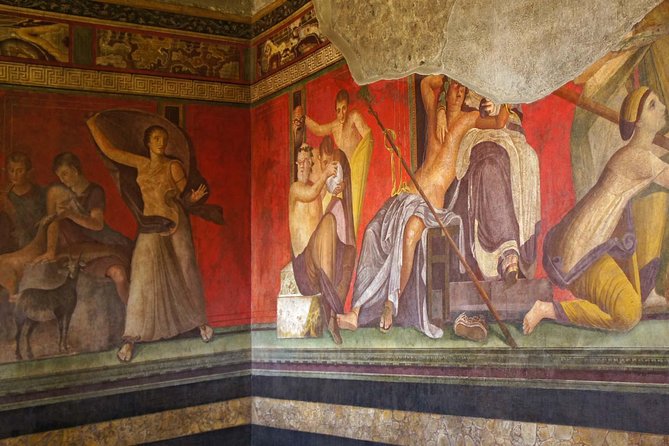
The House of the Vettii (Casa dei Vettii) is widely considered the showpiece for decoration—often described as Pompeii’s “Sistine Chapel.” It reopened in 2023 after a meticulous 20-year restoration, and that level of care shows.
This was home to wealthy freedmen Aulus Vettius Conviva and Aulus Vettius Restitutus, former slaves who became wealthy wine merchants. Their status shows in the home’s design: it wasn’t subtle wealth. It was meant to be seen.
If wall paintings and mosaics are your thing, this is where you’ll lean in. The guide can point out what to look for so the details don’t blur together.
The main practical concern: indoor and semi-indoor areas can feel stuffier than the open street sections. Wear light layers you can manage while the group keeps moving.
Stop 8: Teatro Grande (from Greek roots into Roman style)
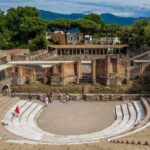
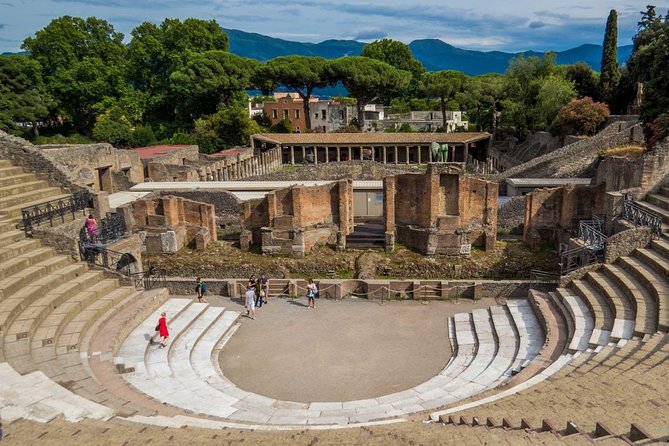
The Teatro Grande (Large Theatre) is carved into a natural lava hillside. It’s one of the world’s oldest surviving masonry theaters, built in the 2nd century BC, and it shows the architectural shift from Greek to Roman styles.
This is a great stop if you want a “how did Romans entertain themselves?” moment. The setting also helps you grasp Pompeii’s geography: lava stone isn’t just background; it’s part of the construction story.
Drawback: theatre zones can require short climbs or uneven footing. Your guide will likely pace you, but bring shoes with traction.
Stop 9: Antiquarium di Pompei (casts of victims)
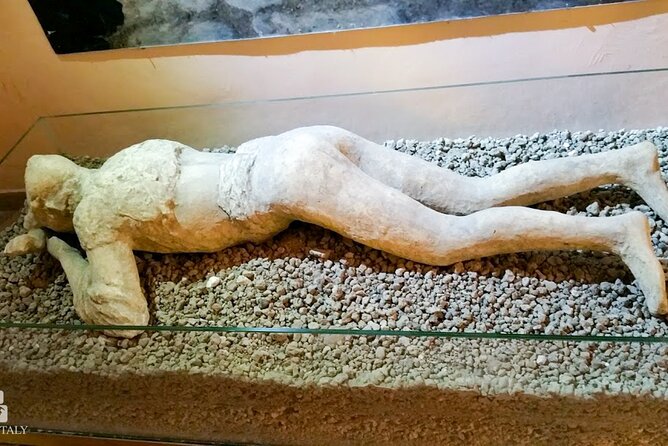
This is the emotional close. The Antiquarium di Pompei is Pompeii’s main museum space for fragile artifacts. Here you’ll see casts of victims—plaster figures preserved in their final moments.
It’s powerful, and it’s also educational. The guide can explain why these casts matter: they translate a disaster into human-scale reality.
If you’re bringing kids, check in with your guide about how much time you want at this stop. Some families spend longer; others move through a bit faster to keep the day from feeling too heavy.
It also has a practical value: the museum environment is more controlled than the outdoor ruins, which can be a relief after walking.
Beyond the Headliners: what Pompeii teaches if you know where to look
One of the best things about a private guide is that Pompeii becomes a place you can read. You don’t just see buildings. You start noticing systems.
Here are a few of the big ideas you’ll likely come away with. Pompeii’s street life wasn’t clean and dry like a modern city. You can spot details that point to frequent flooding and sewage challenges, including stepping-stone blocks across problem areas. You’ll also hear about how the city worked like a living organism: food storage, markets, and daily routines all tied to the urban plan.
The tour description also points to must-sees like the Macellum market and the public weighing scales, plus the “Roman fast food” type of setup with large vases used for storing food. Those details sound random until you connect them to what people needed every day: calories, storage, trade, and a reliable flow of goods.
And yes, there’s also a thread of the darker side of Roman life, including mention of an old brothel. A careful guide can discuss it with context so it doesn’t become a shocky “shock value” stop.
Finally, Pompeii is famous for more than ruins. It’s a city frozen mid-moment, which is why the casts and eruption story belong at the end. It’s the last missing piece: the why behind the preservation.
Price and Value: what you’re paying for at $165.05 per person
At $165.05 per person for about 2 hours, you’re paying for three things at once: a private Blue Badge guide, admission handling, and real time with a route that hits the strongest highlights.
In Pompeii, lines are time tax. Private skip-the-line access turns that tax into actual sightseeing. You’re not just buying information; you’re buying minutes spent where you want them.
Also, the family option adds value if you’re traveling with kids in the recommended age range. The Pompeii4kids kit—map, stickers, activities—does something simple but important: it gives children a reason to pay attention.
What to double-check for your own plans: pick-up and drop-off aren’t included, and the tour ends back at the starting point. So you need your own transport strategy in Pompeii.
One more practical note: the tour includes a mobile ticket, which can make entry smoother as long as your phone works and the format displays clearly.
Booking Tips: how to make the heat manageable and the route work
If you’re visiting in summer, act like it’s Pompeii’s busiest season. Wear a hat, bring water, and don’t rely on luck for shade. The info also says good walking shoes are recommended and that you should have a moderate physical fitness level—so plan for uneven stone and frequent stops.
Timing matters too. If you have flexibility, I’d go earlier in the day to avoid the harshest heat later. Even with a private guide, you can’t change the sun. You can only manage it with smart pacing and quick shade breaks.
Before you start, tell your guide what matters most:
- If your kids need a clearer task, ask to lean on the kit games during the Forum and main street segments.
- If you want maximum art and detail, ask for extra minutes at Casa dei Vettii.
- If you want the emotional weight of the day done properly, ask how long to stay in the Antiquarium.
Also, this tour is in English, so confirm your group’s language comfort. Most people will handle it fine, but it’s still a good idea to check so your kids don’t feel left out.
Should You Book This Private Pompeii Tour?
Book it if you want Pompeii to feel understandable fast. This is a strong choice for first-timers, couples who like guided explanation, and families with kids who need structure to stay engaged. The combination of skip-the-line access, a private guide, and the Pompeii-for-kids kit is exactly how you turn a massive site into a memorable day.
Skip it (or at least rethink) if your group can’t manage walking in heat or you expect a full-day “see everything” tour. Pompeii deserves more time than 2 hours, and this plan is intentionally focused.
If you do book: choose the family option if your kids are in the recommended range, and tell the guide your priorities at the meeting point. That’s how you get the flexible pacing that people consistently love—and it’s how Pompeii stops being overwhelming and starts being clear.
FAQ
How long is the Ancient Pompeii Private Tour?
The tour lasts about 2 hours.
Is this a private tour?
Yes. It’s a private tour/activity, so only your group participates.
Is skip-the-line access included?
Yes. The tour highlights skip-the-line ticket handling, and the guides have access to a fast-track line to handle entry quickly on site.
What’s included for families traveling with kids?
If you choose the family option (recommended for kids ages 6 to 11), you get the Pompeii4kids kit with a map, stickers, activities, and an activity-book. The guide also tailors the route for children with games and clues.
Where does the tour start and end?
It starts at Via Villa dei Misteri, 2, 80045 Pompei NA, Italy, and ends back at the same meeting point.
Are admission fees included?
Admission fee is listed as included, and the tour includes entry tickets for the stops.
Do kids need identification?
The tour notes that children under 18 need a current valid passport on the day of travel.
Is free cancellation available?
Yes. Free cancellation is offered, and you can cancel up to 24 hours in advance for a full refund.