REVIEW · POMPEII
Fast Access Exclusive Private Ancient Pompeii Half Day Tour with Local Guide
Book on Viator →Operated by Private Tours of Pompeii · Bookable on Viator
Pompeii is big. This tour makes it feel doable. With fast-access entry and a guide who can tell you what you’re actually looking at, you get Pompeii’s everyday world without losing hours to lines. I especially like the customizable focus on what you care about most, from mosaics to plaster casts. The one drawback to plan for: at about 2 hours, you won’t see every single corner of the site, so you need to go in with a rough idea of what you want.
The pacing is tight, and that’s the point. You start at Piazza Esedra, walk a focused route, and you’re back at the same meeting spot when you’re done. Guides like Anna, Livio, and Lello (among others) are described as arriving on time and moving quickly through less crowded entry points, then helping with photos as you go. One more practical note: you should have moderate walking comfort, since it’s a guided walk through Pompeii’s outdoor ruins.
In This Review
- Key things you’ll like about this Pompeii half-day tour
- Fast-access entry: why this Pompeii tour saves your day
- The guide experience: local know-how plus art-historian perspective
- A 2-hour Pompeii route that actually works on a half day
- Stop 1: Private tours area in UNESCO Pompeii grounds
- Stop 2: Teatro Grande, the big open-air stage
- Stop 3: Odeon (Teatro Piccolo) for the smaller performance vibe
- Stop 4: Via dell’Abbondanza, the main street of shops and villas
- Stop 5: Terme del Foro, Roman baths buried by 79 A.D.
- Stop 6: Lupanar, an ancient brothel and surviving frescoes
- Price and value: is $203.95 worth it for 2 hours?
- Who this Pompeii half-day tour fits best
- Weather, timing, and what to bring
- Should you book this private Pompeii skip-the-line tour?
- FAQ
- How long is the Pompeii tour?
- Is this tour private or shared?
- What’s included in the ticket price?
- Is hotel pickup included?
- What meeting point should I use?
- Is the tour offered in English?
- Does the tour run in bad weather?
- Do I need to bring a passport?
- Can I cancel for a full refund?
Key things you’ll like about this Pompeii half-day tour
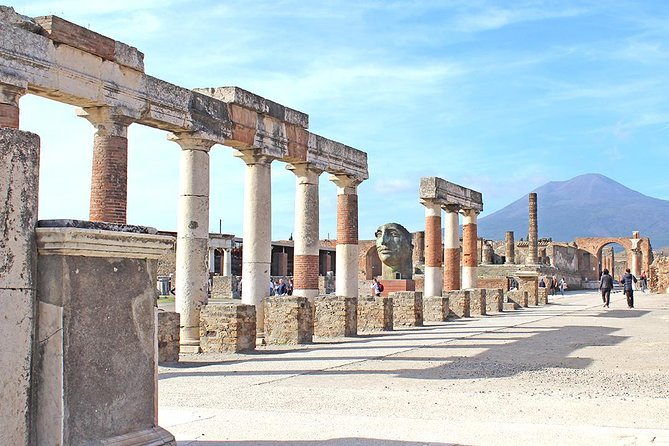
- Skip-the-line, private access so your time goes to sights, not queues
- A professional art historian-style guide that turns ruins into a story you can follow
- A smart, timed route through major set pieces like the theaters and Forum baths
- Choose your interests (mosaics, plaster casts, and more) rather than a one-size-fits-all script
- Two timing options (morning or afternoon) so you can fit it to your day
Fast-access entry: why this Pompeii tour saves your day
Pompeii can be wonderfully intense. It’s also easy to burn time. This is built around the big advantage you care about most on a short visit: priority access that helps you avoid the worst of the delays. In practical terms, that means you’re more likely to enter early enough to get moving while the site is still calmer.
The tour is also private, meaning it’s only your group. That matters in Pompeii because people tend to drift, stop, re-start, and ask questions at their own pace. With a private setup, your guide can keep the momentum going while still answering what you actually care about.
You’ll meet at Piazza Esedra (Pompei), and the tour ends back at that same meeting point. No hotel pickup and drop-off is included, so you’ll want to plan your own short walk or transit connections to the meeting point.
You can also read our reviews of more guided tours in Pompeii

The guide experience: local know-how plus art-historian perspective
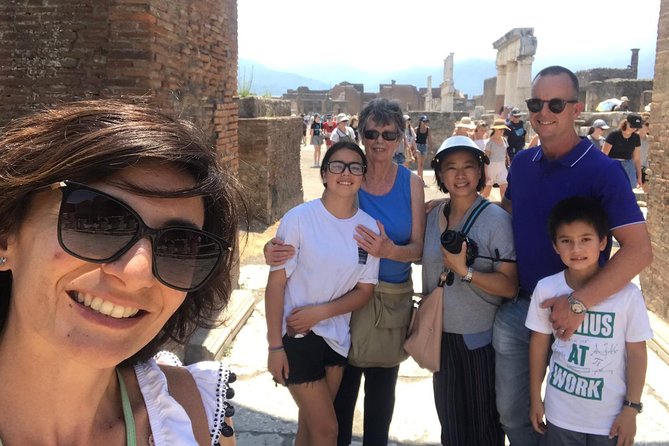
This tour doesn’t treat Pompeii like a photo scavenger hunt. You get a local guide and a professional art historian guide, plus a dedicated guide. That combination is what you’re paying for, even when the route looks straightforward on paper.
Why it’s valuable: Pompeii is full of fragments—walls, floors, sculpture areas, and spaces that look confusing unless someone gives you the “what am I seeing and why it matters” layer. If you’re the type who likes to understand daily life rather than just see big landmarks, this structure is a strong match. And if you’re more interested in specific details like mosaics or plaster casts, you can steer the conversation toward that.
From the guide styles mentioned in real-world experiences, the best-case outcome is that you don’t just rush past sights. You get quick orientation, then enough context to make the images mean something.
A 2-hour Pompeii route that actually works on a half day
This itinerary is designed to hit key areas with minimal dead time. Each stop is around 20 minutes, which creates a rhythm: look, learn, move. It’s a good fit for first-time visitors who want the big themes—public life, entertainment, trade, baths, and domestic-to-private spaces—without spending your whole day on transit and ticket lines.
Here’s the big catch: because it’s compact, you’ll want to choose your priorities. If you’re the kind of traveler who can happily spend an hour alone with one floor detail, you may feel a bit rushed. But if you want a well-paced introduction with a guide who can answer questions on the fly, the short format is a real advantage.
Stop 1: Private tours area in UNESCO Pompeii grounds
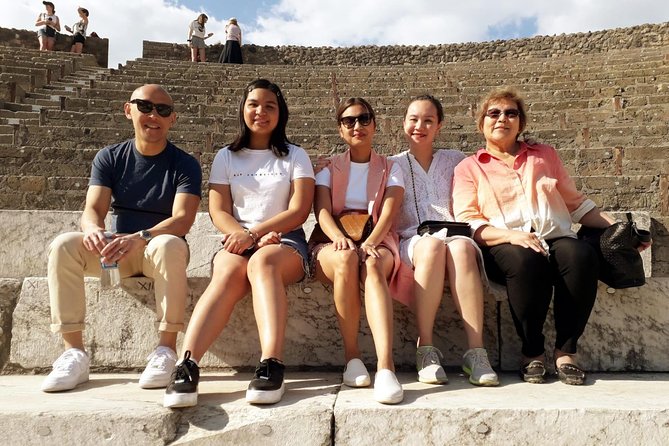
You begin with entry into Pompeii’s UNESCO World Heritage site area, with admission included. This first stretch is less about a single monument and more about getting your bearings fast.
What to expect in this early phase:
- Your guide sets the tone and gives you a quick “here’s how Pompeii is laid out” framework.
- You’ll get context for the larger story—what the eruption froze in place and why that makes the ruins so unusually vivid.
- It’s your chance to ask for what you want to see next, before the route locks in.
Why this stop matters: if you start without any framing, Pompeii can feel like scattered ruins. Starting with orientation helps you connect each later stop to the bigger picture of ancient city life.
Stop 2: Teatro Grande, the big open-air stage
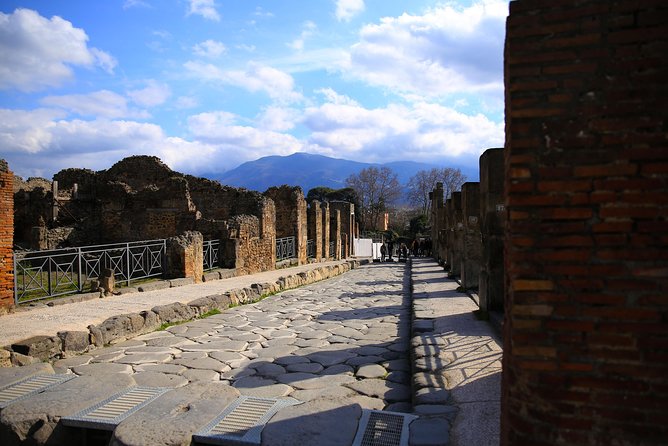
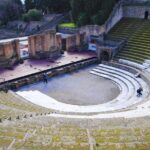
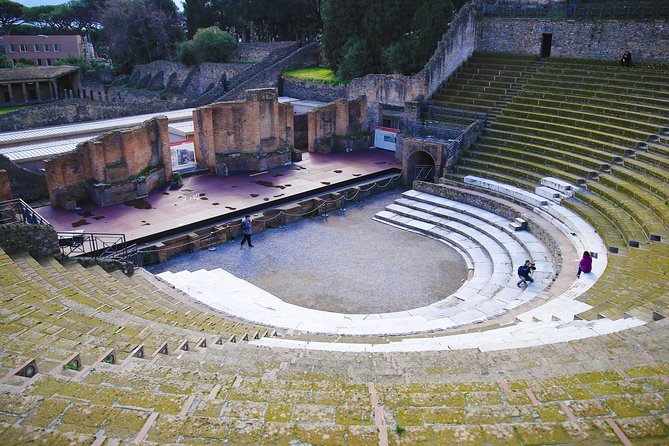
Next up is Teatro Grande, an open-air theater with around 5,000 seats. In about 20 minutes, your guide can explain how this kind of space worked and why entertainment spaces were such a major part of public life.
What you’ll likely appreciate here:
- It’s a clear, recognizable anchor sight.
- You can look at the shape and scale of the theater and understand how people gathered outdoors.
- Your guide’s storytelling turns the architecture into an idea of daily routines and social life.
Possible drawback: theaters are visually strong, but if you’re looking mainly for artwork or small-scale detail, you may want your guide to point out the specific features that connect the theater to the broader story.
You can also read our reviews of more private tours in Pompeii
Stop 3: Odeon (Teatro Piccolo) for the smaller performance vibe
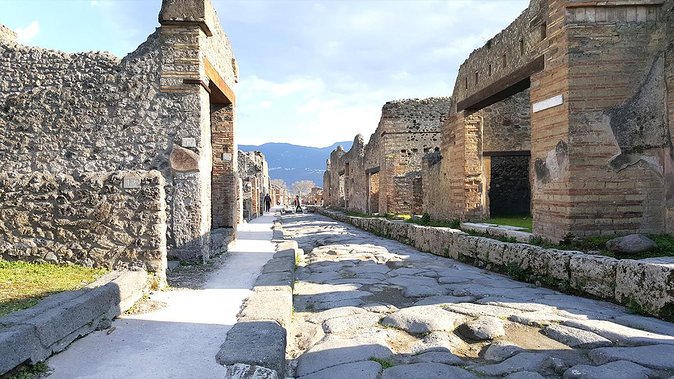
Then you head to the Odeon, also called Teatro Piccolo, an open-air theater seating about 800. Compared with Teatro Grande, this one helps you see how public entertainment wasn’t one-size-fits-all.
This stop is often where the guide’s interpretation really helps, because the difference between the two theaters can be easy to miss unless someone points out what changes and what stays similar in the way people used these spaces.
If you like contrasts—big vs. small, grand vs. intimate—this pairing works well within the tight time window.
Stop 4: Via dell’Abbondanza, the main street of shops and villas
After the theaters, you move onto Via dell’Abbondanza, Pompeii’s main street. This section focuses on movement through daily commercial and residential life, with major villas and ancient Roman shops along the way.
What you can do with this stop:
- Let your guide connect street life to the big spaces you’ve already seen (entertainment) and what people needed in between.
- Pay attention to how the street is organized—because it makes Pompeii feel like a lived-in city, not just a museum.
Why it’s a smart mid-tour stop: it breaks up the bigger “set pieces” and brings you back to the everyday theme. If you’re the kind of person who likes to imagine what a morning walk looked like, this is the stop that helps the most.
Stop 5: Terme del Foro, Roman baths buried by 79 A.D.
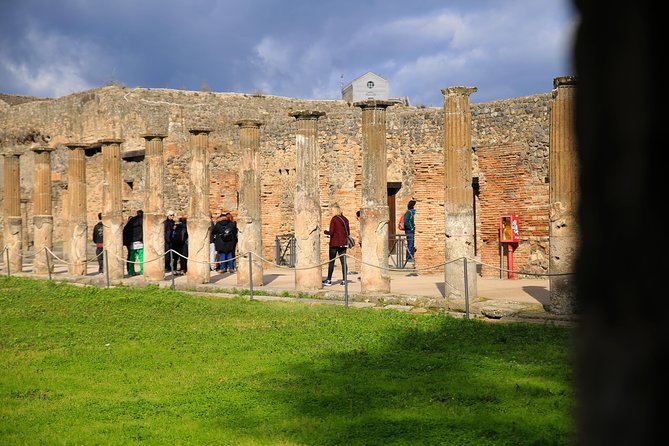
Then comes Terme del Foro, a Roman bath complex buried by the eruption of Vesuvius in 79 A.D. It’s a striking transition, because baths are where you expect routine, privacy, hygiene, social habits—normal life stuff.
In a short time, your guide can help you see:
- This wasn’t just a building; it was a routine space.
- The way it’s preserved lets you read daily patterns in the layout.
Potential downside to know: bath complexes can be visually busy. Without context, you can feel like you’re wandering. With a guide, you get a storyline you can follow, which is the difference between seeing ruins and understanding them.
Stop 6: Lupanar, an ancient brothel and surviving frescoes
Finally, you visit the Lupanar, the ancient Roman brothel. Some frescoes are still visible, and they illustrate the speciality of the woman working.
This is the stop that can be emotionally jarring for some people, and that’s not a bad thing to acknowledge. Pompeii doesn’t only show polite public spaces. It shows real life—sex work included. If that topic doesn’t sit well with you, you may want to mentally prepare, or ask your guide to frame what you’re seeing with care and context.
Why it’s still valuable: Pompeii’s power is that it documents human life in a way few archaeological sites do. The survival of frescoes makes this more than a label on a map.
Price and value: is $203.95 worth it for 2 hours?
At $203.95 per person for about 2 hours, this isn’t a budget option. But it isn’t just you paying for access to ruins. The value comes from the combination of:
- Private tour (only your group participates)
- Guaranteed skip-the-long-lines access
- Local guide plus professional art historian guide
- Admission tickets included for each listed stop
- Mobile ticket, which reduces friction on arrival
How I see the trade-off: if you’re going to Pompeii for the first time and you want a guided overview that hits major highlights fast, paying for fewer wasted minutes can feel very fair. If you already know the site well and you want to wander without structure, you might choose a self-guided plan instead and spend less.
One more practical value point: group discounts are offered. If you can travel with another small group or match up with travel companions, the per-person sting can soften.
Who this Pompeii half-day tour fits best
This is a strong choice if:
- You have only a short time and want major Pompeii themes efficiently.
- You like explanations, not just photos.
- You’re traveling with kids who can handle a moderate walking pace and you’ll keep them with you throughout.
- You want the flexibility of a morning or afternoon option.
It may be less ideal if:
- You plan to spend hours in one spot and hate time limits.
- You want hotel pickup included (it’s not part of this tour).
- You’re dealing with limits beyond moderate walking needs.
Weather, timing, and what to bring
The tour operates in all weather conditions, so dress for rain or sun. Pompeii is outdoors, and the route involves walking between stops. Wear comfortable shoes you trust on uneven ground, and bring a water bottle if you tend to get thirsty during guided walks.
Because confirmation is received at booking time, you can plan your day confidently. Also note that a current valid passport is required on the day of travel.
If you’re using public transit, the start point is described as near public transportation, which is helpful if you don’t want to fight traffic.
Should you book this private Pompeii skip-the-line tour?
If your main goal is to see the core Pompeii highlights in a short window and you value getting there fast, I’d lean yes. The skip-the-line promise, private pacing, and guide depth are exactly what make a half-day Pompeii visit feel worth it instead of rushed.
I’d hold off only if you’re the type who wants to roam slowly, or if your priority is spending long stretches inside museums rather than walking Pompeii’s outdoor city spaces. For everyone else, this tour is a practical way to get the big story, hit major sites like the theaters, baths, the main street, and the Lupanar, and come away with a clearer sense of what life looked like before 79 A.D.
FAQ
How long is the Pompeii tour?
It runs for about 2 hours.
Is this tour private or shared?
This is a private tour. Only your group participates.
What’s included in the ticket price?
The tour includes a local guide, a professional art historian guide, and admission tickets for the listed stops. It also includes guaranteed skip-the-long-lines entry.
Is hotel pickup included?
No. Hotel pickup and drop-off are not included.
What meeting point should I use?
You start at Piazza Esedra, 80045 Pompei NA, Italy, and the tour ends back at the same meeting point.
Is the tour offered in English?
Yes, it’s offered in English.
Does the tour run in bad weather?
Yes, it operates in all weather conditions, so you should dress appropriately.
Do I need to bring a passport?
Yes. A current valid passport is required on the day of travel.
Can I cancel for a full refund?
Yes. You can cancel up to 24 hours in advance for a full refund.