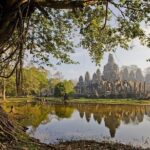
One good loop through Angkor changes your perspective. This tour strings together the big names—Angkor Wat, Bayon, and Ta Prohm—with an expert local guide explaining what you’re seeing as you go, instead of just pointing and moving on.
Two things I really like: you get guided time inside major temples (so the carvings and layouts make sense), and the route stays manageable for a 5 to 7 hour day. The main catch is the cost you add on top: the temple fee of $37 per person is not included, and you’ll need to follow the basic temple dress rule of covering knees and shoulders.
If you want the best highlights without doing full-day chaos, this style of circuit fits well—especially with hotel pickup and drop-off and a group format that keeps the day organized.
In This Review
- Key takeaways before you go
- The overall plan: Angkor Wat, Angkor Thom, then Ta Prohm
- Getting picked up in comfort (and what to bring)
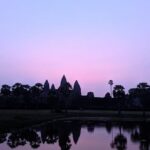
- Angkor Wat inside and out: Suryavarman II, towers, and flag-symbol meaning
- Angkor Thom’s South Gate (Tonle Oum): five gates and a city-scale sense
- Bayon Temple and its faces: learning how the carvings work
- Angkor Thom extra stops when you have energy: Baphuon, Elephant Terrace, and more
- Ta Prohm’s tree roots: the Tomb Rider look with real context
- What the pacing feels like in a 5 to 7 hour day
- Price and value: $45 tour plus the $37 temple fee
- Dress code, footwear, and small choices that save the day
- Should you book this small-circuit Angkor Wat, Bayon, and Ta Prohm tour?
- FAQ
- What temples are included on this tour?
- How long does the tour take?
- Is pickup from my hotel included?
- What’s included in the price?
- Are temple entrance fees included?
- Do I need to wear certain clothing?
- What should I wear or bring for the day?
- Is this a private tour?
- Is there a mobile ticket?
- Can I cancel for free?
Key takeaways before you go
- Inside-and-out temple time: you don’t just admire from the outside; you’ll see key interiors too.
- A guide who connects the dots: you’ll learn why these temples were built and how the stories show up in carvings.
- Comfort matters in Siem Reap: air-conditioned car, drinking water, and cold towels help you stay sharp.
- A focused highlight mix: Angkor Wat, Angkor Thom’s South Gate and Bayon, then Ta Prohm’s famous roots.
- Know the extra cost up front: temple fees are separate from the tour price.
- Dress for temples: cover knees and shoulders, and wear shoes that handle walking.
The overall plan: Angkor Wat, Angkor Thom, then Ta Prohm
The heart of this experience is a compact route through the Angkor big hitters. You start at Angkor Wat, then move to Angkor Thom’s South Gate area (Tonle Oum) and Bayon, and you finish with Ta Prohm, the one people often link to the Tomb Raider look.
Why this works: you get contrast in the temples. Angkor Wat is structured and monumental. Bayon is crowded-face energy. Ta Prohm is the “nature took it back” feel, with roots and stones locked together. In one day, your brain gets a better sense of how the Khmer world expressed power, belief, and artistry.
The tour is paced around set stops. Angkor Wat gets the longest time (about 3 hours), Bayon and Ta Prohm each get about 1 hour, and the South Gate portion is shorter (about 30 minutes). That means you get enough time to actually see things, but you’re not stuck all day in one place.
You can also read our reviews of more tours and experiences in Siem Reap.


Getting picked up in comfort (and what to bring)
You’ll have hotel pickup and drop-off, and you travel in an air-conditioned car. The small stuff helps: drinking water and cold towels are included, which is genuinely useful in a long temple day.
For what to bring, the tour is straightforward:
- Wear comfortable walking shoes. Temple ground can be uneven.
- Pack light and avoid valuables. The experience notes you should not bring valuables with you.
- Plan clothing that meets the temple rule: cover knees and shoulders.
Also, if you hate ticket hassle, this one helps. It uses a mobile ticket, so you’re not scrambling at the last minute.
Angkor Wat inside and out: Suryavarman II, towers, and flag-symbol meaning
Angkor Wat is the reason most people come to Siem Reap, and this tour treats it like the centerpiece it is. You’ll see it from the outside and also go inside, with a local guide explaining the story as you move through.
A few facts your guide will likely connect to what you’re seeing:
- It was built between 1113 and 1150 AD by King Suryavarman II.
- The temple measures about 330 metres by 260 metres.
- It has three levels and five main towers.
- It’s a national symbol of Cambodia and appears on the country’s flag, symbolizing the soul of the nation.
Here’s why those details matter when you’re there: Angkor Wat is huge, and your first reaction is often visual only. With guided time inside, you start to notice how the layout pushes your eye upward and inward, almost like a message written in stone. You also understand the symbolism behind what you’re looking at, instead of admiring it like a museum exhibit and then forgetting it by the ride to the next stop.
Time-wise, Angkor Wat is about 3 hours on this route. That’s a good amount because you can take breaks, look closely at carvings, and still stay on schedule.
Angkor Thom’s South Gate (Tonle Oum): five gates and a city-scale sense
After Angkor Wat, you head to Angkor Thom area and stop at the South Gate, also called Tonle Oum. This is a shorter stop (about 30 minutes), but it’s the kind of moment that helps you “get oriented” fast.
Your guide will point out the city’s structure:
- Angkor Thom is described as 3 kilometres each side.
- It has five gates: South Gate, Ghost Gate (Gate of the Dead), Victory Gate, Dei Chhnang Gate (North Gate), and a Killing Gate.
Even if the time here is brief, the value is how it changes your perspective. Instead of thinking of Angkor as a handful of temples, you start seeing it as a full city design—gates, directions, and symbolic thresholds.
If you like architecture and city planning, you’ll probably enjoy this stop more than you expect. It’s also a nice reset before Bayon, which tends to feel far more character-filled.
Bayon Temple and its faces: learning how the carvings work
Bayon is where the tour shifts from grand structure to instant recognition. You’ll visit Bayon for about 1 hour, again with outside views and time inside while your local English-speaking guide explains the temple’s meaning and the religious ideas that influenced the building and carvings.
Bayon is famous for the faces, and your guide’s job is to help you interpret what you’re seeing. The faces aren’t just decoration; they’re part of the temple’s religious and political language. When someone connects carvings and layout to the bigger Khmer story, the temple becomes easier to read.
One practical note: because Bayon is visually busy, it can feel overwhelming if you rush. Don’t sprint through. Slow down for the face towers and then look for the smaller carving details your guide highlights. That approach makes the 1 hour feel like a full stop instead of a quick photo break.
You can also read our reviews of more city tours in Siem Reap
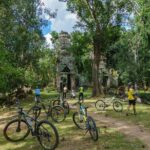
Angkor Thom extra stops when you have energy: Baphuon, Elephant Terrace, and more
This tour is built around a core set of temples, but the route can expand slightly if you want more. The experience notes that if you have energy, you can be brought around to extra points around Angkor Thom.
These additional sights may include:
- Baphuon Temple
- Elephant Terrace
- Terrace of the Leper King
- The Royal Palace
Why this can be worth it: these spots help fill in the “in-between” story of Angkor Thom. Angkor Wat can dominate your memories, and Bayon gives you iconic faces. The extra terraces and palace areas add variety, especially if you enjoy learning what different parts of a complex were used for and what symbols showed up there.
The key trade-off is time and stamina. If you’re feeling good after Bayon, adding these can make your day feel longer in the best way. If you’re tired, you’ll still get plenty with the main stops.
Ta Prohm’s tree roots: the Tomb Rider look with real context
Ta Prohm is the closing chapter, and it’s a strong one. You’ll spend about 1 hour here with outside views and time inside, with your guide explaining its history and why it’s known as a tree temple—and yes, it’s often linked in pop culture to the Tomb Raider look.
Ta Prohm’s big emotional effect is simple: you see how the temple and the forest ended up in a shared conversation. Stones and roots look tangled in a way that’s hard to replicate anywhere else. It’s not only scenery. It’s also a reminder of how time reshapes human projects.
With guidance, the tour is more than walking through a set. You’ll be better prepared to notice what the roots are covering or shaping, and you’ll understand the broader story behind why the temple survived in this particular, recognizable state.
If you’re sensitive to heat and you hate long sun exposure, plan your pace carefully here. The tour’s schedule gives you an hour, but you can still choose slower viewing at the most interesting sections.
What the pacing feels like in a 5 to 7 hour day
A lot of Angkor tours feel either rushed or bloated. This one aims for the middle. You have:
- Angkor Wat as the anchor (3 hours)
- South Gate as a quick orientation (30 minutes)
- Bayon for detail time (1 hour)
- Ta Prohm to finish strong (1 hour)
- Plus time moving between areas in an air-conditioned vehicle
The practical benefit is mental. You’re not trying to “solve” every temple. You’re moving through a story arc: origin and symbolism (Angkor Wat), city structure (South Gate), iconic faces (Bayon), and the nature-over-stone effect (Ta Prohm).
The main consideration is simple: you’ll walk. Even though stops are timed, temples mean uneven surfaces and steady attention. If you’re used to city walking, you’ll likely be fine. If you struggle with prolonged walking, you’ll want to factor that into your expectations.
Price and value: $45 tour plus the $37 temple fee
The tour price is $45.00 per person. The temple fee is $37.00 per person and is not included. On paper, that puts you around $82 total per person before tips (and before any optional add-ons like travel insurance).
Is it worth it? For me, the value is in what you get to avoid:
- You’re paying for a guide who explains what you’re seeing, not just transportation.
- You get hotel pickup and drop-off, which cuts down stress.
- You get water, cold towels, and air-conditioned travel.
- The schedule is tight enough to feel efficient, but not so tight that you’re constantly sprinting.
What might make it less appealing: if you already have your own plan and you’d rather self-guide with a map and audio, you might feel the extra cost is unnecessary. But if you want the temples to make sense while you’re there, this structure usually earns its keep.
Tipping is recommended for guide and driver, but it’s not built into the base price. Plan for that so you’re not caught off guard.
Dress code, footwear, and small choices that save the day
This tour gives simple rules, and following them is the easiest way to have a smooth day.
- Knees and shoulders covered for temple entrances. Bring a lightweight layer if you’re worried about meeting the rule.
- Comfortable walking shoes. Not fancy sandals. Something you can trust on uneven ground.
- Avoid valuables. Keep your phone and wallet secure and only carry what you need.
Also, think about camera strategy. Bayon and Ta Prohm are photo magnets. Angkor Wat can reward slow looking. If you try to photograph everything at full speed, you’ll miss the guided explanations.
Should you book this small-circuit Angkor Wat, Bayon, and Ta Prohm tour?
Book it if you want a high-impact Angkor day with guided context. It’s a solid choice for first-timers who want Angkor Wat + Bayon faces + Ta Prohm tree temple without building a whole itinerary yourself. The mix of inside-and-out temple time and hotel pickup makes the day feel organized.
Skip it or reconsider if:
- You’re allergic to extra fees once you arrive. The temple fee is $37 per person, separate from the tour.
- You don’t want a structured schedule. This tour works best when you’re happy to follow the timing.
One more note: guides can make or break these days. One guide name that’s specifically highlighted is Dan, noted for storytelling and knowledge of Cambodian history and the religions shaping temple building and carvings. Even if your guide differs, the goal is the same: understanding what you’re looking at as you look at it.
If that’s what you want, this is a good way to spend your limited time in Siem Reap.
FAQ
What temples are included on this tour?
You’ll visit Angkor Wat, Angkor Thom South Gate, Bayon Temple, and Ta Prohm Temple. The route may also include additional Angkor Thom sights if you have energy.
How long does the tour take?
The tour duration is about 5 to 7 hours.
Is pickup from my hotel included?
Yes. Hotel pickup and drop-off are included.
What’s included in the price?
Included features are an air-conditioned car, drinking water and cold towels, hotel pickup and drop-off, and a local English speaking tour guide.
Are temple entrance fees included?
No. Temple fee is $37.00 per person and is not included.
Do I need to wear certain clothing?
Yes. You must cover your knees and shoulders when entering the temples.
What should I wear or bring for the day?
Wear comfortable walking shoes. It’s also advised not to bring valuables.
Is this a private tour?
Yes. Only your group will participate.
Is there a mobile ticket?
Yes. The tour uses a mobile ticket.
Can I cancel for free?
Yes, free cancellation is available. You can cancel up to 24 hours in advance for a full refund.