REVIEW · ST AUGUSTINE
Private Historical Tour of St. Augustine
Book on Viator →Operated by Explore Tours And Pickups · Bookable on Viator
St. Augustine makes more sense from a cart. This private ride in an open-air electric vehicle is a fast way to get up close with the big sights, and your driver-guide will answer questions as you move.
In about an hour, you pass anchor stops like Mission Nombre de Dios, Castillo de San Marcos, and the Cathedral Basilica, with guides such as Mark and Karen known for clear storytelling and good pacing. One consideration: it’s mostly a ride-and-point-out format, and the Bridge of Lions is specifically passed by without stopping, so you’ll want other time if you’re aiming for long, hands-on visits.
In This Review
- Quick Take: What Makes This Tour Worth Your Time
- Key Highlights I’d Prioritize
- Entering St. Augustine by Electric Cart (and Why It Works)
- The Downtown Route: A One-Hour Timeline You Can Remember
- Mission Nombre de Dios and Our Lady of La Leche
- St. Augustine’s Cathedral Basilica and the Plaza Connection
- Castillo de San Marcos: Defense Meets Architecture
- Tolomato Cemetery: A Quiet Pause That Adds Depth
- St. Francis Barracks and Coquina Construction
- The Oldest Surviving Spanish Colonial Residence (Gonzalez-Alvarez House)
- Flagler College Area and the Ponce de Leon Hotel Connection
- Flagler’s Memorial Presbyterian Church
- Bridge of Lions: The One You See Without Stopping
- Price and Value: $200 Per Group (Up to 9 People)
- Logistics That Matter: Where to Meet and How to Arrive
- The Best Person for This Tour (and Who Should Skip It)
- Tips to Get the Most from Your Hour
- Should You Book This Private Historical Tour of St. Augustine?
- FAQ
- How long does the private historical tour last?
- What transportation do we use during the tour?
- Is this tour private or shared?
- Where does the tour start and end?
- Can you drop us somewhere other than the start location?
- Which main sights will we pass by?
- Do we get out of the vehicle at every stop?
- Is parking provided?
- What language is the tour offered in?
- What if the weather is bad or I need to cancel?
Quick Take: What Makes This Tour Worth Your Time
I like this setup because it solves two common St. Augustine problems fast: distances between highlights and not knowing where the story actually starts. The electric cart keeps you moving through the downtown historic core while your guide connects dates, power struggles, and daily life into one readable timeline.
And you’re not stuck listening to a lecture. Since the driver is also your guide, you can ask questions while you’re looking at the buildings themselves. That real-time context is the main reason the tour works so well for first-timers and for people who only have a small window.
Key Highlights I’d Prioritize
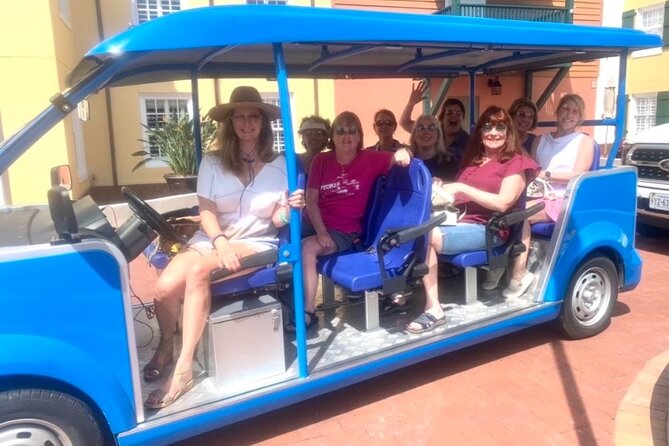
- Open-air electric vehicle comfort for getting close to historic landmarks without dealing with most downtown driving
- Driver-guided Q&A while you’re passing the sites, not after you’ve already moved on
- Major St. Augustine anchors in one circuit across Spanish, British, and American eras
- Stop-by-stop story context at places tied to founding, defense, faith, and civic life
- Photo-friendly sightlines at key downtown locations, without the hassle of coordinating multiple rides
You can also read our reviews of more private tours in St Augustine
Entering St. Augustine by Electric Cart (and Why It Works)
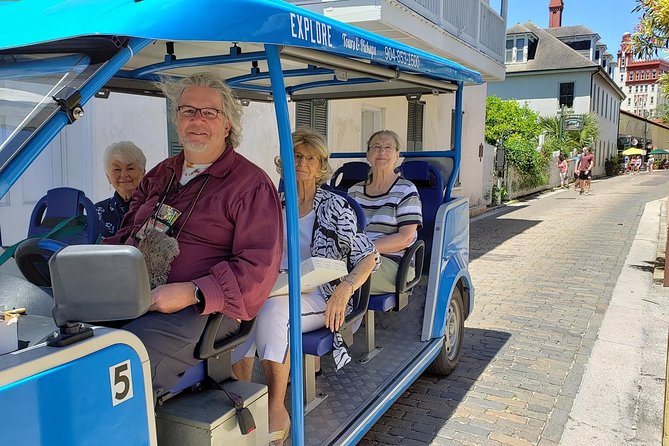
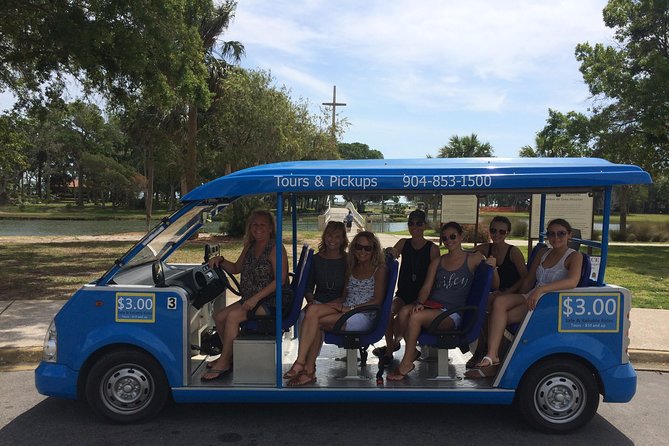
The whole experience is designed around a simple idea: you’ll get a working layout of the city in a short time. You board an open-air electric vehicle and roll through downtown passing major structures and neighborhoods connected to centuries of change.
That format is especially helpful if you’re staying in town and want maximum context per hour. Instead of doing a scavenger hunt with a map, you’re getting a story map—where the guide points, explains, and ties each stop to the next.
Private also matters here. The tour is for only your group (up to nine people), which means you can ask practical questions without the awkward pause of waiting for a turn in a larger crowd.
The Downtown Route: A One-Hour Timeline You Can Remember
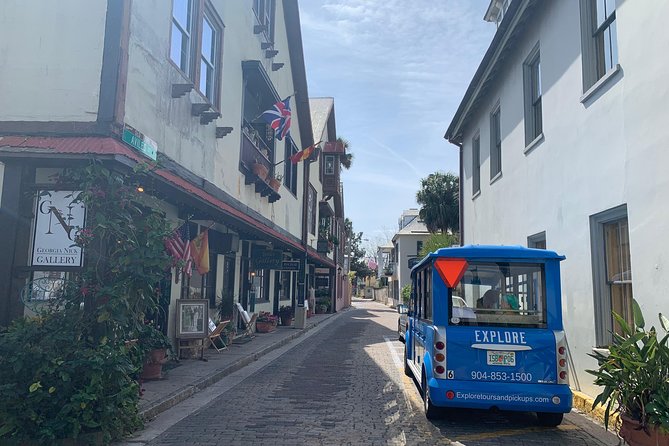
Your tour focuses on the downtown historic district and key landmarks that anchor St. Augustine’s story. You move between mission sites, fortifications, places of worship, cemeteries, and civic squares—so you start to see the city as a chain of locations, not random old buildings.
In practice, the guide keeps the pace tight. Even if you’ve visited before, you’ll usually pick up new connections—like why a certain building matters, or how the city’s Spanish origins echo into later chapters.
If you tend to learn best by seeing the place while someone explains it, this route does that well. If you’re hoping for long entry times into multiple museums, keep expectations realistic: it’s built for orientation and storytelling.
Mission Nombre de Dios and Our Lady of La Leche
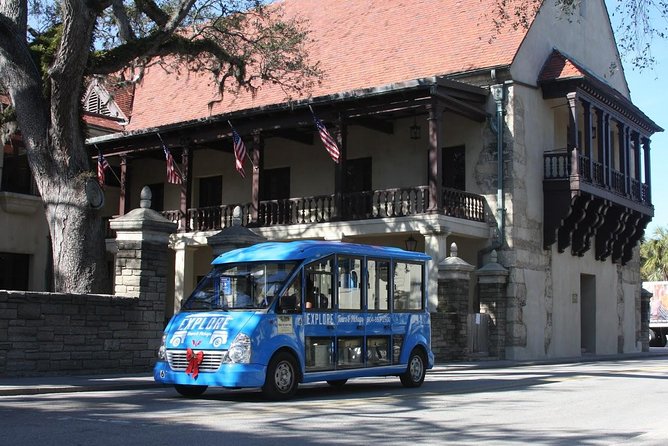
Mission Nombre de Dios is where the tour roots you in the founding story. The Shrine of Our Lady of La Leche traces its origins to the 1565 founding of St. Augustine, when Pedro Menéndez de Avilés landed and proclaimed the site for Spain and the Church.
A detail that really helps the story click: Menéndez named the site Nombre de Dios—meaning Name of God—and placed Father Lopez in charge as the first parish priest in St. Augustine. That connection between naming, mission leadership, and the early church gives you a sense of how intertwined religion and settlement were from the start.
If you care about how European powers established control, this stop frames it clearly. It’s also a strong starting point for first-timers because it explains why St. Augustine’s origins don’t feel like a footnote.
St. Augustine’s Cathedral Basilica and the Plaza Connection
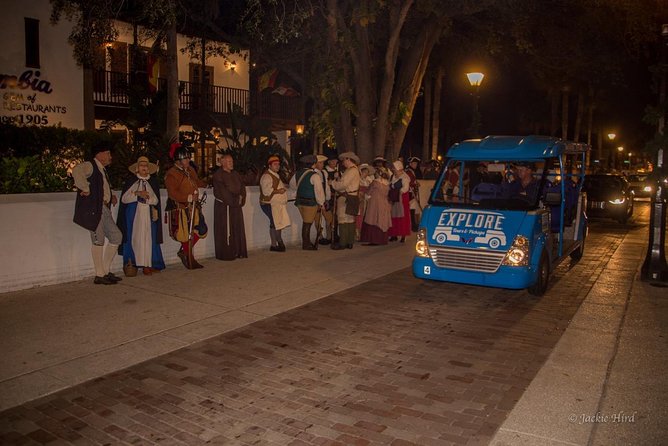
You’ll pass the Cathedral Basilica of St. Augustine, identified here as the oldest Catholic Church in the city and the oldest parish in the country. That’s a big claim, so the tour’s value is in making it feel grounded: you’re seeing the place while hearing how the parish tradition ties back to early settlement.
The tour also ties the cathedral theme into civic life by highlighting the Plaza de la Constitución. This square sits at the center of the historic city and is bordered by the Cathedral Basilica, Trinity Episcopal, and the Government House.
One especially useful detail is the long-running market tradition. The plaza includes a public market in use since the 1500s, when fish, vegetables, and other goods were traded here. That’s not just trivia—it’s a shortcut to understanding how the city functioned day-to-day, even while empires and governments kept shifting.
You can also read our reviews of more historical tours in St Augustine





Castillo de San Marcos: Defense Meets Architecture
Passing Castillo de San Marcos National Monument is one of the most satisfying moments on this tour. This fort preserves the oldest masonry fortification in the continental United States and it interprets over 450 years of cultural intersections.
Even when you’re not stepping inside, the guide’s job is to help you visualize what this location protected: Spain’s grip on the Atlantic trade route and Florida itself, where the fort’s purpose mattered as much as its walls.
If you’re the type who likes architecture with a reason behind it, pay attention during this part. A fort is easy to admire, but the tour helps you understand why it had to be built here—and why it survived cultural transitions.
Tolomato Cemetery: A Quiet Pause That Adds Depth
Tolomato Cemetery can feel like a somber turn in the middle of a fast-moving downtown circuit. It’s also one of the most historically specific stops on the route: it was in use from the 18th century until 1884.
That long span is important. It signals that St. Augustine didn’t just experience dramatic events; it also lived through them, burying generations and keeping community ties over time. This stop gives the tour emotional balance, so the story doesn’t come off as only wars and buildings.
If you prefer your history with human scale, you’ll likely appreciate this portion more than you expect.
St. Francis Barracks and Coquina Construction

The St. Francis Barracks are another standout for explaining how structures shifted roles over time. Here, the barracks were constructed of coquina between 1724 and 1755 by Franciscan friars, which matters because it shows the original building purpose was tied to religious figures and local life.
Then the site changed hands when Florida came under British possession in 1763 and was converted for military use. Later, in 1821 Florida was claimed by the United States, and the U.S. Army took control until deactivation in 1900. The building was leased to Florida State Troops, forerunners of today’s National Guard, in 1907.
That’s a lot of political change to fit into one vehicle ride, but this tour handles it by connecting dates to the physical place you’re seeing. It’s a practical way to understand how one site can carry multiple eras without you needing to research on your own beforehand.
The Oldest Surviving Spanish Colonial Residence (Gonzalez-Alvarez House)
You’ll also pass the Gonzalez-Alvarez House, owned and operated by the St. Augustine Historical Society. It’s presented as the oldest surviving Spanish colonial residence in Florida.
Even though you’re not spending hours here, it’s a meaningful stop because residences anchor history differently than forts and churches. A home tells you what everyday life could look like under a particular cultural influence, and the guide’s stories help you imagine those daily rhythms without turning the tour into a history textbook.
Flagler College Area and the Ponce de Leon Hotel Connection
Another key “wow” factor comes from passing the Ponce de Leon Hotel, now Flagler College. This is one of the city’s big architectural chapters from a much later era, when wealth and grand civic ambition left visible marks.
This part of the route is useful even if your main interest is earlier Spanish Florida. You start to see how St. Augustine kept re-inventing itself, and how older city identity coexists with newer architectural statements.
Flagler’s Memorial Presbyterian Church
Flagler’s Memorial Presbyterian Church is dedicated March 16, 1890, and the tour frames it through a personal detail: it was built for Flagler’s daughter, Jennie Louise Flagler, who died in 1889.
The design connection is also specific. Flagler chose architects Carrere & Hastings—the same firm connected to the Ponce de Leon Hotel—and the church design is based on the Basilica of St. Mark in Venice.
If you like tracing cultural influence, this is a strong stop. It shows that St. Augustine’s story isn’t isolated—it links to larger European architectural ideas and to the American era’s taste for memorial grandeur.
Bridge of Lions: The One You See Without Stopping
You will pass the Bridge of Lions without stopping. It’s noted as a 1927 completion, built during Florida’s extravagant land boom times, designed as a work of art as much as a transport for cars connecting downtown St. Augustine with Anastasia Island.
This is the tour’s only explicit “no stop” landmark, so use it as a planning clue. If you want photos with the bridge from multiple angles or you want to spend time on Anastasia Island, schedule that separately. The bridge is still worth passing, but it’s not the main draw for lingering.
Price and Value: $200 Per Group (Up to 9 People)
The price is $200 per group for up to nine people, and on average people book about 20 days in advance. That makes it feel less like a per-person ticket and more like a group-friendly way to buy time—especially when you’re traveling with family or friends.
Here’s how to think about value:
- For a group of 9, you’re effectively paying about $22 per person for an hour of private guiding and a coordinated route through multiple highlights.
- For 2 people, it’s $100 per person, which is more like paying for a private guide rather than a casual group tour.
If you’re solo or a couple, you’ll get better value when you compare it to the cost of multiple self-guided stops plus your time. If you’re in a larger group, it’s one of the more budget-sensible ways to get a tour-style experience in a short window.
Logistics That Matter: Where to Meet and How to Arrive
This tour uses a mobile ticket, and pickup is available at specific downtown locations by request only. The important practical detail is meeting location: you start and end at 1 Cordova St, St. Augustine, FL 32084.
There’s also a simple instruction on drop-off: you can be dropped at the same location you started or anywhere within the immediate downtown historic district. That’s helpful because it avoids the usual “back to the start” frustration if you’re planning to keep exploring afterward.
Do plan around parking. The experience notes that they do not offer parking, so come early to secure it. You’ll enjoy the tour more if you’re not stress-scrolling for a spot right before boarding.
The Best Person for This Tour (and Who Should Skip It)
This tour is a great fit for:
- First-time visitors who want the story of St. Augustine’s major landmarks in one outing
- Time-pressed travelers who need an overview before choosing what to return to
- Families and multi-generation groups who want reduced driving and an easy way to ask questions
It’s also a solid choice if mobility or logistics make self-driving harder. You’ll stay on the vehicle for the circuit, and the guide’s job is to point out what to look at while you’re moving.
I’d consider skipping (or pairing it with additional time) if you want long interior visits at multiple sites. Since you’re mostly passing highlights, it’s not the best choice for a “see everything deeply today” plan.
Tips to Get the Most from Your Hour
Bring a simple goal: after the tour, pick two places you want to return to for a longer look. The tour’s structure is ideal for that kind of follow-up planning.
During the ride, don’t just ask general questions—ask situational ones. For example, ask what to prioritize first if you only have one extra stop, or what the guide considers the key turning point in the city’s story.
Also, remember it’s open-air and weather is required to run. If the sky looks questionable, plan indoor alternatives for later, or be ready to shift dates if it gets canceled due to poor weather.
Should You Book This Private Historical Tour of St. Augustine?
Yes—if your goal is to get oriented and understand why St. Augustine looks the way it does, this is an efficient, private way to do it. The electric-cart format keeps you moving, and the driver-guide approach gives you a chance to ask questions while you’re actually seeing Mission Nombre de Dios, Castillo de San Marcos, the Cathedral Basilica, and the Plaza de la Constitución.
I’d book it especially if you’re traveling with 4 to 9 people, because the group price makes the per-person cost attractive for a private one-hour introduction. If you’re going as a solo traveler or a couple, weigh the $200 group price against what you’ll do with the extra learning—use the tour to choose where to spend your next hours wisely.
FAQ
How long does the private historical tour last?
It runs for about 1 hour.
What transportation do we use during the tour?
You ride in an open-air electric vehicle.
Is this tour private or shared?
It’s a private tour/activity, and only your group participates (up to 9 people).
Where does the tour start and end?
It starts and ends at 1 Cordova St, St. Augustine, FL 32084.
Can you drop us somewhere other than the start location?
Yes. You can be dropped off at the same location you started or anywhere within the immediate downtown historic district.
Which main sights will we pass by?
You’ll pass by places such as Mission Nombre de Dios, Castillo de San Marcos, the Ponce de Leon Hotel (Flagler College), the Cathedral Basilica, Tolomato Cemetery, the St. Francis Barracks, and the Plaza de la Constitución.
Do we get out of the vehicle at every stop?
This is mainly a tour of the downtown area from the electric vehicles. The Bridge of Lions is specifically noted as being passed by without stopping.
Is parking provided?
No. The experience does not offer parking, so you’ll want to come early to secure a spot.
What language is the tour offered in?
The tour is offered in English.
What if the weather is bad or I need to cancel?
The experience requires good weather. If it’s canceled due to poor weather, you’ll be offered a different date or a full refund. You can cancel up to 24 hours in advance for a full refund.