REVIEW · ROME
Private Tour of Catacombs and Ancient Appian Way (hotel pick up)
Book on Viator →Operated by Eternal City Private and Guided Tours · Bookable on Viator
This is Rome’s road trip with a twist. You’ll ride out to the Catacombs of St. Callisto, then walk part of the legendary Appian Way with stops that connect early Christianity to the Roman world. It is a focused 2.5-hour format that fits well when you want something historical but not too day-long.
I especially like that it includes hotel pickup and the catacombs admission ticket (so you’re not piecing together logistics at the worst possible moment). The private vehicle also makes the ride comfortable and efficient. One drawback to plan for: the underground catacombs portion is its own group tour inside, so if the site is busy, audio and group size can affect how much you get out of the experience.
In This Review
- Quick hits before you go
- Porta San Sebastiano: starting the Appian Way story at a real Roman gate
- Catacombs of San Callisto: what you will see underground (and what you might not)
- Appian Way walking time: cobblestones, but also power and punishment
- Domine Quo Vadis: a small chapel with a very specific tradition
- Basilica Papale di San Paolo Fuori le Mura: scale, art, and a calmer pace
- Price and logistics: what you’re really paying for
- Who should book this Catacombs and Appian Way private tour
- Final verdict: should you book this Rome catacombs and Appian Way tour?
- FAQ
- How long is the tour?
- Is hotel pickup included?
- Is this a private tour?
- What language is the tour in?
- Is the Catacombs of St. Callisto ticket included?
- Are there any other sites on the route with free admission?
- Do I get a mobile ticket?
- What stops are included?
- Is photography allowed inside the catacombs?
- Can I cancel for free?
Quick hits before you go
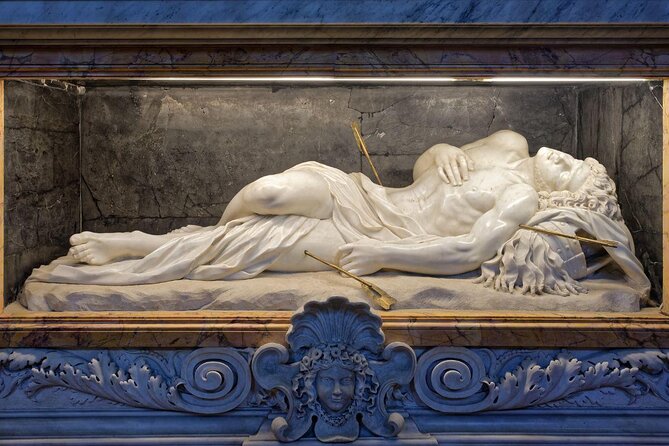
- Private ride, not just a transfer: Your time is structured with narration and timed stops, not only a drop-off.
- Catacombs of St. Callisto entry included: You get the underground access as part of the package value.
- Porta San Sebastiano sets the stage: You start at a major gate of Rome’s defensive Aurelian Walls, then transition onto the Appian Way corridor.
- Domine Quo Vadis is short but powerful: A small church, one famous encounter, and a specific marble slab tied to the tradition.
- St. Paul Outside the Walls is a real palate cleanser: Big, serene early-Christian scale and one of Rome’s most moving sacred stops.
- Guide quality really matters: Multiple guides have been praised by name, but catacombs can also be affected by on-site group conditions.
Porta San Sebastiano: starting the Appian Way story at a real Roman gate
You begin at Porta San Sebastiano, which you’ll also hear connected to Porta Appia. This is one of the largest and best-preserved gates in the Aurelian Walls, and it’s a strong opener because it frames the Appian Way as more than a scenic walk. This gate marks where the historic road begins, and it ties directly into Roman military thinking: control the routes out of the city, control the movement of armies and goods.
What I like about this first stop is how fast it gets you oriented. In a single look at the mass and setting of the gate, you understand that the Appian Way wasn’t just a road for legends. It was a strategic corridor, part of the defensive system that helped Rome function as an empire-sized machine.
The practical side matters too. Since you’re picked up and delivered to the right spot, you can spend your limited time actually seeing the essentials, instead of searching streets around the city walls. If you’re the type who wants the why behind the what, this first segment is a good match.
You can also read our reviews of more private tours in Rome
Catacombs of San Callisto: what you will see underground (and what you might not)
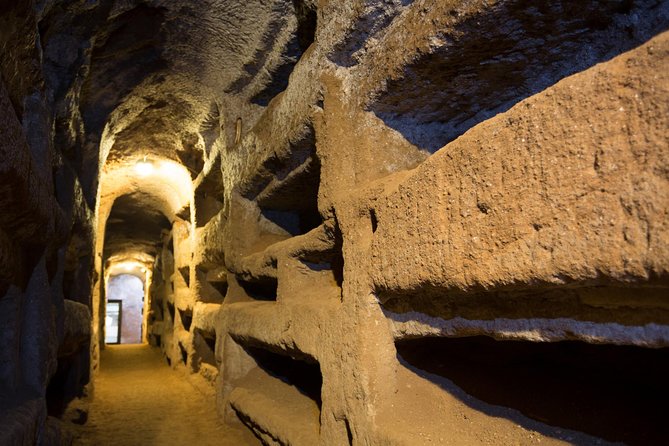
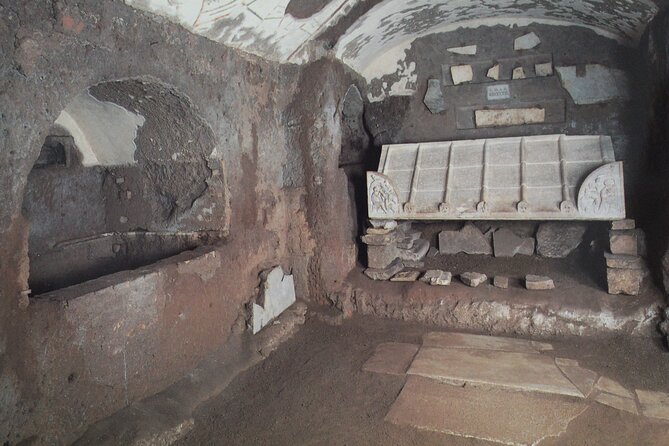
This stop is the heart of the day, and it’s also the one where expectations can clash. Catacombs of San Callisto were established in the 2nd century and served as an important burial site for early Christians. You’ll move through underground passageways and tomb areas that form a long network, described as spanning over 12 miles.
Here is the reality check that helps you get value from your ticket: catacombs are not a museum of dramatic sarcophagi on display. They’re underground burial tunnels where visitors view tomb niches and wall openings, and much of what people imagine as remains or relics can be absent from what you can see on-site. In plain terms, it can look simple at first, then becomes fascinating once you understand how the space worked for generations of burials.
I also appreciate how the cooler underground setting turns this into a relief stop in warm months. It’s one of those places where your body notices the change quickly, even if your day is packed with sunlight outside.
One caution: the catacombs portion is described as a guided group tour inside the site. Even with a private vehicle on the surface, you’ll still experience on-site group logistics. If a guide isn’t easy to hear, or if the group is larger than you’d like, you’ll want to actively lean in, ask questions when possible, and focus on the key visual points your guide points out.
Appian Way walking time: cobblestones, but also power and punishment
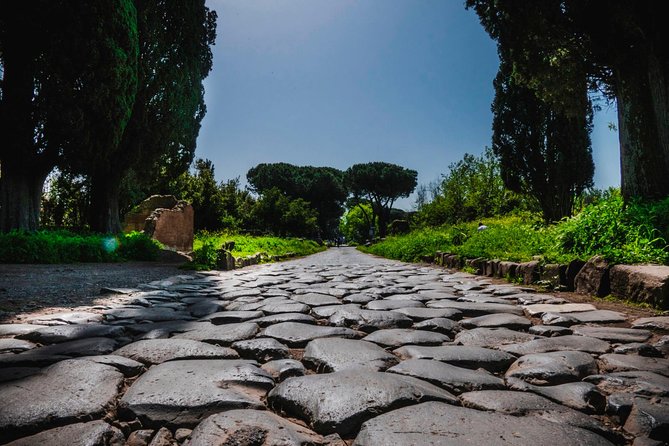
After the underground world, the Appian Way gives you something you can feel with your feet. You’ll have time to walk along part of the Via Appia Antica, Rome’s famous paved road. The big idea here is that you’re stepping onto engineering that survived centuries, not only into a backdrop for photos.
This section also connects to Roman stories you’ve probably heard in class or documentaries. The Appian Way area is tied to Spartacus, including the grim tradition of what happened to him and his followers. You’ll also connect the road to major Roman figures mentioned in your day’s commentary, including Crassus and Commodus.
Is it going to feel like a movie set where you see straight-up fields and nothing else? Not necessarily. What you do get is a preserved stretch of road that shows Rome’s scale and seriousness about infrastructure. It’s a reminder that empires don’t last on speeches; they last on roads, systems, and control.
Because your schedule is tight, you don’t need a long walk to get meaning here. The value is in the combination: catacombs explain early Christian burial practices, and then the Appian Way explains the wider Roman power structure around them.
Domine Quo Vadis: a small chapel with a very specific tradition
Next comes Chiesa del Domine Quo Vadis, also known as the Church of Saint Mary in Palmis. It’s small compared with the big basilicas, but the payoff is in the story and the symbolism.
According to tradition, this is the spot tied to Saint Peter’s vision while fleeing persecution in Rome. When he asks Domine, quo vadis (Lord, where are you going?), the response is connected to the idea of Jesus returning to Rome to be crucified again. It’s a dramatic moment, but the church keeps it intimate.
What I find practical is that this stop is well-suited to a short pause in an otherwise packed itinerary. You’re given time to take in the setting, and inside you’ll find a marble slab believed to bear footprints connected to the tradition. Even if you treat the story as faith-based history rather than strict documentary evidence, the physical presence of the footprints makes it easier to feel the emotional weight of the encounter.
If you’re sensitive to religious art and sacred spaces, this one often lands harder than expected. It’s also a nice contrast point: the Appian Way’s Roman grandeur shifts into a Christian story about turning back.
Basilica Papale di San Paolo Fuori le Mura: scale, art, and a calmer pace
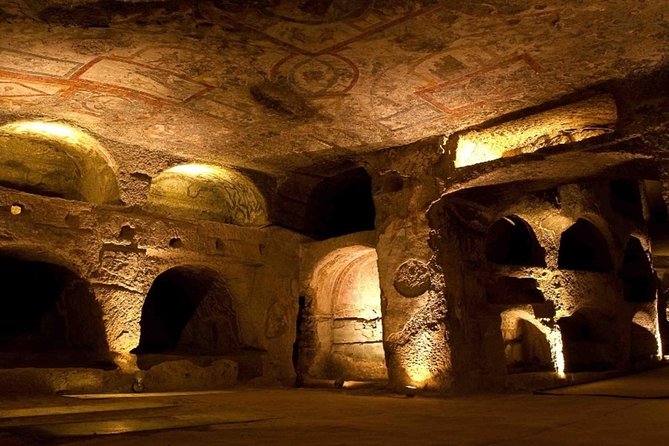
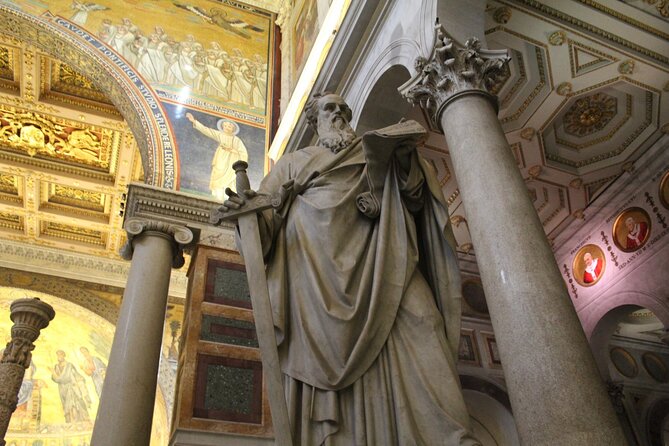
Your final major site is Basilica Papale di San Paolo Fuori le Mura, also called Saint Paul Outside the Walls. This is one of Rome’s four major basilicas, and it’s built over the burial site of Saint Paul the Apostle. If you want a day that moves from underground burial tunnels to a massive early-Christian space, this stop completes the arc.
Inside, you’ll get a sense of how the early church shaped architecture to hold memory and community. A standout feature mentioned for this basilica is a long gallery with medallion portraits of every pope. That kind of visual timeline makes the basilica feel like a living bridge between past and present.
One extra point for special timing: during Jubilee periods, you may have additional access moments like the Holy Door, if it’s open and included in the day’s flow. Since availability depends on the schedule of the basilica and local observances, treat this as a possible bonus rather than a guaranteed scene.
Also keep in mind that churches can close for services and logistics without much warning. If you arrive when access inside is limited, you’ll still get the significance of the place from what you can see, but your experience may be less complete. That’s not a deal-breaker, just plan for the possibility.

Price and logistics: what you’re really paying for
The price is listed at $190.67 per person, for about 2 hours 30 minutes, with hotel pickup included. On paper, that number can look steep if you’re thinking only about the catacombs admission. The better way to frame the value is this: you’re paying for private coordination, a comfortable vehicle, timed stops across multiple sites, and the narrative that ties everything together.
It also helps that the catacombs admission ticket is included, while other listed stops have admission described as free. That reduces the surprise factor. Still, you’re not only buying entry. You’re buying a smoother route through Rome, especially on an itinerary that touches multiple distinct locations.
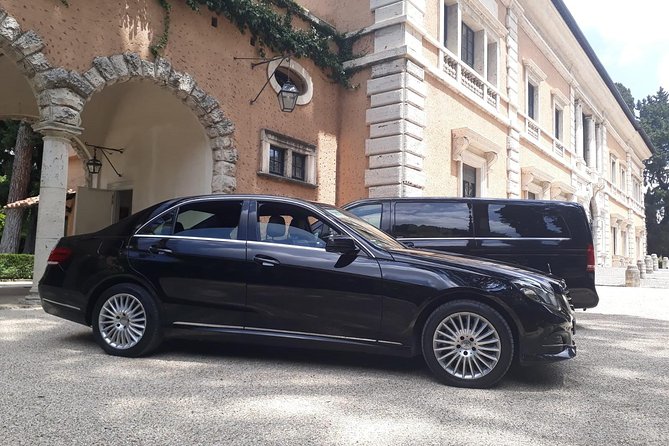
Now, the practical caution: the vehicle can matter. For private tours with small groups, a standard sedan is often used for up to four people. That can feel fine for two, but can get tight for four on a longer ride. If you’re booking for a full group, it’s worth checking that your comfort needs are compatible with a compact private car.
Finally, your overall experience can hinge on the guide. Several guides are praised by name for being friendly, accommodating, and strongly knowledgeable, including people such as Stefano, Alessandro, Lorenzo, Patrick, Victor, Giorgio, and Georgian. The takeaway for you: if you care a lot about interpretation, ask for strong language and communication details when you book, and show up ready with questions. In the catacombs, it’s the questions that turn wall openings into real understanding.
Who should book this Catacombs and Appian Way private tour
This tour is a great fit if you want:
- A private ride with hotel pickup and a structured itinerary, not a scavenger hunt.
- Catacombs of St. Callisto plus the Appian Way in one outing.
- A day that mixes Roman infrastructure (the road and gate) with early Christian sacred spaces.
It may be less ideal if:
- You expect the catacombs to look like a high-production underground attraction. You’re seeing ancient burial spaces, often visually simple compared with what people expect.
- You get frustrated by any on-site group tour dynamics inside the catacombs. Since the underground portion is run by the site’s system, you can’t fully control how audio works at any given moment.
If you’re traveling as a couple or small family and you want to cut through Rome’s logistics, this private format makes life easier. If you’re a solo traveler who doesn’t care about comfort or pickup, you might find cheaper options, but you’ll lose the convenience of the door-to-door rhythm.
Final verdict: should you book this Rome catacombs and Appian Way tour?
I’d book it if your priorities are catacombs plus the Appian Way without wasting time figuring out transit, and if you’re happy to treat the underground visit as a real archaeological experience rather than a display of grand relics. The value gets stronger when you price in the private vehicle, pickup, and the included catacombs entry.
I would hesitate only if you’re extremely sensitive to group dynamics inside the catacombs or if you need a lot of flexibility because access can vary at sacred sites. If that’s you, plan for the possibility that some moments may be more limited than the photos suggest.
FAQ
How long is the tour?
It runs about 2 hours 30 minutes (approx.).
Is hotel pickup included?
Yes, pickup is offered. You’ll be asked to provide your hotel name.
Is this a private tour?
Yes. Only your group will participate.
What language is the tour in?
English is offered.
Is the Catacombs of St. Callisto ticket included?
Yes. Admission tickets to the Catacombs of St. Callixtus are included.
Are there any other sites on the route with free admission?
Your itinerary lists Porta San Sebastiano, Appian Way, Domine Quo Vadis, and Basilica Papale di San Paolo fuori le Mura as admission free.
Do I get a mobile ticket?
Yes, mobile ticket is included.
What stops are included?
You’ll visit Porta San Sebastiano, Catacombs of San Callisto, the Appian Way (Via Appia Antica), Chiesa del Domine Quo Vadis, and Basilica Papale di San Paolo fuori le Mura.
Is photography allowed inside the catacombs?
One account included that photos were not allowed inside the catacombs.
Can I cancel for free?
Free cancellation is available. You can cancel up to 24 hours in advance of the experience for a full refund. If you cancel less than 24 hours before, the amount paid is not refunded.
![[Day trip bus tour from Kanazawa Station] Weekend only! World Heritage Shirakawago Day Bus Tour - The day’s timing: what the schedule actually means for your day](https://l.historytourer.com/wp-content/uploads/day-trip-bus-tour-from-kanazawa-station-weekend-only-world-heritage-shirakawago-day-bus-tour-400x267.jpg)