One day, three ancient worlds. This fully private Athens tour strings together Corinth Canal, Acrocorinth, Ancient Corinth, and Mycenae, so you skip the hassle of car rental and see more in less time with a private driver.
I also like how it builds a story as you go, from ancient boat-hauling technology to the Bronze Age power of Agamemnon’s kingdom.
What I like most is the comfort on a long outing: onboard Wi‑Fi, bottled water, and even refreshing wipes make the drive feel easier. In the feedback I read, drivers like Nikos and Gregory stood out for showing up on time and keeping the pace relaxed, with enough freedom to linger. One possible drawback: the schedule is full, and you may feel a little pressure at Mycenae, especially if you want extra time inside museums.
In This Review
- Key things to know before you go
- A private Corinth and Mycenae day from Athens: what the experience really feels like
- Corinth Canal and Ancient Diolkos: 19th-century engineering with ancient context
- Acrocorinth fortress views: Aphrodite traces, Frankish Tower, and layered ruins
- Upper Peirene Spring and Geraneia views: short stops that set up the big ones
- Ancient Corinth Archaeological Museum and the Agora: where the story becomes physical
- Corinth village time and terrace lunch: a slower pause with big views
- Mycenae: Lion Gate, Grave Circles A & B, and Cyclopean Walls
- Treasury of Atreus and the Mycenae Museum: gold grave goods in person
- Price and time: is $299.78 per person good value?
- Should you book this private tour of Isthmus Canal, Corinth, and Mycenae?
- FAQ
- How long is the private tour?
- Is this tour fully private?
- Do you get hotel pickup and drop-off in Athens?
- Is Wi-Fi included during the tour?
- Are entrance fees included?
- Is lunch included?
- Does the tour offer skip-the-line access?
- Is a licensed tour guide included inside the sites and museum?
- What is the cancellation policy?
Key things to know before you go
- A full-hit itinerary in one day: Corinth Canal, Acrocorinth, Ancient Corinth, and Mycenae, all from Athens.
- Flexible timing with your driver: you decide how long to linger at most stops.
- Canal history with ancient context: you visit the Isthmus Canal and Ancient Diolkos trackway.
- Acrocorinth views + layered fortifications: Aphrodite traces, Frankish Tower, and churches/mosques preserved on the site.
- Mycenae highlights you came for: Lion Gate, Cyclopean Walls, Grave Circles A & B, Treasury of Atreus.
- Comfort details matter: hotel pickup/drop-off, Wi‑Fi, water, and wipes during the long day.
A private Corinth and Mycenae day from Athens: what the experience really feels like
This is built for travelers who want depth without self-driving stress. Your day starts with pickup from your Athens hotel (or Airbnb/apartment entrance), and you return the same way at the end. Since it’s fully private, it’s just your group in the vehicle, not a bus shuffle.
The big win here is compression. Corinth and Mycenae are both “major Greece” stops, but doing them separately can mean extra planning, extra logistics, and more wasted transit time. In one loop, you’ll hit the engineering of the Isthmus Canal, the command heights of Acrocorinth, and then the Bronze Age showpieces at Mycenae.
That said, you should expect a day with moving parts. Even if you’re not rushing, you’ll be on the road enough that it’s smart to plan for breaks during the schedule. Bring a light layer for wind on viewpoints and keep comfortable shoes ready for uneven ruins and uphill stone.
You can also read our reviews of more private tours in Athens
Corinth Canal and Ancient Diolkos: 19th-century engineering with ancient context
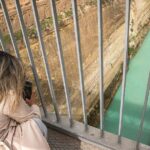
Your first major “wow” stop is at the Corinth Canal area. This is the kind of place where you can see why the region mattered: the canal cuts through the Isthmus, and the project played a catalytic role in Mediterranean trade.
What makes this stop more interesting than a quick photo pull-over is the connection to Ancient Diolkos. You’ll visit the paved trackway in Ancient Greece that enabled boats to be moved overland across the isthmus. That gives you a rare before-and-after feel: humans already had the idea; later technology made it scalable and fast.
Practical tip: plan to spend a little time just looking and orienting yourself, because once you understand the geography, the canal stops feeling like an isolated landmark. It becomes part of a long-running transportation problem and solution.
Time-wise, you’re looking at about 45 minutes for the Diolkos visit. For most people, that’s enough to photograph and walk at a relaxed pace. If you’re the type who reads every sign, you might want to ask your driver to linger a bit—this kind of pacing is where a private setup helps.
Acrocorinth fortress views: Aphrodite traces, Frankish Tower, and layered ruins
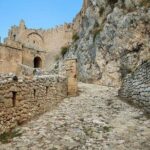
Next comes Acrocorinth, the acropolis of ancient Corinth—an enormous rock that dominates the Peloponnese skyline. This isn’t just one monument. You’ll see the remains of different eras piled on top of each other.
Here’s what you’ll be looking for:
- A three-circuit wall system reinforced by towers, which helped defend the site.
- Traces of the Temple of Aphrodite near the top’s highest point.
- The Frankish Tower fortified during Frankish times, plus other preserved remains such as churches, mosques, houses, fountains, and cisterns.
This is a great stop if you like places where the “history layer cake” is visible. One minute you’re admiring the shape of the defensive walls; the next you’re spotting evidence of later religious and civic use.
Practical tip: bring water and a hat. Even when the ruins themselves are quiet, the summit can feel exposed. Also, if you want your photos to include the horizon, tell your driver early—timing matters as you approach the best viewing angles.
You’ll have about an hour here. In my opinion, that’s a good balance: long enough to walk the circuit thoughtfully, not so long that you turn it into a marathon.
Upper Peirene Spring and Geraneia views: short stops that set up the big ones
These are brief, but they’re not filler.
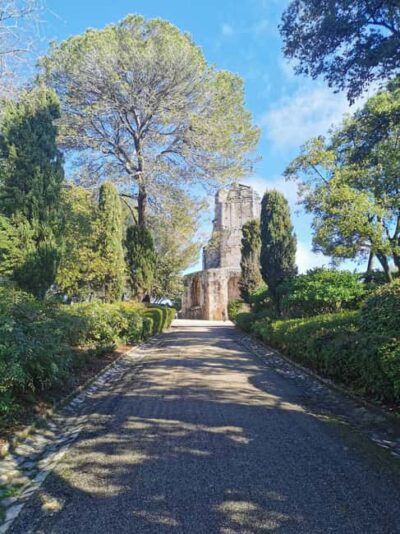
At Upper Peirene Fountain (Peirene Spring), you’ll see the spring located within the encircling walls and learn the myth connection to Sisyphus. It’s small, but it helps you understand why this region kept getting built up: water access and defensible terrain went together.
Then Geraneia gives you a quick visual breather with views over the Corinthian gulf and the SW coast of the Peloponnese. The point isn’t to rush to a perfect panorama. It’s to reset your eyes after the fortress walls and before you get into the ruins of Ancient Corinth.
Both stops are around 15 minutes and list free admission. Use them like pauses: step out, look around, and get your bearings before you move into the archaeology-heavy sections.
Ancient Corinth Archaeological Museum and the Agora: where the story becomes physical
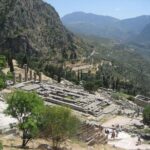
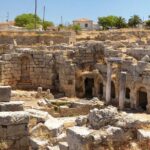
This is the core cultural stop of the day, with several layers in one place. You’ll spend time in and around the major zones at Archaia Korinthos, plus the archaeological museum.
If you’re into “how cities worked,” the list of what you’ll see here is exactly your lane:
- Hadgimoustafa spring, a fountain built during the Ottoman empire.
- The Ancient Corinth Archaeological Museum, packed with artifacts from the local site and nearby smaller sites.
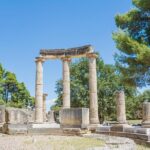
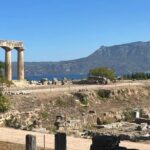
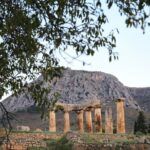
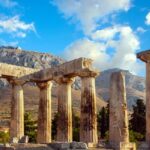
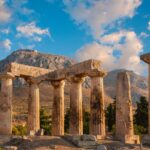
- The Temple of Apollo, an early Doric temple in the Peloponnese/Greek mainland region, with monolithic columns (built around 560 BCE).
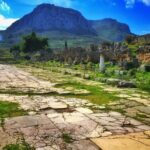
- The Agora, a rectangular space about 160 m by 70 m with shops, small temples, altars, and the famous Bema—the podium where Apostle Paul addressed the Corinthians in 52 AD.
- Roman buildings in the broader complex, showing how the city kept changing over centuries.
- Nearby, you’ll also find Theatre and Odeon/Asklepieion areas.
- The Lechaion road heading toward the port of Lechaion, which ties the city to its shipping connections.
One detail I especially like for context: the St. Paul’s church mosaic mural depicting Saul’s vision as he traveled to Damascus. It’s a modern religious layer, but it helps you connect the ancient Corinth you’re walking through with the later Christian tradition that shaped how people remembered the city.
Practical reality: entrance fees for the archaeology museum and major sites in this section are not included. Budget for that. It’s not a deal-breaker—this is where the ticket price difference matters—but it’s best not to assume every stop is covered.
Also, this is where you might feel the day’s pacing. If you want a longer look at the Apollo temple area or the museum, ask your driver to adjust the flow earlier in the day so you don’t feel rushed here.


Corinth village time and terrace lunch: a slower pause with big views
After the archaeology, you’ll get about an hour in Corinth village—time to stroll shops and pick up handmade souvenirs. This is a nice breather because it shifts you away from ruins and back into everyday rhythms.
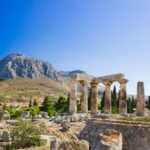
Then there’s lunch time on a terrace that overlooks the archaeological area and the Temple of Apollo. Food isn’t included in the tour price, but the scheduling is built to make this practical: you’re in the right spot to stop and eat without losing half your day to travel.
My advice: treat lunch as strategy, not just a meal. If you want good photos, eat, then reassess. If you want museum time, use lunch to refill water and plan your final route at Mycenae.
Mycenae: Lion Gate, Grave Circles A & B, and Cyclopean Walls
Now for the Bronze Age. You’ll drive to Mycenae (about 40 minutes) and then spend time at the archaeological site.
Mycenae is famous for a simple reason: it’s rich in gold and power in the way Homer describes. You’ll feel that scale when you reach the citadel features and see how the builders made defense look permanent.
Key highlights you’ll visit include:
- Grave Circles A and B, royal cemeteries located south of the Lion Gate outside the Bronze Age citadel.
- The Cyclopean Walls, made from huge limestone boulders—so massive that the myth says only Cyclopes could move them.
You’ll also stop at:
- The Lion Gate, the main entrance of the Bronze Age citadel, built in the 13th century BC.
- The Royal Palace, including the Throne Room Suite, Grand Staircase, officer rooms, and the Forecourt.
You only have about 30 minutes at the Royal Palace area. That’s enough for the signature structures and a solid sense of layout, but it’s not enough for full, slow wandering of every corner. In a private tour, you can usually adjust slightly, but don’t count on adding hours here unless you’re comfortable trimming elsewhere.
Treasury of Atreus and the Mycenae Museum: gold grave goods in person
If Ancient Corinth gives you the classical layers, Mycenae gives you the dramatic stone and the gold—at the same time.
At the Citadel and Treasury of Atreus, you’ll see the tholos tomb, often described as beehive-shaped, constructed around 1250 BC. You’ll also visit the Tomb of Clytemnestra, another tholos type tomb, also dated around 1250 BC.
Then you head to the Archaeological Museum of Ancient Mycenae, where the Mycenean artifacts are displayed. This is the part where the tour can feel like a payoff. You’ll see gold grave goods, burial masks, jewelry, weapons, worship idols, and frescoes.
Time note: the museum stop is about 30 minutes, and entrance fees are not included. If you care about artifacts more than outdoors, this is the stop I’d protect in your schedule. Short, focused museum time is often the best use of limited daylight and heat.
A small but important consideration: if you’re visiting in hot weather, Mycenae can feel intense. Plan to use shade where it exists and ask for water breaks—your driver can help you time the walking.
Price and time: is $299.78 per person good value?
At about $299.78 per person for roughly 8 hours, the value comes from three things:
- Private transportation + hotel pickup/drop-off: you’re not spending your time figuring out routes, parking, or schedules.
- A driver who knows where to go and when: you’re not negotiating local logistics mid-day.
- Comfort extras: onboard Wi‑Fi, bottled water, and refreshing wipes can matter on a full day.
What’s not in the price: entrance fees to the sites, food, and tips. Some stops are marked admission free, while others (museum and major archaeological areas) are not included. So your final spend depends on how many ticketed areas you choose to enter—and how much time you want inside.
I also think timing affects value. The tour is frequently booked about 69 days in advance, so if you have a specific date in mind, booking earlier helps lock in the day plan that fits your Athens schedule.
If you’re traveling as a couple or small group, private tours often feel easier to justify. If you’re solo, it can still be worth it for the convenience, but you’ll want to be honest about entrance fees and the fact that this is a packed route.
Should you book this private tour of Isthmus Canal, Corinth, and Mycenae?
Book it if you want a high-coverage day with clear highlights: Corinth Canal with Diolkos context, Acrocorinth fortress views, the Agora and Paul’s connection at Ancient Corinth, and the signature gates and tombs at Mycenae.
Skip it (or at least reconsider) if you prefer slow, unhurried museum time and don’t like moving from site to site. This itinerary is built to fit a lot, and you may feel the pinch if you love reading every artifact label.
One last practical move: if you’re serious about Mycenae, go in with a short list of must-sees (Lion Gate, Treasury of Atreus, museum artifacts). Then use your private driver to protect that time.
FAQ
How long is the private tour?
The tour is about 8 hours.
Is this tour fully private?
Yes. It’s a private tour/activity, and only your group participates.
Do you get hotel pickup and drop-off in Athens?
Yes. Your personal driver picks you up and returns you to your hotel, Airbnb, or apartment in Athens.
Is Wi-Fi included during the tour?
Yes. There is Wi‑Fi on board.
Are entrance fees included?
No. Entrance fees to the sites are not included.
Is lunch included?
No. Food and drinks are not included, though the day includes time for a village-style lunch.
Does the tour offer skip-the-line access?
A skip-the-line ticket service is available on request.
Is a licensed tour guide included inside the sites and museum?
A licensed tour guide to accompany guests into the site and museum is not included, but it may be available on request for an additional cost.
What is the cancellation policy?
Free cancellation is available up to 24 hours in advance for a full refund.