REVIEW · ATHENS
Visit Delphi the famous oracle! Explore the mysteries of the ancient world!
Book on Viator →Operated by Athens Tours Greece · Bookable on Viator
The Oracle of Delphi starts with a road trip. I like how this private day connects you to central Greece, from the cruise-port pickup to the mountain village of Arachova, without turning your day into a logistics puzzle. I also love the structure in Delphi itself: you get time for the UNESCO archaeological site plus an optional museum stop. The one real catch is simple: entrance fees aren’t included, so you’ll need to budget separately for site and museum tickets.
What makes the day work is pace and focus. You’ll spend real time walking the sanctuary and landmarks around Apollo and Athena, then you can reset in modern Delphi with views over the Ionean Sea area and an olive-grove setting nearby. If you hate set schedules or you’re expecting a fully guided inside-the-rooms experience, read the fine print on guides: the driver handles history up to the sites, but a state-licensed guide inside can cost extra.
In This Review
- Key things to know before you go to Delphi
- How this Delphi day trip runs (and why the timing feels fair)
- The drive through central Greece: Levadia, Thebes, and a lunch near Arachova
- Karakolithos: the WWII road monument you don’t want to skip
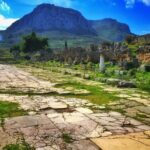
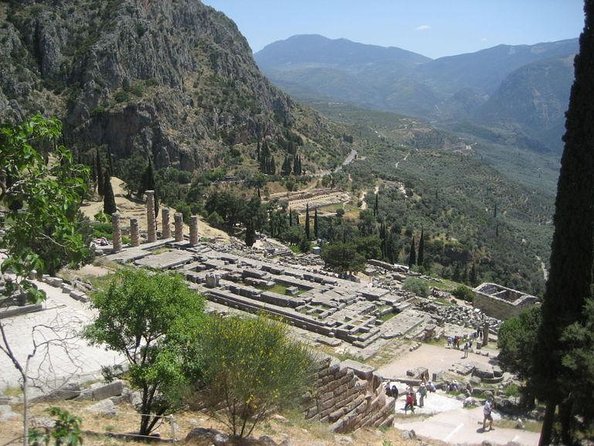
- Delphi’s Oracle zone: UNESCO ruins, the Navel of the Earth, and Apollo’s world
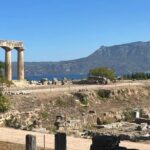
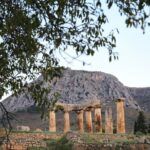
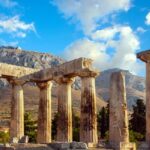
- Temple of Apollo: where rituals and archives lived
- Delphi Archaeological Museum: what the collections actually do for you
- Modern Delphi: olive groves, sea views, and a calmer pace
- Tholos of Athena Pronaia: the circular mystery you can’t ignore
- Price and value: is $497.43 per group worth it?
- What you should plan for (tickets, guide limits, and dress code)
- Who should book this Delphi private shore excursion?
- Should you book it?
- FAQ
- What’s included in the tour price?
- Are entrance fees to Delphi included?
- Is the Delphi Archaeological Museum ticket included?
- Do cruise passengers get pickup from Piraeus?
- Is lunch included in the tour?
- Can the driver guide you inside the archaeological sites and museums?
- What’s the physical effort like?
Key things to know before you go to Delphi
- Piraeus port pickup for cruise days: you leave Athens’ area as a shore excursion, with port pickup/drop-off built in.
- Arachova lunch time near Mt. Parnassos: you get a traditional Greek lunch stop, with time to look around before Delphi.
- Multiple Delphi “micro-stops”: you’re not rushed through the sanctuary; the day mixes ruins, viewpoints, and a museum.
- WWII memorial stop at Karakolithos: a short but powerful roadside monument connects Delphi-area history to 1944 events.
- Private group up to 3: you’re not in a cattle-car group, so the driver can keep your flow smooth.
- Optional licensed guide inside: your driver can guide up to entrances, with an extra-cost option for inside commentary.
How this Delphi day trip runs (and why the timing feels fair)
This is an 8-hour private shore excursion built for people who don’t want to lose the whole day to transit. You start with pickup in Athens (including hotel pickup) and also get Piraeus port pickup/drop-off, which matters a lot when you’re docking on a tight schedule. From there, you’ll head northwest through mainland Greece, with a route that takes you past towns in central Greece (Sterea Ellada / Roúmeli) on the way to Delphi.
Once you arrive, the day doesn’t treat Delphi like a drive-by photo stop. Instead, it breaks the experience into pieces: the sanctuary area, key monuments like the Temple of Apollo, a stop for the Delphi Archaeological Museum, then some time in modern Delphi. That’s exactly how you should do a site this big. Delphi has layers—myth, religion, political games, and later history—so you want breathing room to actually absorb what you’re looking at.
The physical side is “moderate.” You will be walking around uneven terrain and stairs at archaeological sites, so plan like you’re doing a day of sightseeing, not an easy stroll.
You can also read our reviews of more tours and experiences in Athens.

The drive through central Greece: Levadia, Thebes, and a lunch near Arachova

The road trip is part of the point here. You travel through central Greece with views of mountain country and traditional towns, including stops in areas linked to places like Thebes and Livadia (Levadia) as you make your way toward the Delphi region. Even if your main goal is Delphi’s ruins, I find the transit helps you mentally switch gears—from cruise-ship time to Greek mountain time.
A major highlight on the way is the stop near Arachova, a village at the foot of Mt. Parnassos. This is one of those places that feels different in each season. In winter it’s known as a go-to for ski lovers (with a modern ski resort). In other months, it’s still popular for its mountain setting, local tourism, and the fact that it’s close to Athens.
You also get time for a traditional Greek lunch near Arachova. Food and drinks aren’t included in the tour price, so you should plan to pay for your meal. Still, having a real lunch break makes the day more enjoyable than the usual “snack and go” approach.
Karakolithos: the WWII road monument you don’t want to skip
There’s a short stop at Karakolithos – Mnimio Pesonton tied to April 25, 1944. This road connected Livadia with the village of Distomo, an area later known for one of Greece’s most notorious Nazi crimes. The monument marks what happened after partisans of ELAS captured German officers and demanded the release of Greek prisoners.
The Nazi response turned harsh quickly: within hours, Greek prisoners—most in their 20s—were transported and executed on the spot. The stop is brief, but it’s one of those moments that sharpens your perspective. Delphi is famous for myth and ancient religion; this reminder connects the region’s significance to real human history, too.
If you like context, this is a meaningful pause. If you’re short on time, it won’t feel like dead weight—it’s designed as a stop, not a detour.
Delphi’s Oracle zone: UNESCO ruins, the Navel of the Earth, and Apollo’s world
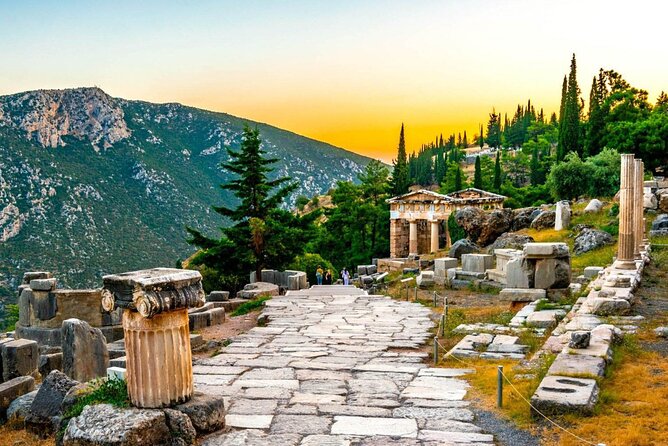
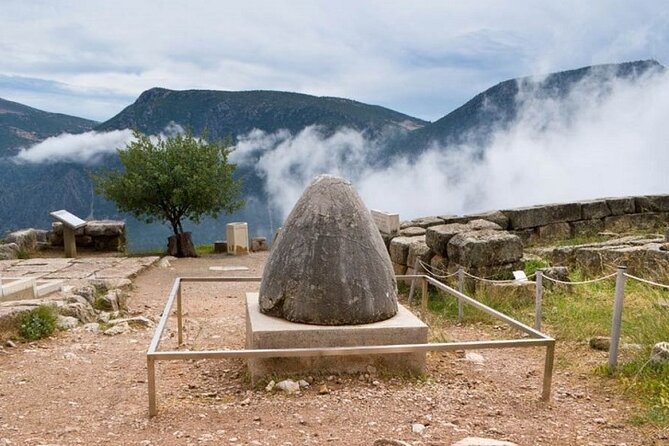
Delphi is the kind of place where it’s hard not to think in stories. The sanctuary at Delphi was considered the center of the world, and myth places it as the meeting point of the navel of the Earth idea—where two eagles sent by Zeus met. The sanctuary served for centuries as a religious and cultural center for the Greek world.
Your time on site is arranged so you don’t just stare at stones. You’re meant to connect what you see to what those spaces were for. Delphi began long before Apollo’s sanctuary. It was sacred to Mother Earth, guarded by a serpent named Python, which Apollo killed in the myth.
Later, Apollo’s presence is central to what you’ll see. The mythology says the sanctuary was built by Cretans arriving at Delphi’s port of Kirra, with Apollo appearing in the form of a dolphin. That story matters because it helps you understand why Delphi became so important for prophecy, cult practice, and pan-Hellenic identity.
Temple of Apollo: where rituals and archives lived
The Temple of Apollo dominates the sanctuary. This wasn’t just an impressive backdrop; it was the key building where statues and offerings were kept. It’s also described as the location for cult rituals, including divination.
One detail I like because it shows Delphi wasn’t only about speeches and fate: there was an archive called the chresmographeion, destroyed in 373 BC. The archive contained lists of victors of the Pythian games—so Delphi also tracked achievement and political-cultural prestige. In other words: it was prophecy and public life in the same sacred zone.
You’ll spend time around this area, and it’s a great place to look slowly. Delphi’s monuments are spread out, so you’ll want to give your eyes a moment before moving on.


Delphi Archaeological Museum: what the collections actually do for you
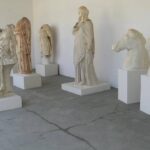
The Delphi Archaeological Museum stop helps you translate the ruins back into people. The museum’s focus is the story of the Delphic sanctuary itself: religious life, political activity, and artistic work from the sanctuary’s early centuries (including the 8th century BC) through decline in Late Antiquity.
This museum is housed in a two-story building with 14 exhibition rooms and major support space—storerooms and conservation labs included. That matters because you’re not just looking at one-off artifacts. You’re seeing curated evidence from multiple categories: architectural sculptures, statues, and smaller objects donated to the sanctuary.
The time here is short, so treat it like a “greatest hits” session. If you’re the type who loves details, prioritize rooms that connect to Apollo and the sanctuary’s broader role. If you’re more about atmosphere and big ideas, focus on what helps you picture what the oracle world looked like beyond the open-air stones.
Modern Delphi: olive groves, sea views, and a calmer pace
After the archaeological site area, you’ll shift to modern Delphi. You’ll have time to explore the town at the foot of Mt. Parnassos, near Arachova. This part is “optional” in the sense that you can choose how you spend the time—walk, look for views, or pause with a meal.
There’s also mention of a restaurant with views toward Itea and the Ionian Sea, surrounded by an olive grove. Since food and drinks aren’t included, you’ll be paying out of pocket. Still, having the option to sit down in a scenic spot is a nice reward after walking the ruins.
This town time also helps you cool down mentally. Delphi’s mythology can feel intense. A quiet break in modern Delphi balances the day.
Tholos of Athena Pronaia: the circular mystery you can’t ignore
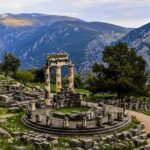
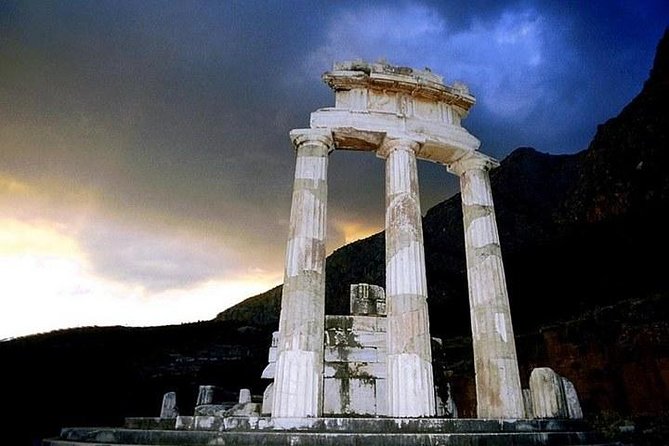
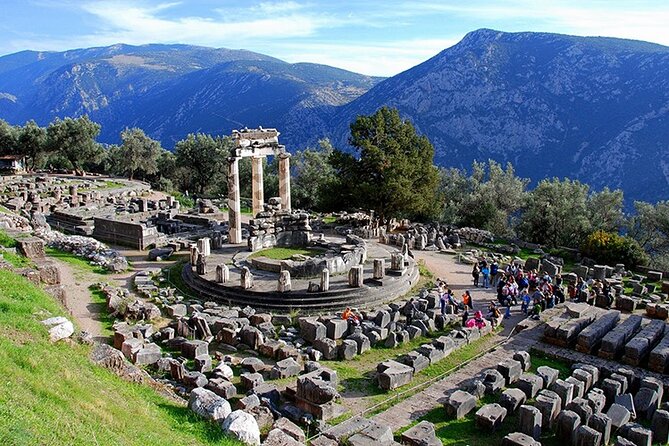
One of Delphi’s most distinctive structures is the Tholos of Athena Pronaia. It’s circular, classical in style, and visible from above—so even if you’re not sure what you’re looking at, you’ll recognize it. It sits between the later Temple of Athena and the Treasury of Massalia.
Its exact purpose isn’t pinned down in your experience details. It’s thought to have connected to chthonic cults, which relates to worship connected with the earth and underworld themes. A note in the description is that Pausanias, who saw the ruins in the second century AD, didn’t refer to it as a temple.
The building is described as a masterpiece of classical architecture. It was raised in 380 BC based on plans associated with architect Theodoros of Phocea or Phocis, who even wrote about its construction method. That combination—unknown purpose, strong design, and famous architect—makes it one of the monuments that sparks conversation.
You’ll have time to see it as part of the day’s flow, and it tends to be a moment where Delphi shifts from oracle myth to “how did they build this?” reality.
Price and value: is $497.43 per group worth it?
The tour price is listed as $497.43 per group (up to 3). On paper, that can look high if you’re thinking “per person.” The value comes from what you get for the group size and the logistics:
- Private transport in an air-conditioned vehicle appropriate for your group
- Hotel pickup and drop-off in Athens
- Piraeus port pickup/drop-off for cruise passengers
- A professional English-speaking driver/guide who provides history and culture up to site entry
- A day itinerary that hits the main Delphi highlights, plus Arachova and the Karakolithos memorial
If you split the cost between up to three people, it often becomes a workable option compared with buying multiple tickets for separate buses or trying to piece together your own transport on a timed cruise day. The big question is whether you’re okay paying extra for site and museum entrance fees, plus any lunch you choose at Arachova or in modern Delphi.
For me, this is best value when you want the day to be smooth. If you’re the DIY type who’s comfortable with independent timing and ticketing, you might do it yourself for less. But if you want a single team handling the schedule, the private structure is where the money makes sense.
What you should plan for (tickets, guide limits, and dress code)
A few practical notes will save you stress:
- Entrance fees are not included for archaeological sites and the museum. You’ll want to budget for them.
- You should pre-purchase admission tickets if you can, because availability can be an issue. There’s also an option where the provider can buy tickets for you in advance with a small service fee.
- Your driver/guide can explain history and culture until you enter the archaeological sites and museums. Tour drivers are not licensed to accompany you inside. If you want a licensed state tour guide inside the sites, that’s available for an extra cost, subject to availability.
- Dress code is listed as formal. That doesn’t mean you need a tux, but it does mean you should avoid anything that looks like beachwear.
- The tour is for people with moderate physical fitness. Delphi involves walking and uneven surfaces, so plan accordingly.
Who should book this Delphi private shore excursion?
This tour fits best if you fall into one of these groups:
- You’re on a cruise day and need a dependable way to reach Delphi from Piraeus.
- You want a private experience for up to three people rather than a large group scramble.
- You like Delphi as a mix of myth, architecture, and real-world context (Apollo sanctuary plus the Karakolithos WWII memorial).
- You want both the open-air ruins and the Delphi Archaeological Museum, without turning the day into a marathon.
It might not fit as well if you strongly prefer a fully licensed guide inside every site and you don’t want to add that extra cost. Also, if entrance fees and museum tickets would make your budget tight, be sure you know the total before you go.
Should you book it?
Yes—if your priority is a smooth, well-timed Delphi day that combines UNESCO ruins, museum context, and the mountain stop at Arachova. The private-group setup and port pickup/drop-off are the real winners, especially when you’re working against cruise clock time.
Just go in with your eyes open: plan for entrance fees and museum tickets, and consider whether you want the extra licensed guide option for inside commentary. If you do that, you’ll get a memorable day where Delphi’s oracle myths and Apollo’s world feel a lot less like a textbook—and a lot more like a place you can stand in.
FAQ
What’s included in the tour price?
The price includes a professional English-speaking driver/guide, transport by air-conditioned vehicle, hotel pickup and drop-off in Athens, and Piraeus port pick up/drop off. Entrance fees, food, and drinks are not included.
Are entrance fees to Delphi included?
No. Entrance fees to the archaeological sites and the museum are at your own expense.
Is the Delphi Archaeological Museum ticket included?
No. The museum admission is not included.
Do cruise passengers get pickup from Piraeus?
Yes. The tour includes Piraeus port pickup/drop-off. Cruise passengers must provide ship name, docking time, disembarkation time, and re-boarding time at booking.
Is lunch included in the tour?
The day includes time for a traditional Greek lunch near Arachova, but food and drinks are not included in the tour price.
Can the driver guide you inside the archaeological sites and museums?
Your driver/guide provides history and culture until you enter the sites and museums. Tour drivers are not licensed to accompany you inside. A state-licensed guide inside can be arranged for an extra cost, subject to availability.
What’s the physical effort like?
The tour notes that travelers should have moderate physical fitness. You’ll be spending time walking around the archaeological site and town areas.