REVIEW · ATHENS
Best of Athens and Ancient Corinth Full Day Private Tour
Book on Viator →Operated by My Athens Transfers · Bookable on Viator
Ancient Athens, then off to Corinth in one day. This private tour strings together the Acropolis and Ancient Corinth with hotel/airport/port pickup, an air-conditioned car, and in-the-moment English commentary from your driver. You’ll also get WiFi onboard plus bottled water, so the day feels smoother than hopping between buses and taxis.
I like the way the Acropolis route is planned. You start with the highest point and the big-picture story first, then you move through key stops like the Propylaea gateway and the Parthenon area without wasting time figuring out where to go next. I also love that the day keeps momentum with short, focused visits, including a solid hour at the Acropolis Museum where the artifacts actually connect the dots.
One thing to consider: the biggest monuments cost extra once you’re there. Acropolis tickets, the Acropolis Museum ticket, and Ancient Corinth museum/site admission are not included, and the Acropolis access can be limited without advance prep. Also, it’s a full day with walking and stairs around the Acropolis and Acrocorinth, so plan for that.
In This Review
- Key points that make this tour work
- A one-day Athens-to-Corinth plan that actually fits
- Acropolis at human speed: Propylaea, Parthenon, and Temple of Athena Nike
- The Acropolis Museum: where the stones make sense
- Classical Athens meets modern Athens at Syntagma Square
- Private transportation and lunch: the underrated comfort bonus
- Corinth Canal: a quick stop with a big view
- Ancient Corinth: Paul’s city, Roman change, and a full hour on the ground
- The Corinth museum stop, Apollo, and Acrocorinth’s fortress views
- Price and tickets: how to budget without surprises
- Should you book this Athens and Corinth private tour?
- FAQ
- Is this tour private or shared?
- Does the tour include pickup and drop-off?
- What’s included in the price besides transportation?
- Are entry fees included for the Acropolis and museums?
- Can you get help with Acropolis and museum tickets?
- How long is the day trip?
- Do the drivers act as licensed tour guides inside sites?
- What languages is the tour offered in?
Key points that make this tour work

- Private pickup and drop-off in an air-conditioned vehicle with WiFi, so you’re not rushing across Athens alone.
- A tight Acropolis sweep: Propylaea, Parthenon, Erechtheion, Temple of Athena Nike, plus the Theatre of Dionysus and Herod Atticus Odeon.
- Acropolis Museum time that helps you understand what you just saw up on the hill.
- Corinth Canal viewpoint + Ancient Corinth in one long day, including the major stops around Apollo and Acrocorinth.
- Modern Athens photo stops at places like Syntagma Square and the Tomb of the Unknown Soldier guarded by the Evzones.
- Driver commentary from start to finish, with reported standouts including George and Panos.
A one-day Athens-to-Corinth plan that actually fits
This tour is built for travelers who want Athens highlights and then want Ancient Corinth too, without adding another hotel night. The schedule runs about 8 to 9 hours, and it’s private, so you’re traveling as your group only.
The value is in the logistics. Hotel/airport/port pickup and drop-off means you skip the time and stress of coordinating transport all day. You also get a car with air-conditioning and WiFi, plus bottled water, and there’s lunch with a Greek traditional food option, which matters when your day is packed.
Let’s talk price. At $231.19 per person for a private day, it’s not cheap, but it can pencil out when you compare it to paying for separate transportation plus multiple ticket lines plus the time you’d lose coordinating everything yourself. And there’s a clear add-on budget: Acropolis entry is listed at €30 per person, the Acropolis Museum is €20, and Ancient Corinth & its museum are €15.
You can also read our reviews of more private tours in Athens

Acropolis at human speed: Propylaea, Parthenon, and Temple of Athena Nike
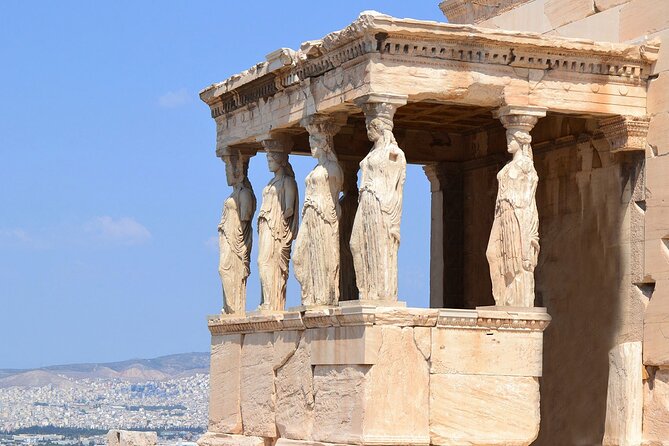
This is the heart of the day, and it starts at the top. The Acropolis is described as the edge of the city and the spiritually highest point in ancient Greek thinking, so you feel the purpose of the whole site right away. You get about an hour on the hill, but remember the Acropolis entry ticket is not included and needs advance purchase (there’s limited availability).
From there, the tour keeps you oriented. Propylaea is the monumental gateway to the Acropolis of Athens, commissioned by Pericles as part of rebuilding after the Persian Wars. It’s a short stop, but it sets up the main temples by giving you the big entry story before you reach the viewpoints.
You’ll spend time in the Parthenon area, and this is where you can use your brain instead of just taking photos. The tour frames the Parthenon as an architectural jewel and encourages you to connect what you see to the wider cultural debate surrounding its sculpture. Next up is the Erechtheion, dedicated to both Athena and Poseidon and located on the north side of the Acropolis.
Then comes the Temple of Athena Nike. What I like here is that it’s not treated like a random building stop; it’s positioned as an early example, noted as the earliest fully Ionic temple on the Acropolis. You also get context about the Nike parapet and the victory-themed frieze (Nikai) that celebrates sacrifice to Athena and Nike.
Two more quick stops round out the hill. The Theatre of Dionysus is explained as an ancient theatre tied to the sanctuary of Dionysus Eleuthereus, with its scale reaching up to 17,000 capacity in the 4th century BC. The Herod Atticus Odeon is dated to completion in 161 AD and renovated in 1950, which gives you that useful sense of how layers of history keep getting reused and reshaped.
Practical note: some of these stops are free, but the Acropolis ticket isn’t. If you want the simplest day possible, request skip-the-line assistance for the Acropolis (and the museum) when you book, because the provider states availability is limited.
The Acropolis Museum: where the stones make sense
After the hill, you drop to the Acropolis Museum, which the route places right at the foot of the hill. You get about an hour here, but again, the entry ticket is not included (it’s €20 per person).
I like this pairing because the museum does the job walking can’t. Up on the Acropolis, you’re surrounded by scale and views; inside the museum, you can focus on statues and important ancient works of art that help you interpret what you saw above. The museum is described as holding some of the most important Greek statues and artworks, and that’s exactly what you want after spending time around the major monuments.
If you’re sensitive to ticket lines, this is also where advance planning pays off. The tour offers the possibility of skip-the-line tickets for the Acropolis Museum upon request or through pre-purchase, with limited availability—so don’t assume you can leave it to chance.
Classical Athens meets modern Athens at Syntagma Square
Once you’re back on the road, the day shifts into a mix of ruins, monuments, and city landmarks. This part works well because you’re not sprinting between far-apart places; you’re doing guided driving plus short stops.
Hadrian’s Gate (Arch of Hadrian) is a quick photo-worthy gateway that resembles a Roman triumphal arch and once spanned an ancient road toward the Temple of Olympian Zeus complex. Nearby, you see the Pillars of Olympian Zeus, described as some of Athens’ oldest shrine remains, with enough space around them to feel that sense of grandeur even today.
Then you head to Panathenaic Stadium, also called Calimarmaro, built of Pentelic marble and tied to the first modern Olympic Games. It’s short, but it gives you a neat bridge between ancient sport traditions and modern Olympic ideals.
Now for the city pulse. Mount Lycabettus is your panorama break: you drive up and enjoy city views, with the tour framing it as a combination of ancient and modern Athens from above. After that, Syntagma Square is a central stop, and you get a quick look at the Hellenic Parliament area plus the Tomb of the Unknown Soldier.
The Tomb of the Unknown Soldier matters here because it’s guarded by the Evzones of the Presidential Guard. The tour describes it as a war memorial and notes it was sculpted between 1930 and 1932. If your day needs one modern moment to break up the archaeology, this is a good one.
Along the drive, you may also pass notable institutions like the Academy of Athens, the National Library of Greece, and the University of Athens. The Academy is described as Greece’s national academy established in 1926. The University is framed as operating continuously since 1837, the oldest higher education institution in the modern Greek state, with tens of thousands of students today.
Private transportation and lunch: the underrated comfort bonus
The car and pacing aren’t just nice-to-have. A private day like this keeps you from losing time while someone negotiates tickets, waits for transfers, or argues with the weather. The air-conditioning and WiFi sound small until you’re an hour in and still fully awake.
Lunch is included, with a Greek traditional food option. That’s a real advantage on a long route to Corinth, because you’re less likely to end up eating something you don’t want just to stay on schedule. Bottled water is also included, which helps you avoid the classic Greek summer problem: thirst turns a good day into a cranky day.
One more practical detail: your driver can provide English commentary and answer your questions, but they are not official tour guides inside archaeological sites. That’s normal for many private transport-led tours. If you want a licensed guide inside sites, the tour says this can be arranged depending on availability.
A few more Athens tours and experiences worth a look


Corinth Canal: a quick stop with a big view
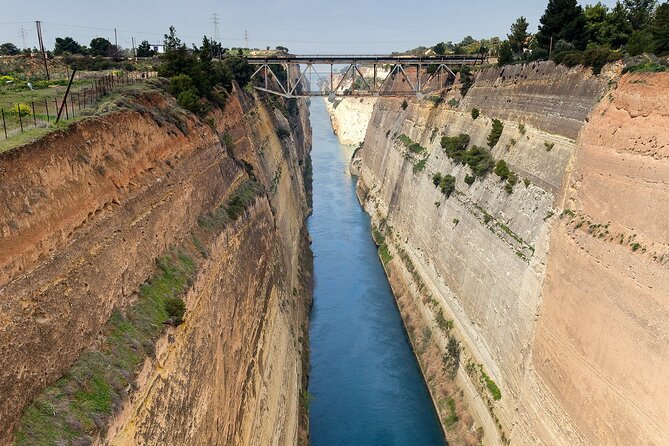
Leaving Athens for Corinth is where the day becomes a travel story, not just a sightseeing checklist. The Corinth Canal connects the Gulf of Corinth with the Saronic Gulf, cutting through the Isthmus of Corinth and separating the Peloponnese from the mainland like it’s turning the peninsula into an island.
This stop is short, but it’s the kind of view that makes you pause. The canal is described as dug at sea level with no locks, only about 6.4 kilometers long, and roughly 21.4 meters wide at its base, which makes it impassable for many modern ships. From a high viewpoint, you can watch vessels move through the cut, plus see the steep limestone walls.
If you’re a person who likes engineering stories, this is one of those stops that adds something new without taking over the day.
Ancient Corinth: Paul’s city, Roman change, and a full hour on the ground

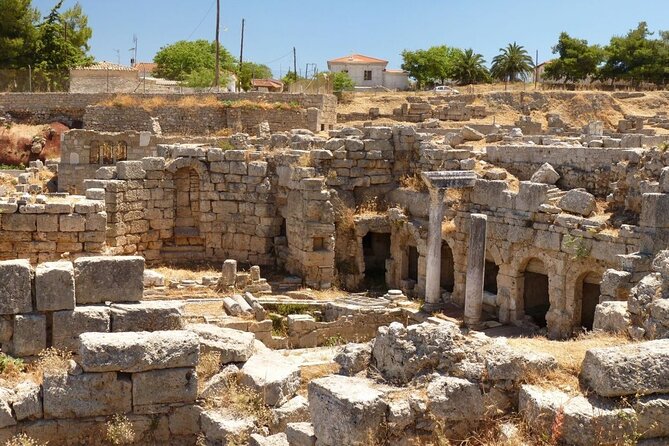
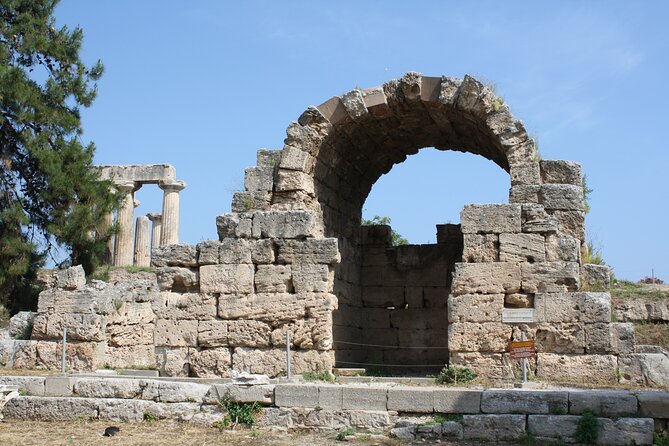
Ancient Corinth (Archaia Korinthos) is your main Corinth destination, and you get about an hour here with admission listed as free. The ancient site is tied to Corinth as a city-state on the Isthmus of Corinth—halfway between Athens and Sparta by the tour’s framing.
What I like is that the tour connects the site to multiple layers of meaning. For Christians, it points to Paul’s letters known as First and Second Corinthians and mentions Corinth in Acts as part of Paul’s missionary travels. It also outlines the political shifts: Romans demolished Corinth in 146 BC, built a new city in its place in 44 BC, and later made it the provincial capital of Greece.
This is also where you can appreciate why the location mattered. The Isthmus is the choke point between regions, so whoever controlled Corinth controlled movement. You’ll feel that idea again later at Acrocorinth.
The Corinth museum stop, Apollo, and Acrocorinth’s fortress views

After Ancient Corinth, the tour includes the Archaeological Museum of Corinth on-site. It’s about a 30-minute stop, but entry is not included; it’s listed as €15 per person. The museum is described as built between 1931 and 1932 to display archaeological excavations, and it sits within the archaeological site under the Greek archaeological service authority.
I appreciate that the tour names specific site highlights in the museum area and around the complex, like Hadgimoustafa spring, Lechaion Road, Basilica, Fountain of Peirene, Stoa, Agora, Odien, other temples, and a theatre. Even if you don’t have time to see everything in detail, those references help you recognize the pieces when you walk around.
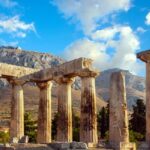
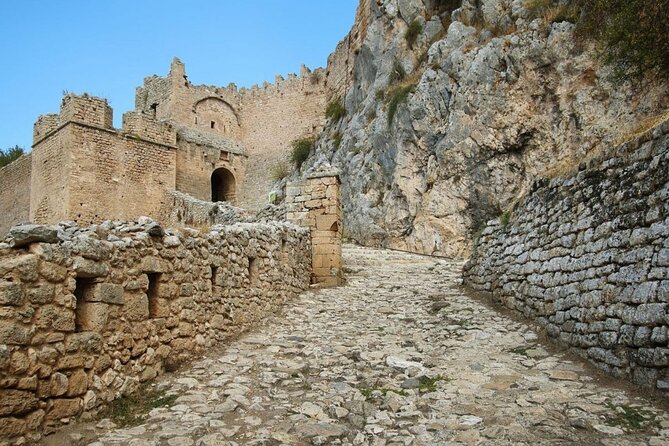
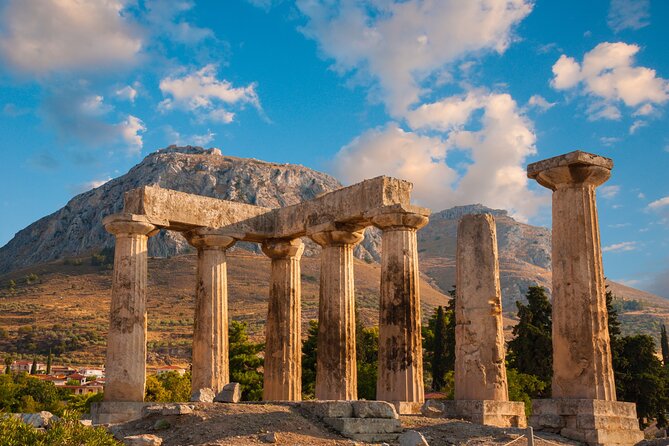
Then you stop at the Temple of Apollo, constructed around 550 BC, with an admission-free visit time of about 20 minutes. After that, you go up to Acrocorinth (Acrocorinthos), described as the upper Corinth and a monolithic rock overseeing the ancient city.
This is more than a viewpoint. Acrocorinth’s fortress had secure water supply, and the tour explains how it served as a last line of defense, controlling the Isthmus and repelling foes from entry by land into the Peloponnese peninsula. That defense logic makes the whole Corinth story click.
Price and tickets: how to budget without surprises
Here’s the honest math based on what’s listed as not included. Expect to pay for these main items if you want the full experience:
- Acropolis ticket: €30 per person
- Acropolis Museum ticket: €20 per person
- Ancient Corinth & Archaeological Museum of Corinth: €15 per person
Some other monuments and stops are listed as free during the day, including major viewpoints like Temple of Athena Nike, Theatre of Dionysus, Herod Atticus Odeon, Corinth Canal, Ancient Corinth, Temple of Apollo, and Acrocorinth.
So the tour price covers the private vehicle, your driver’s commentary, bottled water, and lunch. The extra cost is mostly entry fees for the top two ticketed sites in Athens plus the Corinth museum/site admission.
Also factor in this: skip-the-line options for Acropolis and the museum are available upon request or through pre-purchase, but availability is limited. If you want this to feel easy, plan ahead instead of gambling on same-day access.
Should you book this Athens and Corinth private tour?
Book it if you want the easiest path to seeing the biggest hits in both Athens and Corinth in one go. It’s especially appealing if you care about getting a structured route on the Acropolis, then using the museum time to connect it all, and finally switching gears to Corinth Canal and the ruins.
Pass or consider another option if your priority is unhurried wandering. This is a full day with many stops, and you’ll spend limited time at any single location beyond the planned museum and Acropolis time windows. If you’re sensitive to walking on uneven surfaces and stairs, you’ll want to plan carefully for Acropolis and Acrocorinth.
If you want a day that feels organized, comfortable, and story-driven from pick-up to drop-off, this one is a strong choice.
FAQ
Is this tour private or shared?
It’s private, meaning only your group participates.
Does the tour include pickup and drop-off?
Yes. The tour includes hotel/airport/port pickup and drop-off, and the pickup time is adjustable upon your request.
What’s included in the price besides transportation?
Included are bottled water, WiFi on board, an air-conditioned vehicle, and lunch (with a Greek traditional food option). It also includes professional drivers with English commentary.
Are entry fees included for the Acropolis and museums?
No. Acropolis entry is not included, and Acropolis Museum entry is not included. Ancient Corinth and its Archaeological Museum entry are also not included.
Can you get help with Acropolis and museum tickets?
Yes. The tour states you can request skip-the-line tickets for the Acropolis and the Acropolis Museum, or pre-purchase them through links on your voucher. Availability is limited.
How long is the day trip?
It runs about 8 to 9 hours.
Do the drivers act as licensed tour guides inside sites?
No. The drivers are not licensed tour guides, but they can still answer questions and provide commentary in fluent English. They won’t enter the archaeological sites with you.
What languages is the tour offered in?
The tour is offered in English.