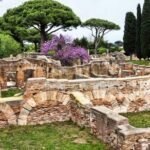
Ostia Antica feels like a time machine. This half-day, small-group tour takes you outside the usual Rome crowds to a working ancient port site, with guide commentary that makes the ruins far easier to understand. I love the skip-the-line entry because you spend your limited time on the ground instead of waiting at the gate. One thing to consider: the surfaces are uneven, so plan for comfortable walking shoes.
What makes this trip especially satisfying is how much daily life you can trace in a short span. You’ll move through places tied to commerce and industry—bathing facilities, shops, a forum, even latrines—and you get context for how all that fit together in a huge Roman hub. I also like that the group is capped at 6 people, so questions don’t get lost in the back row. The main drawback is simple: train tickets to and from Rome aren’t included, so you’ll want to budget and plan that part.
You start with an expert guide at the park entrance in time for a smart first look, then you’re left with enough time to keep exploring without feeling rushed. If you want a Roman site that reads like a city, not just a monument, this is a strong choice for a Rome itinerary.
In This Review
- Key things I’d watch for
- A small-group trip to Rome’s ancient harbor, not its usual hits
- Start at the park entrance with skip-the-line entry
- Baths of Neptune: Roman comfort, engineered water, and daily routine
- The Forum of Corporations: where trade was organized
- Shops, storefronts, and how Roman water worked
- Ancient theatre and the amphitheatre for crowds and spectacle
- Piazza della Minerva and the necropolis side of Ostia
- Bakery and latrines: the stops that feel most real
- How the timing works (and why 2.5 hours is the sweet spot)
- Who this tour is best for (and who might prefer something else)
- Price and value: what $152.97 buys you in practice
- A quick note on the guide experience
- Should you book this Ostia Antica tour?
- FAQ
- How long is the Ostia Antica tour?
- What is included in the tour price?
- Are train tickets to and from Rome included?
- Is skip-the-line entry included?
- How big is the group?
- Where do I meet for the tour?
- What time does the tour start?
- Is the tour wheelchair or mobility-friendly?
- Does the tour include food and drinks?
- What’s the cancellation policy?
Key things I’d watch for
- Skip-the-line access means less queue time at the entrance and more time inside.
- Max 6 people keeps the pace human and the explanations easy to follow.
- Real city-life stops: baths, theatre, forum, necropolis, bakery, latrines.
- Concrete Roman tech: you’ll see how hot/cold water systems worked in daily buildings.
- Atmospheric harbor setting: you’re visiting Rome’s old Mediterranean gateway, not an inland ruin.
A small-group trip to Rome’s ancient harbor, not its usual hits
Most Rome first-timers have a clear checklist: big-name ruins, iconic squares, and long lines. Ostia Antica is different because it’s Rome’s older “city machine”—an ancient harbor town that processed goods coming by sea and sent them onward by road. It’s the kind of place where you can actually picture streets and routines instead of only imagining what once stood here.
This tour is built for smaller pacing. With a max of 6 people, you get guide focus instead of a constant voice-over for a crowd. That matters at Ostia, because the site covers a lot of ground and the layout can feel confusing if you’re on your own.
The time frame is also realistic: about 2 hours 30 minutes. That’s long enough to see the best “story pieces” of the city, but short enough to keep your day from turning into a logistics marathon. You’ll just need to add the time for getting to and from the park by train since train tickets are not included.
You can also read our reviews of more city tours in Rome


Start at the park entrance with skip-the-line entry
You meet at Viale dei Romagnoli, 717, 00119 Roma RM at 10:00 am, and the experience begins right at the entrance to the archaeological park. Starting there matters, because it helps you get your bearings fast: once you understand where you’re going first, the rest of the walk feels more logical.
Skip-the-line entry is the practical win here. At big Roman sites, you can easily burn time before you even start seeing. With this tour, you get to move into the site quickly and let the guide do the heavy lifting—pointing you toward the best-preserved areas and the details that make the ruins click.
The tour includes the entrance ticket and keeps it guided from start to finish. That’s helpful when you want to understand what you’re looking at without spending your energy reading alone, translating layout clues, and guessing what you should prioritize.
Baths of Neptune: Roman comfort, engineered water, and daily routine
One of the most memorable stops is the Baths of Neptune. Even if you’re not a history nerd, baths are an instant hook because they reveal how Romans spent time—socially, hygienically, and with serious attention to comfort.
Here’s what makes this bath complex worth your time: you’re not just seeing stone walls. You’re learning how the Romans managed hot and cold water systems to feed different parts of the buildings. That turns the ruins from pretty shapes into a working technology story.
If you like to “read” a site like a city, baths are a great place to start. You can connect them to other daily-life stops later in the route—like the forum areas and the latrines—because everything ties back to how people lived, worked, and cleaned themselves.
A note for planning: this isn’t a museum-style stop where you sit and look. You’re walking through ruins, so bring comfortable shoes and accept that the ground is uneven in places.
The Forum of Corporations: where trade was organized
Next up is the forum area—especially the Square of the corporations and the wider Ostia forum zone. These spaces can feel abstract when you first see ruins: forums are often described in sweeping terms, but here you get concrete clues about how business worked.
The key idea is that Ostia wasn’t just a city with buildings—it was a trade hub. The forum and related areas connect to merchant activity, and you’ll notice how the layout supported business flow. Think: meeting places, commercial activity, and the kinds of structures that helped different groups coordinate.
What I like most is that the guide explanation helps you spot how this kind of forum functioned in real daily life. If you try to do Ostia alone, it’s easy to walk past “columns and walls.” With a guide, those same walls start to sound like a schedule.
Shops, storefronts, and how Roman water worked
Ostia rewards attention to small things. Even though the tour focuses on top highlights, you’ll get time to peak into ancient storefronts and to understand how the city’s infrastructure supported everyday routines.
One detail that tends to land with people is the explanation of plumbing systems, including the idea that buildings were wired for both hot and cold water. It’s a reminder that Rome’s engineering wasn’t only about aqueducts on the horizon. It reached inside neighborhoods and public-facing spaces.
If you enjoy architecture that has a purpose—not just a view—this is a good stop. You’ll start seeing Ostia less as “a place of ruins” and more as “a place where systems mattered.”
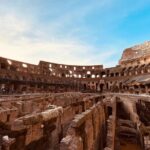
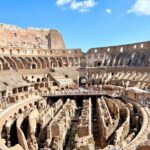

Ancient theatre and the amphitheatre for crowds and spectacle
Ostia has performance spaces, and they’re worth it for one reason: they show how public entertainment fit into a working city. The tour includes the ancient theatre of Ostia and also highlights the Ostia Antica Amphitheatre, which historically held up to 3,500 onlookers.
When you stand in or near an amphitheatre, it’s easy to imagine crowd noise and spectacle. With a guided walk, you also get help reading the scale—how seating and access would have shaped the experience. The theatre stop adds variety, so the tour isn’t just “commercial ruins and plumbing.”
This pairing also makes the city feel complete. A harbor city needed trade and storage, yes. But it also needed leisure and collective experiences—places where locals and visitors could share attention for an event.
Piazza della Minerva and the necropolis side of Ostia
Not every Roman site emphasizes the afterlife the way you want it to. Ostia includes the necropolis, plus a stop that includes Piazza della minerva.
The necropolis shift is useful because it changes the mood. Trade cities have a rhythm, but so do burial spaces—different space, different tone. You see how this place served multiple roles across a person’s life cycle: daily work, public gatherings, and then the final resting places.
Piazza della minerva helps break the route up, too. It’s a reminder that Ostia isn’t only about big set pieces. You’re moving through different types of spaces that together feel like a full city, not a single attraction.
Bakery and latrines: the stops that feel most real
Two of the most specific included highlights are the ancient bakery and the ancient latrines. These are often the exact stops people underestimate—until they stand there and realize these were built for repeated use every day.
A bakery points you toward the city’s food supply. In a harbor economy, food processing and distribution mattered because incoming shipments didn’t mean much if there was no way to feed the population. The latrines, on the other hand, are a straight-up window into public health habits and design.
I like these stops because they’re practical. They don’t ask you to guess what something might have been for. Instead, the purpose is written in the structure and the guide connects it to how a Roman city ran.
How the timing works (and why 2.5 hours is the sweet spot)
A 2 hours 30 minutes tour length can feel short—until you’re actually inside Ostia. This is a large archaeological park, and the highlights are spread out. The guide’s job is to keep you on the right path so you don’t waste time zigzagging.
You’ll start at 10:00 am and end back at the meeting point. That makes planning your afternoon easier, especially if you still want to squeeze in another museum or neighborhood walk in Rome.
To make the timing painless, plan your train and buffer time ahead of arrival. Train tickets aren’t included, and the tour runs on a schedule. The site experience itself is efficient; your outside-the-park logistics need a little care.
Who this tour is best for (and who might prefer something else)
This is a smart fit if you:
- Want Roman ruins with daily-life details, not just monuments
- Prefer a guided narrative because Ostia’s layout can be tricky to interpret alone
- Like small groups and don’t want to shout to your guide
- Have limited time in Rome and want a memorable out-of-center day
It might feel less ideal if you:
- Struggle with uneven surfaces (the tour isn’t recommended for people with physical disabilities)
- Want long, unstructured “wander time” without a defined route
- Don’t want to plan train travel on your own
One more small tip: since this tour is about understanding, you’ll get more from it if you ask questions as you go. The format is set up for that, and with only up to 6 people, it works.
Price and value: what $152.97 buys you in practice
At $152.97 per person, this isn’t the cheapest way to visit Ostia Antica. But it can still feel like good value if you add up what’s included: the entrance ticket, a fully guided walkthrough, and time-saving skip-the-line access.
That skip-the-line piece matters. If you’ve ever done large sites without a guide, you know how quickly your time disappears at entry points and in “which way do we go” moments. Here, the guidance aims to compress the best parts of the site into your limited 2.5-hour window.
Also, the small group size is part of the price logic. With fewer people, you’re more likely to get targeted explanations and less likely to feel like you’re being herded through.
If you’re traveling in a small group and can’t stomach wandering with uncertainty, this price is easier to justify. If your main goal is cheap and flexible, you might compare self-guided options—but you’ll likely trade away the city-life context you get here.
A quick note on the guide experience
The guide factor is where Ostia tours can really separate. One review highlighted a guide named Angelo, and that kind of name recognition tells you something: the guide role is visible, not generic. In practice, you should expect commentary that helps you understand what each part of the site meant—especially around trade spaces, daily tech, and public buildings.
If you like to learn while walking, you’ll appreciate this structure. If you prefer silence and self-direction, you may want to pick your pacing carefully within the tour route.
Should you book this Ostia Antica tour?
I’d book it if you want Ostia to feel like a real city. The combination of skip-the-line entry, a max 6 group, and stops that cover commerce, entertainment, daily services, and even the necropolis gives you a balanced slice of what Roman life looked like in a major harbor town.
I’d think twice if your mobility is limited due to uneven surfaces, or if you’re the type who wants to roam at your own pace without guidance. Also, make sure you’re comfortable handling train travel since it’s not included.
If you’re aiming for one standout “off the main track” day from Rome, this is a strong bet.
FAQ
How long is the Ostia Antica tour?
It runs about 2 hours 30 minutes.
What is included in the tour price?
Entrance tickets for Ostia Antica are included, along with a fully guided experience and specific included ruins such as the Baths of Neptune, the ancient theatre, the necropolis, and more.
Are train tickets to and from Rome included?
No. Train tickets are not included.
Is skip-the-line entry included?
Yes, you get skip-the-line access to the Ostia Antica archaeological site.
How big is the group?
Maximum 6 people per booking.
Where do I meet for the tour?
The meeting point is Viale dei Romagnoli, 717, 00119 Roma RM, Italy.
What time does the tour start?
Start time is 10:00 am.
Is the tour wheelchair or mobility-friendly?
The tour is not recommended for those with physical disabilities due to uneven surfaces.
Does the tour include food and drinks?
No. Food and drinks are not included.
What’s the cancellation policy?
Free cancellation is available up to 24 hours before the experience start time for a full refund.