REVIEW · NEW DELHI
6- Days Private Heritage Golden Triangle Tour
Book on Viator →Operated by BOUT INDIA TOURS · Bookable on Viator
Three cities, zero travel headaches. This private Golden Triangle tour strings together Delhi, Agra, and Jaipur with pre-arranged 4–5 star hotels, an English-speaking guide for monuments, and entrance tickets handled for you. I like the door-to-door, air-conditioned private car approach, and I also like that you’re not skipping the big UNESCO stops. One thing to keep in mind: it’s a full schedule with long driving days, so it helps to build in patience (and water) between sights.
In This Review
- Key takeaways before you go
- How the private Golden Triangle tour saves your time
- Price and logistics: what $1,224 per person really includes
- Day 1 in Delhi: India Gate and the easy airport handoff
- Humayun’s Tomb, Jama Masjid, and Qutub Minar: the Delhi day you’ll remember
- Agra Fort and evening market time: arriving before the Taj rush
- Taj Mahal morning: an early start that’s worth it
- Jaipur core sights: Amber Palace, Hawa Mahal, and Jantar Mantar
- Jal Mahal photos and Amber Fort reality: how to get the most out of big monuments
- Day 6 back to Delhi: a clean ending with a convenient drop-off
- Where meals fit into the plan (and where you’ll likely spend extra)
- Hotels, guides, and the feel of a private tour
- Who should book this Golden Triangle tour
- Should you book this private Golden Triangle tour?
- FAQ
- What cities are included in the Golden Triangle tour?
- How long is the tour and how many nights do you stay in hotels?
- Are monument entrance tickets included?
- Is airport pickup and drop-off included?
- What meals are included?
- What should I wear when visiting religious sites?
Key takeaways before you go
- Airport pickup and drop-off included at Indira Gandhi International Airport, with a private AC vehicle and driver throughout.
- UNESCO sights plus entry tickets covered, so you spend less time budgeting and queuing.
- Old Delhi experience built in, including Jama Masjid, Chandni Chowk, and a rickshaw ride through the market lanes.
- Taj Mahal early start plus a planned move to Jaipur the same day, keeping your sightseeing efficient.
- Jaipur market time with a guided walk, plus major forts and palaces like Amber Palace and Hawa Mahal.
- Meals are partially included (breakfasts and select lunches/dinner), which helps you avoid hunting for food on tight timing.
How the private Golden Triangle tour saves your time
If you’ve ever tried to stitch together Delhi hotels, Agra transport, and Jaipur ticket lines while fighting jet lag, you already know the real cost of DIY. This tour pays that friction upfront. You’re not doing the planning puzzle, and you’re not spending half your trip figuring out what runs on what day.
The value is clear in the “boring but important” inclusions: 5 nights in 4–5 star hotels (double/triple sharing), monument entry passes, and an English-speaking guide for the sites. Add private AC transfers and you get something practical: you show up, and the day has a shape.
The trade-off is flexibility. This is a guided, pre-planned route. If you want to linger for hours in one bazaar corner or skip a stop, you’ll have to work with the schedule you’re given.
You can also read our reviews of more private tours in New Delhi


Price and logistics: what $1,224 per person really includes
At $1,224 per person for about 6 days, it’s not the cheapest way to do the Golden Triangle. But it also isn’t trying to be. Most of what you pay for is the structure: hotels for 5 nights, a private car with driver at your disposal, and guides for monuments.
For many travelers, that’s money well spent. Entrance fees for multiple UNESCO sites add up fast, and private transport between Delhi–Agra–Jaipur removes major uncertainty. You also get a built-in “start and end” plan: pickup from the airport and a return drop in Delhi at your chosen location.
Where this may feel pricey: if you’re traveling as a true budget backpacker and you’re comfortable managing taxis, ticket lines, and long road transfers on your own. But if you’d rather convert your energy into the sights themselves, this kind of package usually lands as good value.
Day 1 in Delhi: India Gate and the easy airport handoff
Your tour starts with pickup at Indira Gandhi International Airport and a transfer straight to your Delhi hotel for check-in. That first step matters. Delhi can be chaotic, and arriving with a driver already assigned helps you get your bearings fast.
After you freshen up, you head out for sightseeing that works well as an introduction to the city. You’ll drive past Rashtrapati Bhavan (the residence of the President of India) and then visit India Gate, a memorial for 82,000 soldiers who died in the period 1914–21 during the First World War.
Day 1 is a good “settle-in” day. You’re not thrown immediately into the most intense old-city walking. You get a major landmark, a gentle start, and then you’re back for an overnight in Delhi.
One practical consideration: India Gate evenings can be pleasant, but if you arrive late, you may feel the day more than you expect. The tour gives you the framework, but jet lag still does jet lag things.
Humayun’s Tomb, Jama Masjid, and Qutub Minar: the Delhi day you’ll remember
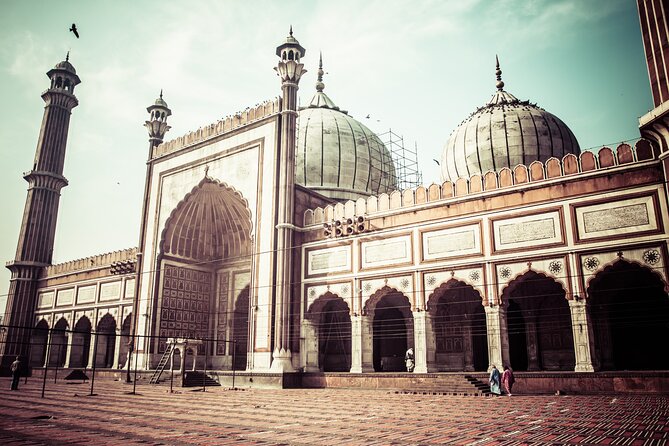
Day 2 is where Delhi becomes real. After breakfast, you’ll head into a loop that balances big monuments with local street life. You pass Red Fort without stopping, then visit Jama Masjid, described as the largest mosque in India. It’s one of those places where scale changes how you look at the city.
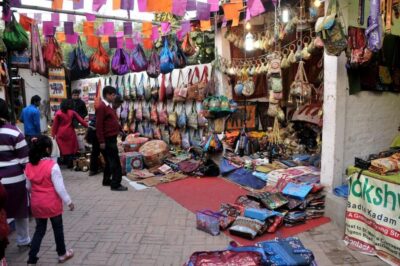
Next comes Chandni Chowk, one of the oldest and busiest markets in Old Delhi. You’ll get a rickshaw ride here, which is fun but also practical: it helps you cover ground without burning your legs early.
You’ll then visit Humayun’s Tomb, a UNESCO World Heritage Site. It was built in 1570 and is noted as the first garden-tomb on the Indian subcontinent. That “garden-tomb” concept is part of why this stop feels different from other mausoleums. Even if you’re not a garden person, the layout helps you slow down and look properly.
After lunch at a nice restaurant, you move to Qutub Minar, another UNESCO site. It’s a 73-metre tall tapering tower of five storeys. Construction is tied to Qutb-ud-Din Aibak, founder of the Delhi Sultanate, and you’ll see the tower that his era kick-started.
This is a strong day, but it’s also a long one. You’re packing several major sites into about 7 hours, so pacing is important. Wear comfortable shoes and expect that some parts involve standing, walking, and waiting for entry.
Agra Fort and evening market time: arriving before the Taj rush
Day 3 shifts you to Agra. After breakfast you check out, transfer toward Taj country, and reach Agra in the afternoon. The plan keeps the late day useful: you’ll have lunch, check in, then do the first Agra sightseeing—Agra Fort.
Agra Fort was the main residence of Mughal emperors until 1638, when the capital shifted from Agra to Delhi. That context helps you connect the fort to the broader story of the empire. This is not only a monument stop; it’s a “how power worked here” stop.
Then you get some breathing room in the evening by hanging out in the local market. This is where you catch everyday Agra rather than just postcard angles. It’s also where you’ll likely feel the difference between being driven around vs. being able to choose what catches your eye.
Tip for the evening: if you want photos, do a quick walk first, then return for shots. Fort courtyards and market streets can change quickly with light and crowd movement.
You can also read our reviews of more historical tours in New Delhi





Taj Mahal morning: an early start that’s worth it
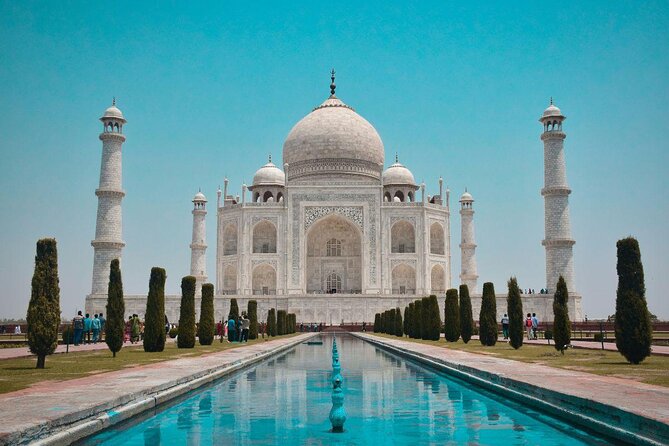
Day 4 is the marquee day. You’ll go out early to visit the Taj Mahal, a UNESCO World Heritage Site built by Shah Jahan in 1560 in memory of queen Mumtaz Mahal. The timing is the main reason this stop works so well. Going early helps the visit feel less hectic and gives you better odds for clearer photos.
After breakfast you check out and drive toward Jaipur, the Pink City. Rather than making it a straight transfer day, the route adds a meaningful detour: Chand Baori in Abhaneri. It’s described as a 13-floor stepwell, built over a thousand years ago, and listed as one of the largest stepwells in the world. Stepwells can look like architecture trivia from afar; up close, you see how people engineered light, depth, and daily life.
You arrive in Jaipur by afternoon, check in, and then go into the old city for a guided walk-tour of the Pink City market. This is a nice contrast after Taj Mahal. Instead of grand symmetry, you get color, shops, and streets built for movement.
Potential drawback: you’ll cover a lot of ground in a single day—Taj Mahal, then travel, then Jaipur. If you’re prone to feeling rushed, plan to keep your evenings calm and don’t overbook yourself outside the group.
Jaipur core sights: Amber Palace, Hawa Mahal, and Jantar Mantar
Day 5 is a packed Jaipur classic circuit. You start with sightseeing and hit several icons without losing too much time.
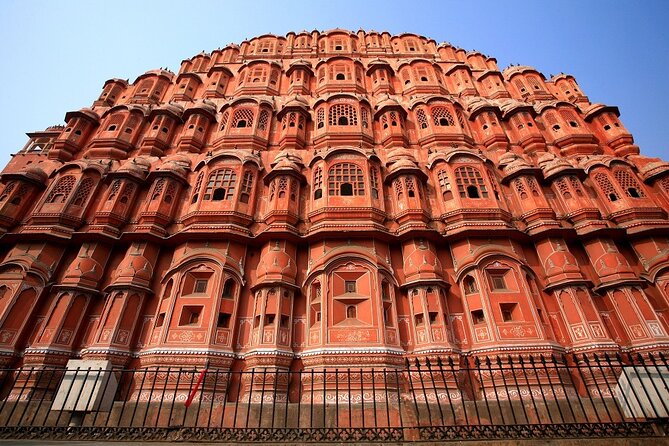
First up is Hawa Mahal (Palace of Winds). Even if you only see it from the outside at first, it’s an instantly recognizable Jaipur landmark.
Then you visit Jantar Mantar, another UNESCO World Heritage Site. This is a collection of nineteen architectural astronomical instruments, built by Rajput king Sawai Jai Singh and completed in 1738 CE. It’s one of the best places on this route for curiosity. You can look, then read, then look again and realize these structures aren’t decoration—they’re tools.
Next is City Palace, right in the centre of the Old City. The complex includes courtyards, gardens, and buildings, and it’s positioned as a core part of Jaipur’s layout.
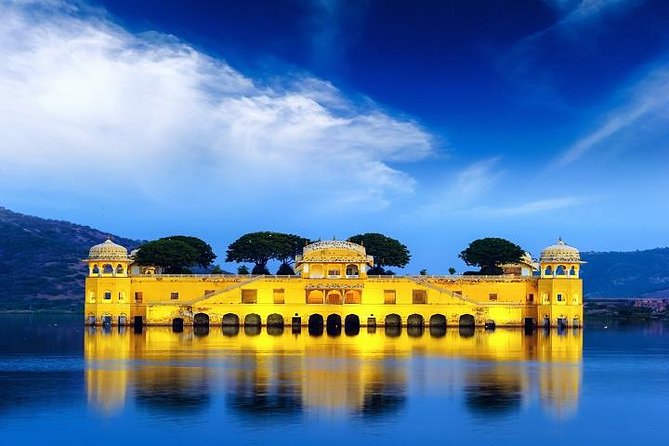
Then you visit Jal Mahal, a palace in the middle of a lake built in the 17th century. It’s a photo stop, yes, but it’s also a reminder that Jaipur’s architecture isn’t only about palaces on land.
Finally, you end with Amber Fort (Amber Palace/Amer Fort), listed as a UNESCO World Heritage Site. This is the grand finale of the day’s monuments. It’s usually where the “wow” factor lands for most people, because forts are built to impress from far away—and to work up close.
This is also a day where heat can hit. Even though your transport is air-conditioned, your time at major monuments isn’t. If you visit in warmer months, start early, hydrate, and use breaks strategically.
Jal Mahal photos and Amber Fort reality: how to get the most out of big monuments
By Day 5 you’ll understand why the Golden Triangle is so famous. The big sites don’t just look beautiful; they’re also layered with meaning. Amber Fort and City Palace help you grasp how power and daily life mixed. Jantar Mantar adds the science angle. Hawa Mahal brings the “city as architecture” idea.
Here’s how to make this kind of day feel easier for you:
- Keep your phone charged. You’ll want photos, but you also need it for tickets and maps.
- Take notes fast at each stop. Even a few words helps you remember what you saw later.
- Don’t chase every single angle. Pick one or two. Otherwise you’ll burn time and feel tired before the good parts.
Also, remember the dress guidance. The tour notes that when visiting religious sites, you should dress conservatively. For mosques and temples, that means covering appropriately and keeping things practical for walking.
Day 6 back to Delhi: a clean ending with a convenient drop-off
Day 6 keeps the structure simple. After breakfast you check out, then you drive back toward Delhi. The car drops you back in Delhi at your desired location, and the tour ends where you started from.
This is a smart way to end. You’re not stuck in a confusing “nearby meeting point” situation. You’re also not forced to spend Day 6 figuring out road transfers right after a long tour.
If your flight or onward plans are later in the day, use the morning energy wisely. You may want a quick meal after breakfast and keep valuables easy to access during the drive.
Where meals fit into the plan (and where you’ll likely spend extra)
Meals are partially included, which can really help on a tight schedule. The tour includes breakfasts (5) and lunch (2). The overview also points to select meals, including a traditional Rajasthani dinner and breakfasts most mornings.
What this means in practice: you’ll likely pay out of pocket for some dinners and drinks unless they’re specifically included in your schedule. That’s normal for India travel, but it’s nice you won’t be stuck hungry between major monuments.
A practical approach: if you’re sensitive to stomach surprises, use the included lunch spots and lean on breakfast you know will be safe. Save your riskier street-snack experiments for calmer evenings.
Hotels, guides, and the feel of a private tour
This is a private tour/activity, so it’s just your group. That matters because it makes the pacing easier to manage. You won’t be waiting on strangers who move at different speeds.
Hotels are described as 4/5 star and are “mentioned or similar,” and rooms are on double/triple sharing. That phrasing usually means you’ll get a good standard but not necessarily a specific property name locked in from the start.
Your monument time comes with English-speaking guides for the monuments. That’s important here, because these sites are packed with details. Without a guide, some of the meaning can blur into “pretty buildings.” With one, you’re more likely to understand what you’re seeing as you go.
One other small plus: the tour lists mobile ticket and pickup offered, which keeps the whole process straightforward.
Who should book this Golden Triangle tour
I think this works best for you if:
- You want to see the Golden Triangle highlights without handling transport and hotel bookings yourself.
- You like having a guide at major sites (UNESCO stops can feel much clearer that way).
- You’re okay with a packed schedule and long driving days between Delhi, Agra, and Jaipur.
It may not be ideal if you’re the type who wants total freedom to choose stops day-by-day, or you prefer slow travel where you stay put in one city longer than planned. This tour is built for efficient coverage, not wandering.
It’s also a decent fit for families with young kids. The tour notes that a child below 5 years is complimentary when sharing the same bed, and there’s a requirement of minimum two adults to book.
Should you book this private Golden Triangle tour?
If you want a Golden Triangle trip that’s organized, guided at the key monuments, and logistically low-stress, I’d say it’s a strong choice. You’re paying for the hard parts: private AC driving, hotel nights, entrance passes, and English guidance. That means more of your day goes to the sights and less goes to problem-solving.
Before you book, be honest about your tolerance for a full agenda. If long car days and early starts sound exhausting, then you might prefer a slower, city-by-city plan. But if you’re craving a clear route and want the big UNESCO names handled for you, this 6-day run is set up to deliver.
FAQ
What cities are included in the Golden Triangle tour?
The tour covers three cities: Agra, Delhi, and Jaipur.
How long is the tour and how many nights do you stay in hotels?
It’s a 6-day tour with 5 nights of accommodation.
Are monument entrance tickets included?
Yes. Entry passes for all the monuments mentioned in the itinerary are included.
Is airport pickup and drop-off included?
Yes. The tour includes pickup from Indira Gandhi International Airport in New Delhi and the car drops you back in Delhi at your desired location at the end.
What meals are included?
The tour includes breakfasts (5) and lunch (2). The tour overview also mentions a traditional Rajasthani dinner as part of the select meals.
What should I wear when visiting religious sites?
The tour advises conservative dress when visiting religious sites.