REVIEW · ROME
Full Day Combo: Colosseum & Ancient Rome and Rome Evening Panoramic Walking Tour
Book on Viator →Operated by Your Way Tours · Bookable on Viator
Rome rewards you most when you pace it well. This combo tour pairs Colosseum + Roman Forum with an evening sights walk, so you cover more than a typical day trip. I especially like the line-skipping at the start and the way the night route hits classic landmarks when the air cools off. One catch to plan for: it’s a long 6.5-hour run of walking, and there’s no transport between the two halves.
The afternoon is built around real ruins and clear stories, with time at the Capitoline Hill and the Pantheon. In the evening, you get a scenic route through Rome’s historic center toward some of the most photographed places, including the Spanish Steps and Trevi Fountain. The drawback isn’t the sights; it’s the schedule compression—if you like slow wandering, you’ll want to leave extra time on your own day afterward.
Small group size is a real plus here (up to 18/20), and you’ll use headsets when needed so you don’t miss the details in crowded areas. Just be ready with the required ID and make sure the names on your booking match your documents, or entry to the Colosseum and Forum can be denied.
In This Review
- Key things you’ll notice on this tour
- A smart two-half day plan: Colosseum by afternoon, Rome by night
- Meeting at Campo de’ Fiori: IDs, small groups, and headsets
- Entering the Colosseum without the line: tiers, gladiators, and real scale
- Roman Forum and Capitoline Hill: where government lived and Michelangelo designed the view
- Pantheon and Piazza Navona: the afternoon walk that feels like a mini greatest-hits tour
- Piazza del Popolo to Terrazza del Pincio: sunset views over Rome’s rooftops
- Spanish Steps and Trevi Fountain at night: classic scenes with better atmosphere
- Pantheon from the outside and a second Piazza Navona stop: why the loop makes sense
- Ending at Campo de’ Fiori around 22:00: a practical finish point
- Guide quality and storytelling pace: what makes this combo work
- What your $104 includes (and what you should plan for)
- Timing and comfort: what to know before you commit
- Who this tour suits best
- Should you book this Colosseum + Roman Forum + evening walk?
- FAQ
- What is the duration of the tour?
- Where does the tour start and end?
- What time does the tour begin?
- Are entrance tickets included for the Colosseum and Roman Forum?
- Does the tour include Pantheon entry?
- Is transport included between the afternoon and evening parts?
- How big is the group?
- Do I need a passport or ID document?
- What fitness level is required?
Key things you’ll notice on this tour
- Line-skipping entry into the Colosseum at 13:45, plus headset use when needed
- First and second tiers of the Colosseum, with gladiator-fight stories tied to what you’re seeing
- Capitoline Hill and Piazza del Campidoglio designed by Michelangelo
- Pantheon visit in the afternoon, then a look from the outside later in the evening
- Sunset timing from Terrazza del Pincio, then the Spanish Steps and Trevi Fountain at night
- Ends around 22:00 in Campo de’ Fiori, a good springboard for your own nightlife plans
A smart two-half day plan: Colosseum by afternoon, Rome by night
This is a time-stretching format that makes sense if it’s your first trip to Rome or you only have one day to pack in the biggest hits. You start with the Colosseum and Roman Forum in the afternoon, then you switch gears at dusk for a walking tour through central Rome’s highlights.
You’ll begin at 13:45 for the Colosseum portion and then meet up again at 19:00 for the evening walk. The tour winds down around 22:00 back at Campo de’ Fiori, which is handy because you finish where you can easily continue on your own.
The pacing is the key idea: early enough to enjoy daylight for monuments like the Pantheon and Piazza Navona, then late enough that spots like the Spanish Steps feel less hectic.
You can also read our reviews of more walking tours in Rome
Meeting at Campo de’ Fiori: IDs, small groups, and headsets
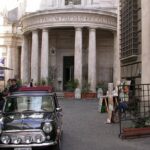
Your official start point is Campo de’ Fiori (00186 Roma RM), and you’ll end in the same area around 22:00. The exact flow includes a Colosseum start at 13:45, so you’ll likely spend a bit of the early afternoon getting sorted with the guide and group before heading in.
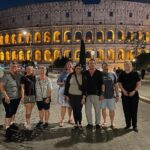
This tour runs with a maximum group size of about 18 (the info also references a maximum of 20). That matters because the Colosseum and Forum can turn into a noisy stampede if your group is too large. Here, you’re more likely to hear your guide and actually keep up without constantly losing the flow.
Also: bring an identity document and make sure the full names you provided match the ticket names. The Colosseum and Roman Forum entry require name matching at the ticket office, and denied entry is the kind of problem that ruins the day.
Finally, there’s headset use when needed. In Rome’s big stone spaces, that’s the difference between hearing stories and only catching fragments.
Entering the Colosseum without the line: tiers, gladiators, and real scale
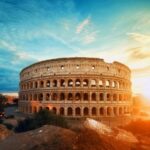
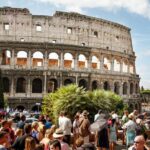
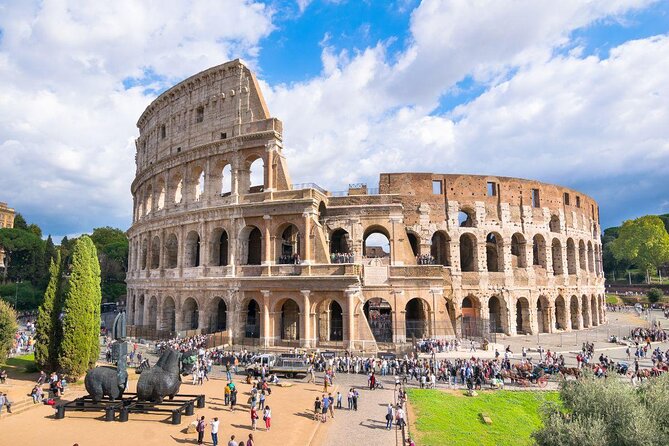
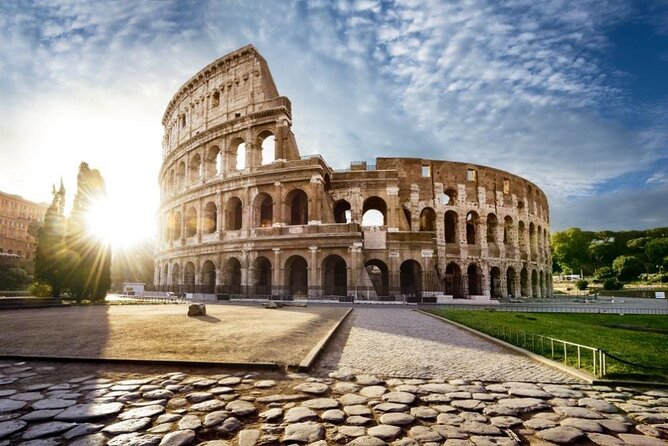
The Colosseum portion is the star of the schedule. You get a reserved entry and skip the long lines at the entrance, which is one of the biggest value boosters in a city where queues can eat your whole afternoon.
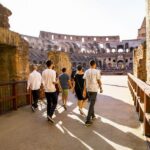
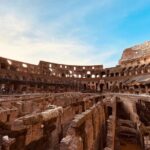
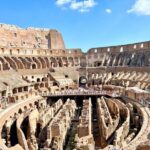
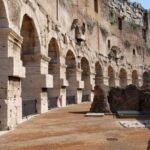
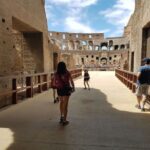
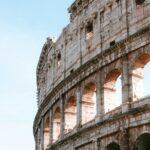
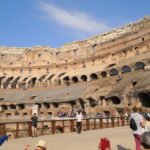
Once inside, your guide focuses on the building’s first and second tiers while telling stories connected to gladiator combat. Even if you already know the basics, seeing the tiers in relation to each other helps you grasp the Colosseum’s scale—where spectators sat, how the structure was layered, and why it felt so intense for the crowds.
There’s a practical advantage here too: the line-skipping starts you at 13:45, so you avoid the later crush that can make the Colosseum feel like a logistics problem.
Roman Forum and Capitoline Hill: where government lived and Michelangelo designed the view
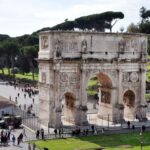
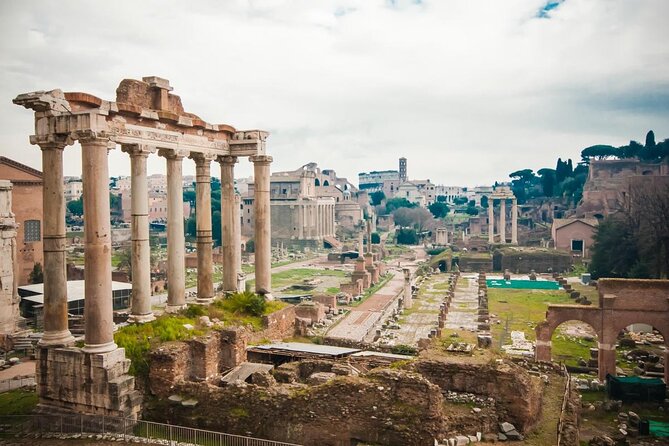
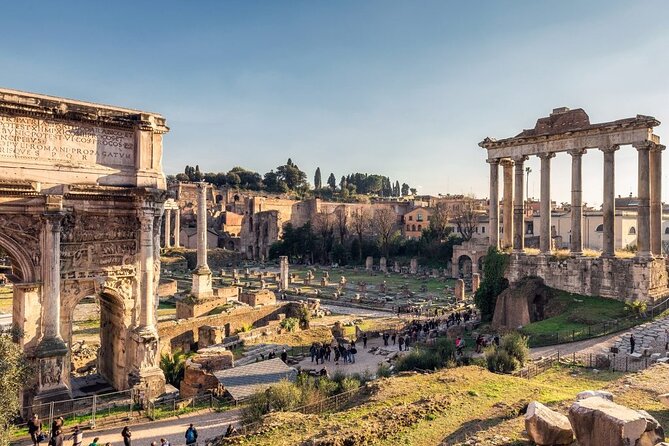
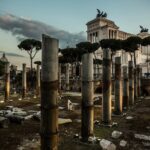
After the Colosseum, you move into the Roman Forum, the center of Roman government and daily public life. The Forum can feel like a collection of stones if you don’t have someone tying it to how Romans actually lived. With a guided pace, you get the context so the ruins feel like places with roles, not just walls and columns.
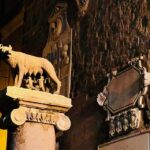
From there, you climb to Capitoline Hill. It’s described as the smallest of Rome’s seven hills, but it’s still significant—because the view and the symbolism matter. You’ll spend about 30 minutes at Piazza del Campidoglio, designed by Michelangelo. That square is more than a photo spot: it’s a reminder that Rome’s “ancient layer” didn’t stay ancient. The city kept shaping itself on top of old power.
If you have moderate fitness, you should be fine, but do expect a climb and some uneven surfaces. This part is where sturdy shoes matter.
Pantheon and Piazza Navona: the afternoon walk that feels like a mini greatest-hits tour
Next up is the Pantheon, visited in the afternoon. This is one of those buildings you can’t fully appreciate from outside—the interior space is the point. Your stop is about 30 minutes, and the guide frames it as a Roman temple dedicated to all pagan gods.
Even more than that: the Pantheon is often described as the most preserved and influential ancient Roman building, and standing there helps you understand why it became a model later on. This is the kind of stop that turns your understanding of Roman engineering from facts into a feeling.
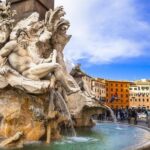
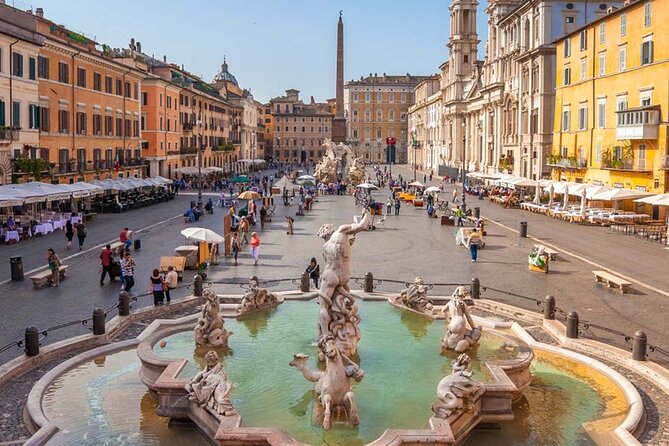
After the Pantheon, your daytime route continues to Piazza Navona. You’ll spend around 30 minutes here, and the square’s layout does the work of selling the scene: three magnificent fountains, with Bernini’s Fountain of the Four Rivers as the centerpiece. It’s lively even in daylight, and at this point in the tour it also works as a natural reset before evening starts.
You can also read our reviews of more evening experiences in Rome
Piazza del Popolo to Terrazza del Pincio: sunset views over Rome’s rooftops
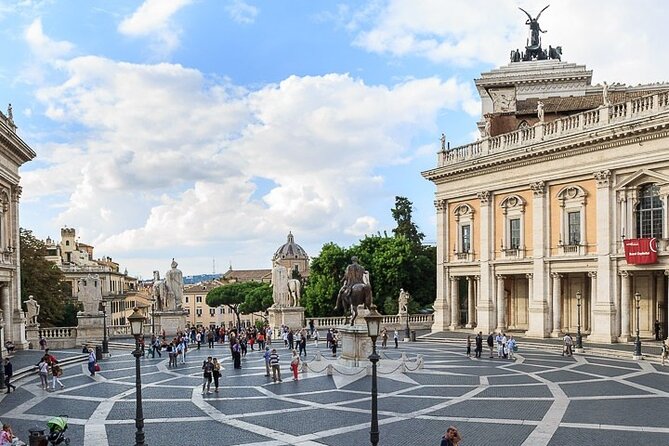
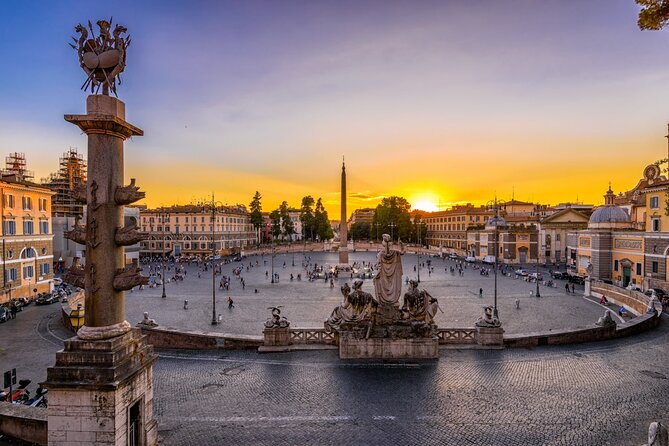
At 19:00, the evening walk starts at Piazza del Popolo. This square has churches, fountains, and monuments around it, and it also has a darker past connected to public executions. Tonight, though, it’s a place for people watching and a jumping-off point for the walk into the historic center.
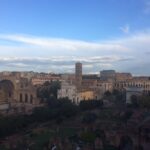
Then your guide takes you toward Terrazza del Pincio. This is the sunset stop, with about 20 minutes to enjoy the view over Rome’s rooftops. Even if you’ve seen photos, the payoff is in the angle and the changing light—when Rome’s stone tones shift and the city feels more human scale.
This part of the tour is one of the best “first-time visitor” moves because it gives you a mental map. From here, the city’s layout clicks in your head.
Spanish Steps and Trevi Fountain at night: classic scenes with better atmosphere
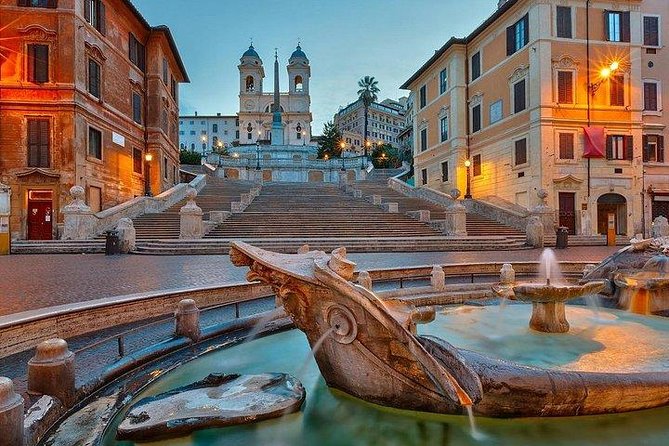
After Pincio, you hit Piazza di Spagna and the Spanish Steps. You’ll spend about 20 minutes at this stop and see Bernini’s Barcaccia fountain and the iconic steps. Evening brings a different rhythm than midday, and the timing helps the area feel more like a street scene and less like a queue.
Then comes Trevi Fountain, around 20 minutes for wandering. You’ll see it as the biggest Baroque fountain in Rome, and you’ll also hear the famous coin legend: toss a coin and you’re supposed to return to Rome.
Two tips that keep this stop enjoyable:
- Wear shoes that work on uneven stone. The area is active and you’ll be shifting your position often.
- Don’t treat Trevi like a quick checkmark. A couple minutes of just looking at the water and figures helps you understand why it’s still drawing crowds.
Pantheon from the outside and a second Piazza Navona stop: why the loop makes sense
In the evening, the Pantheon stop is listed as an exterior look with explanation. Admission isn’t included for this part, so expect a viewpoint and storytelling rather than an inside visit.
Then you return to Piazza Navona again for about 20 minutes. Seeing it twice is not redundant if you approach it right. In the afternoon it feels like a bright postcard square; at night, it becomes a social stage with different light and movement. Even the fountains feel like different sculptures depending on the hour.
Ending at Campo de’ Fiori around 22:00: a practical finish point
Your evening ends at Campo de’ Fiori, back near the start. This is a useful place to finish because it’s a real neighborhood square.
Campo de’ Fiori has a marketplace feel in the morning and a nightlife vibe after dark. Since your guided walk finishes around 22:00, you’re set up to grab dinner, continue walking, or find a nearby bar without needing a long transfer.
Guide quality and storytelling pace: what makes this combo work
The strongest praise in this kind of tour model is usually the guide—because you’re walking fast and seeing a lot. Here, you’ll be following a professional expert guide, and the small group helps the guide actually connect details to the sites.
One named example from guide feedback is Riccardo Fiore, described as one of the best guides people have had, with clear explanations and a friendly, patient style. That’s exactly what you want on a full-day combo: someone who can slow down without losing momentum.
Headsets when needed also help the guide keep control of the pace in loud spaces, so you don’t miss key points while you’re trying to see.
What your $104 includes (and what you should plan for)
For $104, you’re paying for a full afternoon-and-evening experience, not just “entry tickets plus a walk.” The Colosseum ticket is included (valued at €18), along with the Colosseum reservation fee (valued at €2). Your remaining cost covers the guide, organization, and the full guided itinerary.
A few practical notes about what is and isn’t included:
- Hotel pickup and drop-off aren’t included, so you’ll get yourself to the start area.
- Transport from the Colosseum & Ancient Rome portion to the evening walk isn’t included. The evening meeting point is at Piazza del Popolo at 19:00, so be ready to handle that transfer on your own time.
Also, you’ll get entry to the Colosseum and the Roman Forum, and your daytime Pantheon visit is also included. The evening Pantheon is exterior only (admission not included), so treat it as a viewing moment rather than a second interior tour.
Timing and comfort: what to know before you commit
This is a 6 hours 30 minutes tour, and it’s built around a lot of walking. You’ll also do a climb to Capitoline Hill. If you’re dealing with mobility issues or you prefer slow pacing, you might find it intense.
On the other hand, if you want a structured day that shows you the big Roman anchor points plus a classic evening route, this schedule is efficient. It’s the kind of combo where you leave with a mental map of central Rome: Colosseum → Forum → Capitoline → Pantheon → Navona → Popolo → Pincio → Spanish Steps → Trevi → Campo de’ Fiori.
One more reality check: sometimes the evening portion can shift. If you end up with only the Colosseum and Forum segment due to changes, you still get a strong chunk of the value because that first part is the most ticket-heavy and the most time-sensitive.
Who this tour suits best
I’d steer you toward this if:
- It’s your first time in Rome and you want the greatest-hits highlights with context.
- You only have one day and you want to maximize it without spending hours figuring out routes.
- You like guided storytelling but still want to end in a lively area where you can keep going.
I’d think twice if:
- You hate structured timing and prefer to wander freely without group pacing.
- You’re sensitive to crowds and stair climbs.
- You rely on smooth transport from stop to stop and don’t want any self-transfer.
Should you book this Colosseum + Roman Forum + evening walk?
Book it if you want a balanced day: practical line-skipping for the Colosseum, guided context for the Forum, and an evening route that shows you Rome’s classics in cooler hours. At $104, the price feels fair because you’re getting real entrances (including the Colosseum reservation) plus a guided evening walk that strings together multiple top sights.
Don’t book it if you want an unhurried day, or if the idea of handling your own transfer between the afternoon and evening parts would add stress.
If you do book: pack comfortable shoes, bring your ID, and plan to eat after the tour near Campo de’ Fiori so you don’t waste time traveling when you’re done.
FAQ
What is the duration of the tour?
The tour runs about 6 hours 30 minutes.
Where does the tour start and end?
It starts and ends at Campo de’ Fiori (00186 Roma RM, Italy). The evening portion ends around 22:00.
What time does the tour begin?
The Colosseum portion starts at 13:45 (1:45 pm).
Are entrance tickets included for the Colosseum and Roman Forum?
Yes. Entrance to the Colosseum and the Roman Forum is included, with the Colosseum ticket and reservation fee included in the price.
Does the tour include Pantheon entry?
You visit the Pantheon during the daytime portion (admission is noted as free for that stop). During the evening, Pantheon is an exterior stop with explanation, and admission is not included for that part.
Is transport included between the afternoon and evening parts?
No. Transport from the Colosseum & Ancient Rome tour to the Rome Evening tour is not included.
How big is the group?
The tour is limited to a small group size, with a maximum of 18 participants (the information also references a maximum of 20).
Do I need a passport or ID document?
Yes. You must bring an identity document (passport, driving license, etc.), and the name must match the booking for successful entry to the Colosseum and Roman Forum.
What fitness level is required?
The tour calls for a moderate physical fitness level, including some walking and a climb to Capitoline Hill.