REVIEW · ROME
Ancient Rome’s Ultimate Night Walk
Book on Viator →Operated by Rome's Ultimate Free Walking Tours · Bookable on Viator
Rome at night feels like a secret you can actually walk. This 7:00 pm outing strings together Italy’s modern identity and ancient power with a guide’s story between major squares.
What I like most is how the route keeps switching time periods without confusing you. And I also like the built-in payoff at the end, including a complimentary nightcap in the city center. One thing to consider: the experience depends on good weather, so rain can change the mood fast.
You’ll be moving for about 2 hours 30 minutes with multiple short stops, and it’s capped at 15 people, so the guide can keep the pacing human-sized. Expect an English narration, a mobile ticket, and plenty of free viewing—most of the stops are listed as ticket-free.
In This Review
- Key things to know before you go
- A 7:00 pm Rome route that connects power from Caesar to modern Italy
- Piazza Venezia: the unification story and the monument you can’t miss
- Piazza del Quirinale: from papal residence to today’s presidency
- Piazza del Campidoglio: Michelangelo’s design and the seat of the Roman mayor
- Via dei Fori Imperiali: where you intersect and view the Roman Forum
- Piazza di Pietra: Hadrian’s temple columns on a modern facade
- Piazza Colonna and the nightcap finish in the city center
- Price and value: what $84.33 buys you for 2.5 hours
- Weather reality and what to do if the evening gets messy
- Who this night walk is best for (and who should skip it)
- Should you book Ancient Rome’s Ultimate Night Walk?
- FAQ
- What time does the tour start?
- Where do I meet the guide?
- Where does the tour end?
- Is the tour in English?
- Is there a ticket fee for the stops?
- How big is the group?
- What’s the weather plan?
Key things to know before you go
- Small group (max 15): more chances to hear the details and stay on track.
- 7:00 pm start: perfect for seeing Rome after daylight crowds thin out.
- Free-entry stops: you’re paying for the walking tour and storytelling, not tickets.
- Michelangelo + Roman Forum in one arc: modern Rome’s layout points back to ancient Rome’s worldview.
- Ends with a nightcap: a real finish, not just a drop-off.
A 7:00 pm Rome route that connects power from Caesar to modern Italy
This is a night walk designed to help you read Rome like a timeline. You start where modern Italy announces itself, then you pivot toward papal and civic power, and finally you line up your eyes with the Roman Forum area—Rome’s old-world center of gravity.
The timing matters. A 7:00 pm start gives you a better shot at softer light and a calmer pace than midday sightseeing. You’ll spend about 15 minutes at several key photo-and-story stops, then you’ll walk between them along central routes.
The tour also feels structured but not rushed. There’s no long ticket line to manage at each stop, since the listed admissions are free. So your money mostly buys one thing: a guide who can connect what you’re seeing to why it mattered.
You can also read our reviews of more walking tours in Rome
Piazza Venezia: the unification story and the monument you can’t miss
Your first stop is Piazza Venezia, and it’s a smart opener because this square is basically a headline. You’ll hear the story of Italian unification and learn how the monument here symbolizes what was being built after the country came together.
Even if you already know the basics, this kind of guided framing changes how you see the space. Rome’s grand monuments don’t just look impressive; they’re political messages in stone. Starting here helps you understand why later squares feel like chapters in the same book.
Time on this stop is about 15 minutes, so it’s enough to orient yourself without turning into a museum detour. Admission is listed as free, so you’re not stuck waiting on entry procedures.
Piazza del Quirinale: from papal residence to today’s presidency
Next up is Piazza del Quirinale, where history gets interesting in a practical way. You’ll see the current seat of the Italian president and also what once used to be a main papal residence—before it became inhabited by the Italian royal family.
This stop is valuable because it shows how power shifts without the city changing its address. Rome reuses real estate. The buildings stay, and the rulers change. That’s a theme you’ll keep feeling as the walk continues.
It’s another 15-minute stop, with free viewing. The main “cost” here is attention. If you tune in for the transitions—papal, royal, then presidential—you’ll come away understanding why Rome looks the way it does today.
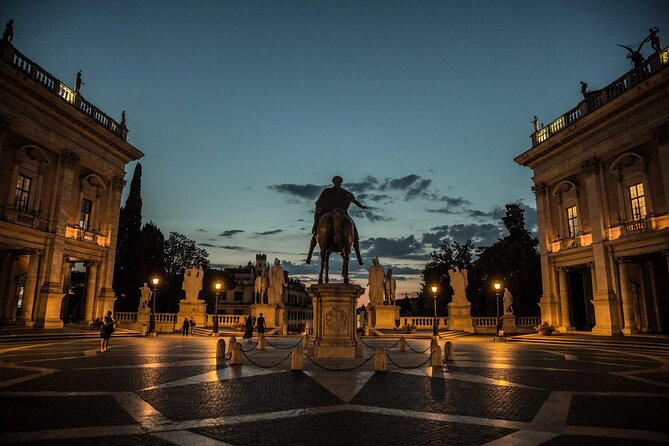
Piazza del Campidoglio: Michelangelo’s design and the seat of the Roman mayor
At Piazza del Campidoglio, the story turns architectural. You’ll visit the breathtaking piazza designed by Michelangelo, and you’ll also connect it to the seat of the Roman mayor.
This is one of those places where the space itself does storytelling. The guide’s narration helps you see why Michelangelo’s choices weren’t random aesthetics. The layout supports the idea of civic authority—Rome as a city that knows it can choreograph respect.
Expect about 15 minutes here. Like the earlier stops, admission is listed as free. The value is in how the guide helps you look: what to notice, what to compare, and how the piazza’s purpose links back to Rome’s long habit of centering governance in public space.
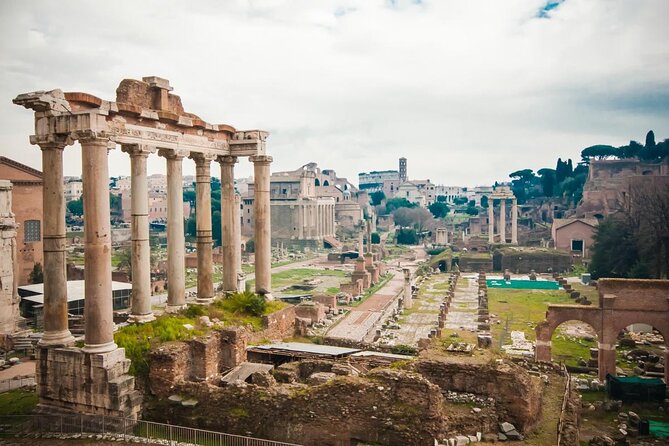
Via dei Fori Imperiali: where you intersect and view the Roman Forum
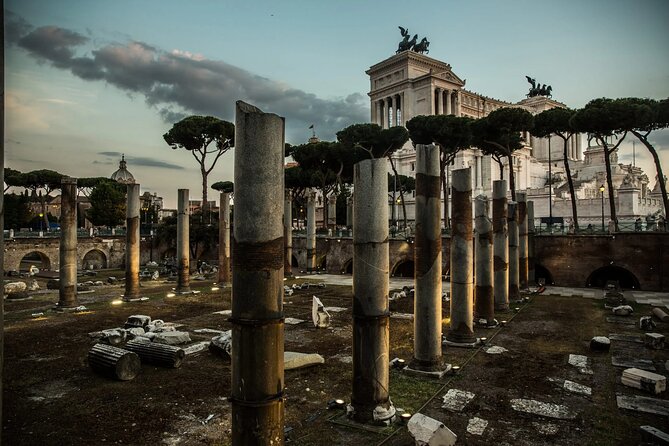
Now you hit the “wow” section: Via dei Fori Imperiali. This is where the walk starts to feel less like a sequence of squares and more like a guided alignment with ruins.
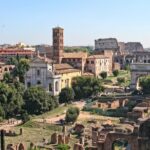
You’ll intersect the route and view the Ancient Roman Forum—the place once described as the center of Western civilization, a.k a caput mundi. Even when you’ve seen photos before, it’s the scale and the perspective that hit in person.
Time here is short—about 15 minutes—but that can be enough if you’re focused. The trick is to listen for the big picture while you look for the telltale shapes of the forum’s role. Think: streets of power, public debate, and the physical “stage” where Roman life made decisions.
A practical note: the Forum area is outdoors and you’ll be walking. If it’s damp or cold, wear layers. If it’s dry, good shoes matter because you’ll want stable footing while paying attention.
You can also read our reviews of more evening experiences in Rome
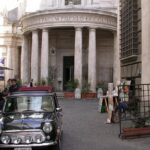
Piazza di Pietra: Hadrian’s temple columns on a modern facade
At Piazza di Pietra, you’ll stop for a quick but clever contrast: the facade of the seat of the local Camera di Commercio still has original columns of the Temple of Hadrian.
This stop is only about 5 minutes, which is exactly why it works. It’s a fast reminder that Rome doesn’t “replace” its past in a clean break. It folds it in. Old elements get reused, repainted by time, and turned into part of today’s streetscape.
If you like architecture that shows its age, you’ll appreciate this. If you’re only chasing the biggest monuments, you might be tempted to skip this kind of detail—don’t. These are the micro-moments that make the bigger story believable.
Admission is listed as free again, so you’re paying for the context, not an entry fee.
Piazza Colonna and the nightcap finish in the city center
Your last stop is Piazza Colonna, tied to political and religious history. You’ll hear about Roman families who used to run the Catholic Church and learn how this area relates to the seat of the Italian prime minister.
Then the tour ends with a complimentary nightcap in the city center. That matters more than it sounds. It gives you a chance to decompress after you’ve been switching centuries in your head all evening.
This is also where the day-to-night rhythm makes sense. You’re finishing in a central area with a clear endpoint—helpful if you’re planning dinner right after.
Time here is about 15 minutes at the square. Ending at Piazza Colonna keeps the walk coherent because it’s both a historical reference point and a practical “where do I go next” location.
Price and value: what $84.33 buys you for 2.5 hours
At $84.33 per person for about 2 hours 30 minutes, you’re paying for a guided night walk that’s built around free viewing. That’s the key value equation here.
You’re not buying a pile of paid attractions at each stop. The listed admissions for the key stops are free, so the cost goes toward:
- A structured route through major Roman power centers
- English narration that connects those stops into a storyline
- A small group size (max 15)
- A finish that includes a nightcap
Is it “cheap”? Not exactly. But it’s not pretending to be. What you’re really buying is time with an expert guide who can translate what you see into why it exists. If you’ve ever felt lost in Rome—staring at statues and wondering why anyone cared—this kind of tour is designed to fix that fast.
One more detail: this is often booked about 14 days in advance on average. If your dates are firm, don’t wait until the last minute.
Weather reality and what to do if the evening gets messy
The experience lists a good weather requirement. That means you should treat the night like a plan with conditions, not a guaranteed fantasy.
Bring a light rain layer even if the forecast looks okay. If it’s chilly, dress in warm layers; a night walk means your body can cool down between stops.
Also, arrive early to the meeting point. Your start is Via dei Serpenti, 89, 00184 Roma RM and the start time is 7:00 pm. The route ends at Piazza Colonna.
If you’re dealing with flight delays, keep your expectations grounded. One booking story tied frustration to a rainy day and difficulty getting a date change. The practical takeaway: have a flexible plan in mind, and give yourself buffer time so you’re not trying to run Rome like an airport shuttle.
Who this night walk is best for (and who should skip it)
This tour is a great fit if you want a guided way to understand Rome without spending your evening in lines. The “short stop, then move” format works well for people who:
- Like history, but hate long lectures
- Prefer walking neighborhoods and squares over one big-ticket site
- Want the Roman Forum area as part of a bigger storyline
- Appreciate ending with something social like a nightcap
It might be less ideal if you’re expecting a long, ruin-focused time for deep exploration. The Forum viewing is about 15 minutes, so you’ll see it, but you won’t be turning it into a full-day archaeology seminar.
And if you know you get uncomfortable outdoors in bad weather, pay attention to the good weather requirement and pack accordingly.
Should you book Ancient Rome’s Ultimate Night Walk?
If you’re choosing between “random sightseeing” and a guided narrative that connects modern Rome to ancient Rome, I’d book it. This one has a clear structure: major squares, quick context, then the Forum, and a tidy finish with a nightcap. That combo is hard to recreate on your own in a single evening.
Book it especially if:
- You want an English-led explanation that helps you read the city
- You like small groups and more focused storytelling
- You’re short on time and want the Roman Forum area without committing to a full day
Skip it or think twice if weather would ruin your plans or if you need very long time in the ruins themselves. The best way to win this tour is to show up ready to walk, listen, and enjoy Rome in the after-hours tempo.
FAQ
What time does the tour start?
The start time is 7:00 pm, with an experience duration of about 2 hours 30 minutes.
Where do I meet the guide?
Meet at Via dei Serpenti, 89, 00184 Roma RM, Italy.
Where does the tour end?
The tour ends at Piazza Colonna in Rome (P.za Colonna, Roma RM).
Is the tour in English?
Yes, it’s offered in English.
Is there a ticket fee for the stops?
The listed admissions for the stops are free, and the experience includes a mobile ticket.
How big is the group?
The tour has a maximum of 15 travelers.
What’s the weather plan?
The experience requires good weather. If it’s canceled due to poor weather, you’ll be offered a different date or a full refund.