REVIEW · ROME
Private tour of Ostia, the ancient city harbor, by van with a PhD archaeologist
Book on Viator →Operated by Rome in tours · Bookable on Viator
A short walk can feel like a time machine. A private Ostia Antica tour with a PhD archaeologist (plus van pickup) turns Rome’s ancient harbor city into something you can actually picture, from street life to sacred spaces. I especially like the focus on major zones like the forum and the necropolis, and I like that you get a real expert who can handle questions. The main thing to consider is timing: you’ll spend about three hours on site, so if you want hours and hours in the museum or want to linger nonstop, you may feel slightly rushed.
This is also the kind of tour that removes everyday hassles. You’re picked up in a car/van and dropped back at your accommodation, and you’ll get skip-the-line entry, plus admission fees are included. Even better, the tour can work for small groups and larger parties because headsets are provided when needed.
If you’re short on time (or you just don’t want to wrestle with transit), this is a strong match. You’ll do a walking route with a tight, guided flow of ruins, and you’ll end back in Rome with a driver handling the return.
In This Review
- Key highlights worth prioritizing
- Rome to Ostia Antica by van pickup: what “private” really means
- The 4-hour plan: driving time plus about three hours on site
- Entering Parco Archeologico di Ostia Antica: from necropolis to city walls
- The decumanus and warehouse zone: how a port city functioned
- Baths, taverns, and day-to-day life: Neptune and the charioteers
- Housing and public gathering: insulae, theater, and the square of guilds
- Military camp and the border of power: the castrum
- The forum and temples: seeing civic religion and authority in one flow
- What the PhD archaeologist adds (and why you’ll feel it during questions)
- Skip-the-line and headsets: small things that change the experience
- Who this Ostia Antica tour is best for
- A few considerations before you book
- Price and value: what $528.09 per person is really paying for
- Should you book this Ostia Antica private tour?
- FAQ
- How long is the Ostia Antica private tour?
- Is pickup from my hotel included?
- Will I need to buy tickets?
- What language is the tour in?
- Is the tour walking heavy?
- What does the tour cover at Ostia Antica?
- Do I need headsets?
- Is food included?
- Is the tour private?
- Are there any ID requirements or accessibility notes?
Key highlights worth prioritizing
- PhD archaeologist guide: you’re not just looking at stones, you’re getting explanations you can ask questions about.
- Van pickup and return: door-to-door makes a half-day trip feel effortless.
- Skip-the-line plus ticket fees included: less waiting, more time on your feet.
- A “street to sacred sites” route: necropolis, main street (decumanus), baths, taverns, forum, and temples.
- Heated-season reality: the tour’s on-site time is designed to keep the walk enjoyable.
- Headsets for groups of 6+: clearer listening without awkward crowding around the guide.
Rome to Ostia Antica by van pickup: what “private” really means
Ostia Antica is close enough to Rome to make a half-day trip practical, but far enough that transport can eat your energy. That’s why I like tours with a luxury van pickup and return: you don’t spend your morning planning the bus, timing transfers, or hauling your stuff around with no place to wait comfortably.
This tour is private, so your group sets the pace. The guide can answer questions as you walk, and you’re not stuck listening to a schedule built for a big tour group. It also helps your experience stay coherent: you’re moving as a unit from the entrance into the ruins, then back out after the visit.
One practical note: it’s a walking tour. You’ll be on your feet for the time you’re at the archaeological park, and you’ll want to wear shoes you trust on uneven ground and stone steps.
You can also read our reviews of more city tours in Rome


The 4-hour plan: driving time plus about three hours on site
The total duration is listed as about 4 hours, and the structure is pretty logical. Round-trip driving time is roughly 1.5 hours, leaving about 2.5 hours for the park experience in many real-world cases. The site portion is described as around 3 hours with the admission ticket included.
This is the most important expectation to set for yourself. Ostia Antica is large, and you could spend longer if you had the freedom to wander. But the upside of this timing is that you get the core highlights in a focused way, which is ideal when you’re balancing multiple sights in Rome.
If you’re the type who likes to read every plaque slowly and sit often, consider pairing this with either a quicker museum stop later (if you have energy) or choose a longer on-site plan if one is available for your dates.
Entering Parco Archeologico di Ostia Antica: from necropolis to city walls
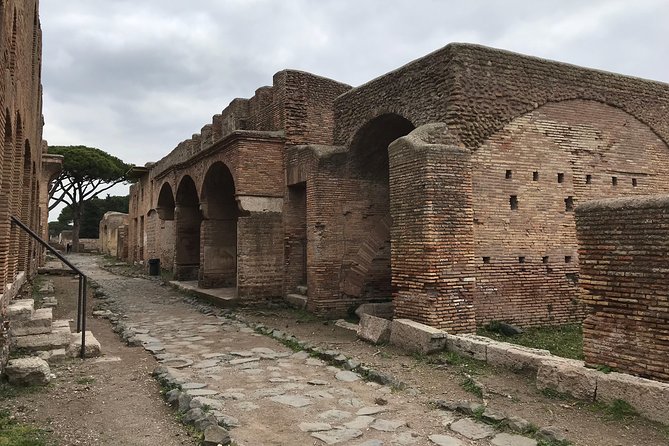
Your on-foot portion starts inside the Parco Archeologico di Ostia Antica complex, and the sequence matters. You don’t begin in the forum and then work outward. Instead, the route helps you understand the city as a whole system: where people lived, worked, gathered, and were laid to rest.
The necropolis is the first big mood shift. In many Roman cities, the dead aren’t hidden away—they’re part of the city’s relationship to the living and the roads leading to town. Seeing this early helps you realize Ostia wasn’t only about commerce; it was a full community with rituals and social structure.
Then you move toward the entrance gate and city walls. This is where the city begins to feel “real” in scale: walls, gates, and defensive layout give you a sense of movement and control. From there, you step onto the decumanus, the main street. That thoroughfare view is key because it gives you a backbone for everything you’ll see next.
The decumanus and warehouse zone: how a port city functioned
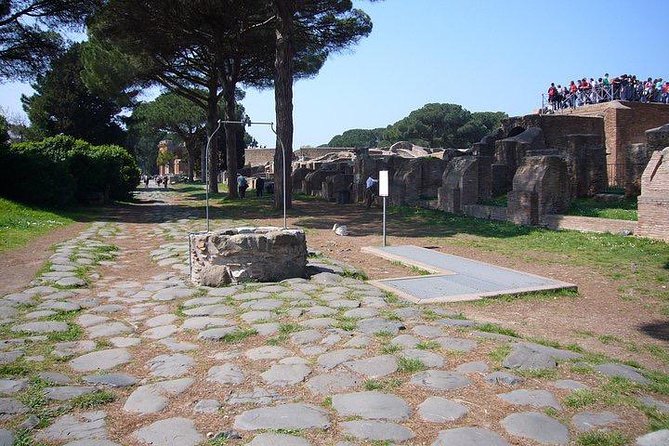
The decumanus isn’t just an old road—it’s the organizing line for urban life. The guide’s job here is to help you connect the street to the economy. Ostia’s identity as Rome’s harbor city means logistics are the story: goods needed storage, distribution, and steady flow.
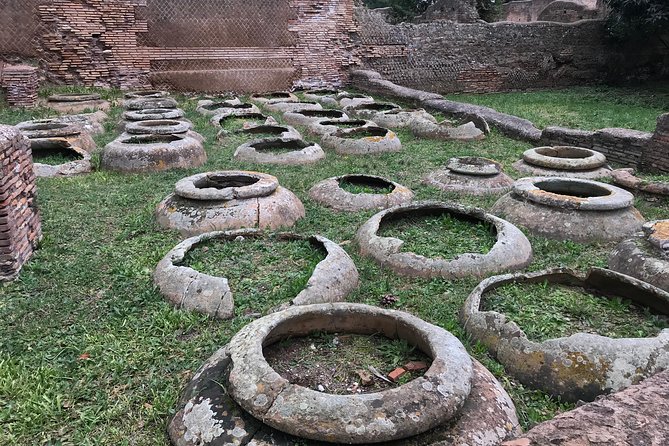
That’s why the route includes warehouses along the way. You’re not only looking at walls; you’re learning what the buildings were likely doing in daily operations—how bulk storage fit into movement toward the city’s civic center.
If you’ve visited other Roman ruins and wished you understood the practical side more, this part is where you’ll feel the tour pay off. You start noticing “systems,” not just scenic blocks of stone.
Baths, taverns, and day-to-day life: Neptune and the charioteers
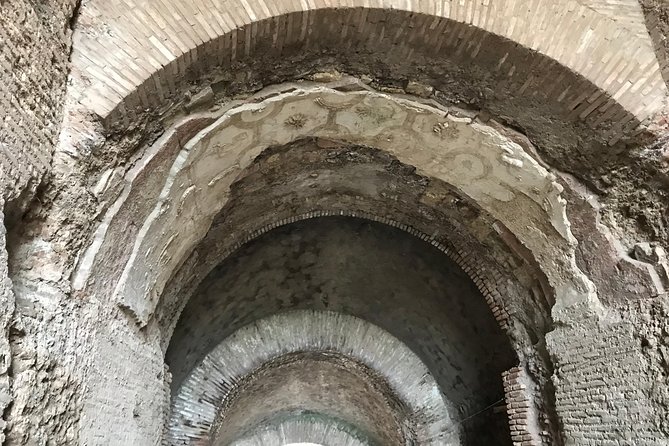
One reason Ostia Antica feels less like a graveyard of buildings and more like a lived-in city is that the route includes entertainment and routine. You’ll see the Bath of the charioteers and the Bath of Neptune, which are perfect for understanding how leisure and public hygiene worked in Roman life.
Roman baths weren’t only about cleanliness. They were social spaces where people talked, rested, and spent time. In a port city, that matters even more because crowds of workers, merchants, and travelers created a constant churn of human energy.
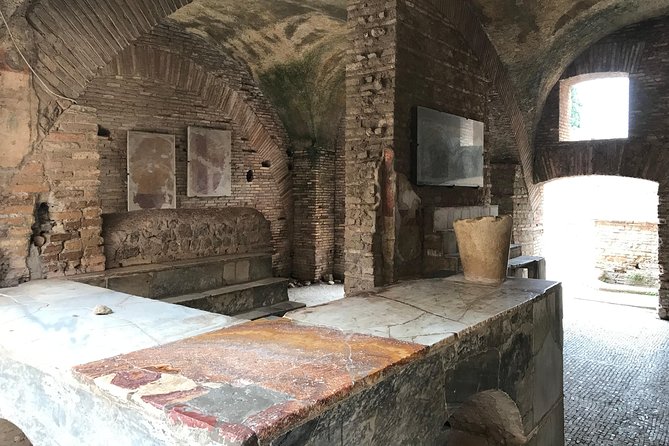
Then comes the caupona, essentially a tavern. This is the kind of stop that makes you think about meals, conversations, and the informal side of daily living. A “caupona” stop is also a reminder that ancient cities were busy places built for people who needed food and drink.
To keep it concrete, the walk also includes a thermopolium, another food-and-drink spot. Seeing more than one hospitality-related site helps you compare how spaces functioned, rather than treating any single room as a random ruin.
You can also read our reviews of more private tours in Rome




Housing and public gathering: insulae, theater, and the square of guilds
As you move from utilities and services into the social heart, you’ll see the insulae, the middle-class apartment blocks. This is one of the best segments for helping you picture where most people actually lived, not just elites in grand spaces.
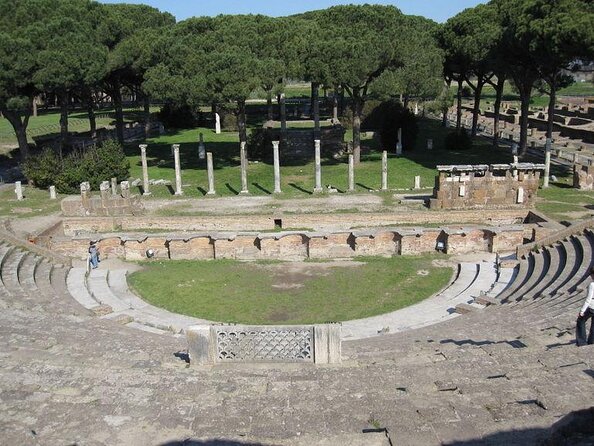
After that, the route includes a theater. The theater is your cue that Ostia wasn’t a one-note commercial outpost. Entertainment and public performance were part of how people held onto community identity and culture.
Next is the Square of the guilds. This is where your tour starts to feel especially relevant if you like economic history or city life details. Guilds point to organized labor, shared interests, and the networks that made a port city run. If the guide explains how commerce linked to community, this is where it clicks.
Military camp and the border of power: the castrum
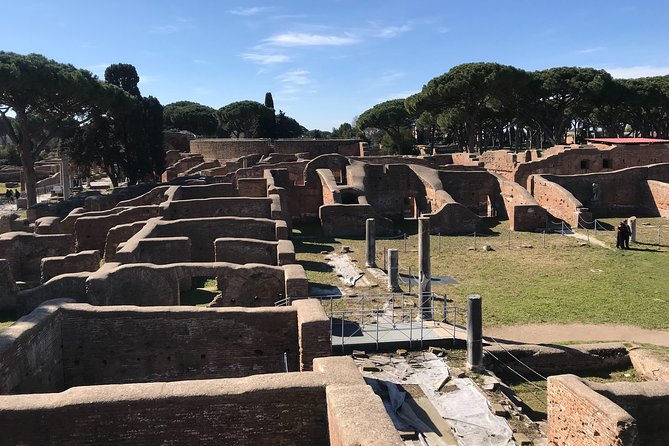
The tour route continues to the castrum, a military camp area. This is a smart inclusion because it complicates the simple story of “trade city.” Roman power also needed security, and ports bring risks—smuggling, conflict, and the constant need to maintain control.
Even without every detail laid out in front of you, seeing a castrum in the same walk as taverns and housing gives you a clearer map of responsibilities within the city.
The forum and temples: seeing civic religion and authority in one flow
Now you arrive at the forum, and this part is often what people remember most. The forum isn’t just a courtyard of old columns. It’s where civic life, administration, and public ceremony braided together. In Ostia, understanding the forum helps you understand how Roman culture and governance projected authority deep into everyday places.
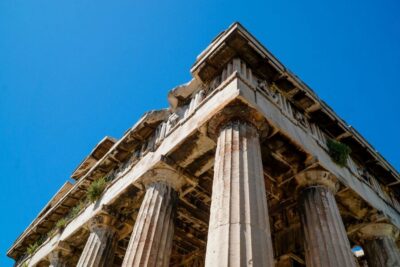
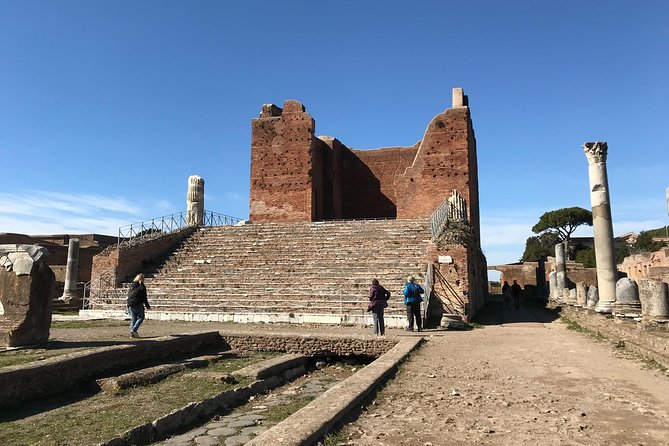
The tour doesn’t stop at generic ruins. You’ll also see the Capitolium, tied to temples of Jupiter, Juno, and Minerva. That triad makes the religious side feel structured and intentional. This is the kind of stop where the guide’s expertise matters because it’s easy to look at temple remains and miss what they meant for people’s worldview.
Then you’ll visit the so-called shrine of the Lares Augusti and the Temple of Augustus and Rome. These spaces connect religion to state identity. If you want to understand why the Roman Empire felt like more than military expansion—why it was also cultural and ideological—this is where the tour’s “why it mattered” theme becomes concrete.
What the PhD archaeologist adds (and why you’ll feel it during questions)
The standout value here is not only that the guide is a specialist, but that your tour is set up for conversation. A strong guiding moment for many people is when you ask one question and realize it unlocks five other things you were already seeing.
Ostia can feel like “a lot of stones” if the explanations are thin. With a research-trained archaeologist, the guide can connect layout and building functions to the bigger picture: how this harbor city fed Rome, supported movement, and helped the empire grow.
And since the tour is private, you’re less likely to feel rushed out of a topic you care about. The difference is real when you’re standing in the middle of ruins and trying to understand what used to happen here.
Skip-the-line and headsets: small things that change the experience
Skip-the-line is one of those perks that saves time without making the tour feel staged. When you’re visiting a major archaeological park, arriving with a plan beats waiting in queues.
Headsets matter too. When you’re in a group of 6 or more, sound can get messy fast in open spaces with people talking and wind moving. Having headsets keeps the guide’s explanations clear, so you spend more time listening and less time craning your neck toward the guide.
These details are part of the “value” of the experience. You’re not just paying for access—you’re paying for how the time gets used.
Who this Ostia Antica tour is best for
This is a great fit if you want an efficient, expert-led visit without complex planning. You’ll likely enjoy it most if you:
- care about how the Roman city worked, not only what it looked like
- want a guide you can ask questions of, while you walk the ruins
- prefer a calmer experience than big-group logistics
- are balancing a Rome itinerary and want a half-day that doesn’t steal your whole day
It’s also a good option for people staying in Rome who don’t want the hassle of figuring out transport on their own. The driver takes you to the site and back to your accommodation, which is a big deal when you’re tired.
A few considerations before you book
Two things to keep in mind.
First, the on-site time is limited by design. If you want extended wandering, you might feel the clock. One review noted that the visit length can feel short if you love the site and want more museum time, so be honest with yourself about your style.
Second, it’s a walking tour. The schedule is built to work in warmer months, but you’ll still want to plan for sun and hydration.
If you’re traveling with mobility constraints, the provided details only say “most travelers can participate,” so you should think carefully about your walking tolerance before booking.
Price and value: what $528.09 per person is really paying for
At $528.09 per person, this is not a budget tour. But you’re buying a package: private guide with PhD archaeologist, skip-the-line access, admission fees, and van transport to and from your accommodation.
The real value question is this: do you want time saved and interpretation upgraded? If you’re comparing this to doing Ostia on your own, the difference is not only comfort. It’s understanding. In a place like Ostia—full of ruins that are impressive but also confusing—a strong guide makes the route make sense, from decumanus to forum to temples.
If you’re traveling in a group, the headset provision for larger parties is a helpful detail. And if you can’t easily manage transportation and entry planning, the private van component starts to look more like a convenience fee that you actually use.
Should you book this Ostia Antica private tour?
I’d book it if you want a focused, expert-guided Ostia visit with minimal hassle. You’ll get the park’s main zones in a logical walking sequence, and the archaeologist-led explanations are the kind of thing that turns ruins into a story you can follow.
Skip this only if you’re the kind of traveler who needs extra time to linger in every corner or you’re specifically hoping for lots of museum time beyond what fits into a half-day. In that case, you’ll likely want a longer on-site option.
If your goal is simple—see Ostia Antica properly, learn it deeply, and get back to Rome without stress—this one is easy to recommend.
FAQ
How long is the Ostia Antica private tour?
The tour is listed as about 4 hours total. You’ll spend about 3 hours at the archaeological site, with additional time for round-trip driving.
Is pickup from my hotel included?
Pickup is offered. If your accommodation is beyond the defined pickup area, you’re asked to contact customer support to find a solution.
Will I need to buy tickets?
No. Ticket fees are included, and skip-the-line entry is part of the experience.
What language is the tour in?
The tour is offered in English.
Is the tour walking heavy?
Yes. It’s a walking tour, and the driver will take you to the attraction and then back to your accommodation after the visit.
What does the tour cover at Ostia Antica?
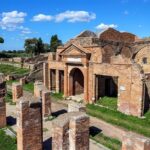
You’ll cover multiple parts of the park, including the necropolis, city walls, the decumanus, warehouses, baths, tavern areas, housing areas (insulae), a theater, the square of the guilds, the castrum, the forum, and several temple areas and shrines.
Do I need headsets?
Headsets are included for a party of 6 or more.
Is food included?
No. Food and souvenirs are not included.
Is the tour private?
Yes. It’s a private tour/activity, so only your group participates.
Are there any ID requirements or accessibility notes?
A valid ID is required for participants under 18 on the day of the tour. Service animals are allowed, and the tour notes say most travelers can participate.